Research Article | | Peer-Reviewed

Numerical Simulation Using Comsol Multiphysics of Temperature Profiles in Solar Cooker

Received: 21 November 2025     Accepted: 15 December 2025     Published: 31 December 2025
Views:       Downloads:
Abstract

Solar thermal energy is available in abundance in a country like Senegal where direct solar radiation is on average 1950kWh/m2 per year. Solar thermal treatment is one of the methods to preserve food. Thermal treatment of agricultural products using solar thermal energy utilizes collectors to capture solar irradiation and convert its energy into heat, which is then used for drying, heating, cooking, or cooling the products. This study focuses on thermal treatment using a solar cooker. The work involves performing a numerical simulation of a solar cooker using COMSOL Multiphysics software to analyze the temporal and spatial distribution of physical parameters such as temperature, air velocity, and absolute pressure within the cooker. A theoretical model is made in order to establish the heat balance at the level of the cooker components. A model of the cooker was developed within the software after establishing assumptions and defining boundary conditions. The simulation results show that in the solar cooker, the absorber temperature can reach 123°C, allowing the cooking of many types of food. The isothermal profile reveals a dome-shaped structure evolving from the absorber, where the temperature is highest, towards the glass cover. The pressure is also uniform within the cooker. The pressure is approximately equal to 1.11 104Pa. Similarly, the air velocity inside the cooker is low.

Published in International Journal of Energy and Power Engineering (Volume 14, Issue 6)
DOI 10.11648/j.ijepe.20251406.13
Page(s) 159-167
Creative Commons

This is an Open Access article, distributed under the terms of the Creative Commons Attribution 4.0 International License (http://creativecommons.org/licenses/by/4.0/), which permits unrestricted use, distribution and reproduction in any medium or format, provided the original work is properly cited.

Copyright

Copyright © The Author(s), 2025. Published by Science Publishing Group

Keywords

Thermal Treatment, Solar Energy, Solar Cooker, Comsol Multiphysics, Physical Parameters

1. Introduction
Conventional fuels such as kerosene, gas, electricity, biomass, charcoal and coal are used for cooking in various regions in the world . In many less developed countries cooking becomes the main energy consumption as covering primary needs is the focus of a large percentage of the population. In addition, the energy sources used in these countries often imply a relevant amount of work and health hazards as population lacks the access to modern forms of energy or they are too expensive for their incomes . The major energy supply for cooking and hot water supply of the less developed country come from biomass. This intensive biomass utilization is accounted for deforestation, expensive fire wood price and poor kitchen environment . This traditional biomass based cooking affected health, energy, school time, and hardship issues of women and children . In Ethiopia, most households have no access to clean energy and most cooking activities are performed in a separated chimneyless confined kitchen and this is worse in rural parts of the country where majorities live . The concept of sustainability has opened up great horizons for harnessing the potential of solar energy in the producing thermal energy and reducing dependence on fossil fuels or coal . The problems caused by fossil fuels and coal not only harm the environment, but they are also energy sources that are becoming depleted due to population growth and urbanization. This also leads to higher prices due to the high demand, which poses a challenge, especially in low-income countries . Solar cooking eliminates the need for a significant amount of conventional fuels. Solar cooking is a real solution to limit deforestation and the overuse of fossil fuels. These fossil fuels represent the main source of greenhouse gas emissions. In fact, each solar cooker can save one ton of wood per year in sunny and arid regions. Most tropical developing countries have a high potential for solar energy that could be used sustainably for different food processing applications. . Solar thermal energy is available in abundance in a country like Senegal where direct solar radiation is on average 1950kWh/m2 per year . Access to reliable and clean cooking energy remains a critical challenge, particularly in developing regions. Nearly 2.1 billion people globally still depend on inefficient cooking methods using biomass fuels such as firewood, animal dung, crop residues, kerosene, and coal, resulting in severe indoor air pollution . These traditional methods have low thermal efficiency, typically between 35%–40%, leading to excessive fuel consumption, deforestation, and high household energy costs, especially in rural communities . Solar cooking is a sustainable and environmentally friendly alternative to conventional cooking, particularly interesting in regions where access to clean energy is limited. By reducing reliance on biomass and fossil fuels, solar cooking helps mitigate deforestation, decrease greenhouse gas emissions, and improve indoor air quality, thereby addressing critical health and environmental concerns . Its benefits include reduced household air pollution, lowering respiratory disease risk in rural communities caused by the use of open fires or inefficient stoves fueled by kerosene, coal or biomass . Solar cookers have been the subject of several theoretical and empirical investigations, with numerous modifications attempted to increase efficiency and security. Solar cookers need much sophisticated research and enhancement work to function better . Our objective is to view the behavior of a solar cooker. The description of the theoretical model and the heat balance are given in Section 2. The numerical simulation was performed using COMSOL Multiphysics software. The simulation results are presented in Section 3.
2. Materials and Methods
2.1. System Description
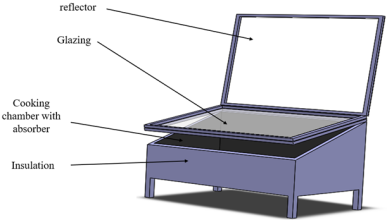
The solar cooker studied is a box-type model. An experimental model can be carried out using cardboard or wood. Aluminum foil can be used as an absorber. Polystyrene is used for good thermal insulation. Double glass cover is also used to create a greenhouse effect inside the cooker. A reflector is often used to concentrate the solar irradiation within the cooker. The heat balance allows us to visualize the temperature profiles inside the cooker.
Figure 1. Theoretical model of solar cooker.
2.2. Thermal Balance
We will consider four elements for which we will perform the thermal balance: the external glass cover, the internal glass cover, the air inside the cooker, and the absorber.
Several assumptions are made to ensure the accuracy of this work. Thus, the following assumptions are made:
1) Heat transfer is unidirectional;
2) There is no temperature gradient along the thickness of the glass;
3) Convective heat transfer between the inner surfaces of the cooker's side walls and the air inside the solar cooker is negligible;
4) Radiative heat exchange between the absorber and the vertical walls is negligible;
5) Wind speed is constant inside the cooker;
6) The thermophysical properties of the absorber, the air, and the glass are considered constant within the cooker's operating temperature range.
Similarly, the initial conditions are:
Tget0=Tgit0=Tat0     (1)
Tabt0=Tambt0      (2)
2.2.1. Thermal Balance on the External Glass Cover
The thermal energy balance is given by equation (3) .
mgcgTgst=AgαgG+hrgi-geAgTgi- Tge
+hcgi-geAvTgi- Tge- hrge-cAgg- Ts-hcge-ambAgTge- Tamb  (3)
In steady state, equation (3) becomes:
0=AgαgG+hrgi-geAgTgi- Tge
+hcgi-geAgTgi- Tge- hrge-sAgTge- Ts
-hcge-ambAgTge- Tamb (4)
2.2.2. Thermal Balance on the Internal Glass Cover
The glass cover exchanges heat with the environment outside the cooker and with the air inside the cooker. The heat balance is given by:
mgcgTgit=AgαgτG-hrgi-geAgTgi- Tge
-hcgi-geAgTgi- Tge+hca-giAgTa- Tgi
+hrab-giAgTab- Tgi(5)
In steady state, equation (5) becomes:
0=AgαgτG-hrgi-geAgTgi- Tge-hcgi-geAgTgi- Tge+hca-giAgTa- Tgi+hrab-giAgTab- Tgi(6)
2.2.3. Heat Balance of the Air Inside the Cooker
The system of equations that governs the convective flow of air through the solar cooker is based on the principles of conservation of mass, momentum and energy. The standard K-ε model is chosen for the description of turbulent flow.
Although there are several other turbulence models, the standard K-ε model still remains an industrial reference and its applications are found in numerous studies. The system of equations inside the solar cooker is written as follows :
Continuity equation is given by:
ux+vy=0     (7)
u and v are the components of the fluid velocity in the x and y directions respectively;
Momentum equation
Along the ox axis
ρut+uux+vuy=-Px+μt2ux2+2uy2 (8)
Along the oy axis
ρvt+uvx+vvy=-Px+μt2vx2+2vy2+
ρgβT-T0 (9)
Equation of turbulent kinetic energy k
ρkt+kux+kvy=μ+μtσk2kx2+2ky2
+GK-ρε(10)
Equation of the dissipation rate ε
ρεt+εux+εvy=μ+μtσε2εx2+2εy2+εK(C1GK-C2ρε)(11)
Energy equation
ρTt+uTx+vTy=μPr+μtσt2Tx2+2Ty2  (12)
2.2.4. Thermal Balance on the Absorber
The energy balance on the absorber is given by equation (13).
mabcabTabt=αabτgAgG-hrab-giAabTab- Tgi-hcab-aAabTab- Ta (13)
2.3. Model Mesh
To better visualize the physical phenomena within the solar cooker, a numerical simulation was performed using COMSOL Multiphysics simulation software version 6.0.
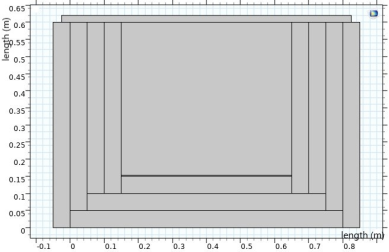
A front view of the cooker was created by superimposing different rectangles. The resulting model is shown in Figure 2.
Figure 2. Model of the solar cooker created in the software.
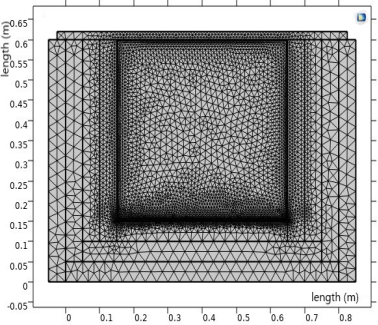
Figure 3. Mesh visualization in Comsol Multiphysics.
Figure 2 is a two-dimensional representation of the solar cooker created using COMSOL Multiphysics 6.0 software. Following this step, the physical parameters of the cooker materials can be entered, and the initial conditions defined to select the appropriate mesh type. For the initial conditions, the temperature inside the cooker is assumed to be equal to that of the ambient air (T = 300 K), the pressure is atmospheric (P = 1 ATM), and the air velocity inside the cooker is zero. The mesh is a discretization of the domain using finite elements, allowing the physics equations to be solved for these elements while taking into account the boundary conditions between each cell. In this study, the normal mesh is chosen (see Figure 3).
3. Results and Discussion
A thermal behavior model of the cooker was developed using COMSOL Multiphysics software to predict the performance of solar cooker. Modeling is a very important step. It makes it easier to choose the ideal materials, the actual dimensions of the device with its optimal orientations. This allows them to achieve the most efficient energy gain possible before prototyping. The various results obtained are analyzed and interpreted in the three subsections that follow.
3.1. Temperature Profiles
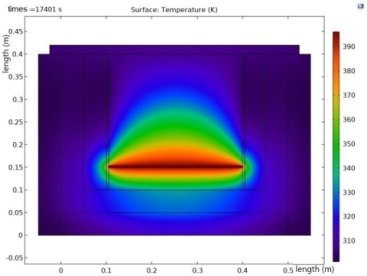
The temperature profile in the cooker is given in Figure 4.
Figure 4. Temperature distribution inside the cooker.
Figure 5. Distribution of isotherms in the cooker.
Figure 4 shows the temperature distribution inside the cooker. It can be seen that when the cooker is exposed to heat for 17,401 seconds, the temperature can reach 390 K. This creates a dome-shaped structure where the temperature is highest at the bottom of the cooker on the absorber (390 K = 117°C) and then increases towards the glass cover. This distribution is explained by the fact that the absorber, with its very high thermal conductivity, is a heat source.
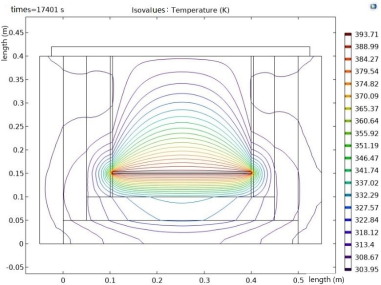
The display of the isotherms allows for a better visualization of the spatial distribution of temperature and its evolution. The isotherm profile is shown in Figure 5.
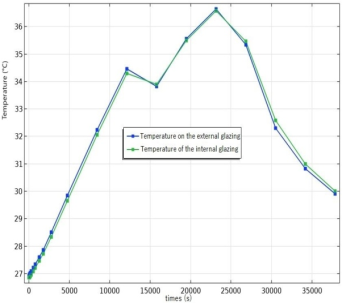
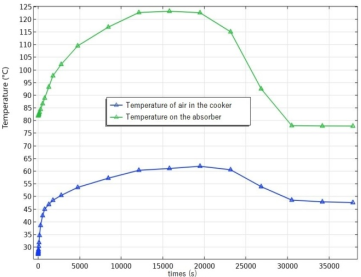
Figure 5 show that the isotherm display confirms the dome-shaped structure. The isotherm display shows the evolution from the absorber, where the temperature is maximum, towards the glass covers. Similarly, we have shown the temperature evolution on the outer of glass cover, the insider glass cover, the air inside the cooker, and the absorber. These temperatures are shown in Figures 6 and 7.
Figure 6. Evolution of temperatures on the external glass cover and on the internal glass cover as a function of time.
Figure 7. Evolution of air temperatures inside the cooker and at the level of the absorber as a function of time.
Figure 6 shows that the temperatures on the external and internal glass cover have the same pattern and follow a Gaussian distribution. However, the temperature on the external glass cover is higher than that on the internal glass cover up to a maximum before the trend reverses. This is due to the fact that during this period the cooker is highly exposed to the solar irradiation (between 1 p.m. and 2 p.m. in practice). After this period, solar irradiation decreases and the cooker cools down. Since the external glass cover is in contact with the air, it cools down more quickly by convection.
Figure 7 shows the evolution of the air temperatures inside the cooker and at the absorber.
The curves in Figure 7 follow a Gaussian trend with a maximum around t=17401s. One note that the temperature on the absorber (Tmax=123°C) is almost double that inside the cooker (Tmax=63°C). This is explained by the fact that the absorber is the heat source, receiving solar radiation and converting it into heat that warms the interior.
3.2. Pressure Profiles
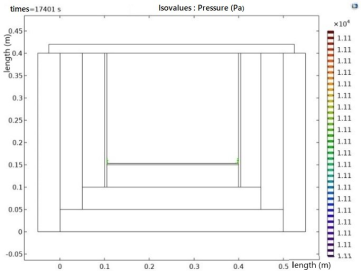
Figure 8 shows the pressure profile in the cooker at maximum temperature.
Figure 8. Pressure Profile at t=17401s.
Figure 8 shows a uniform pressure distribution within the cooker. This is due to the fact that the flow regime is laminar and the system remains closed by the glass cover, thus there is no exchange with the external environment.
3.3. Velocity Profile of the "Air" Fluid in the Cooker
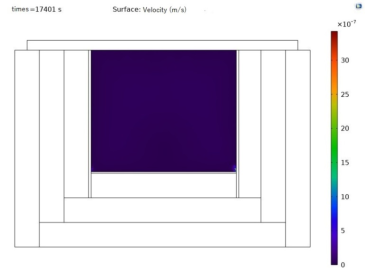
Figure 9 shows the air velocity profile inside the cooker.
Figure 9. Air velocity profile in the cooker.
Figure 9 show that the fluid (air) velocity inside the cooker. Thus, we note a very small variation in the fluid velocity.
The results obtained on the isotherms, the pressure variation in the cooker and that of the fluid velocity are in agreement with the study carried out by Diatta, J. et al. .
4. Conclusions
This study focuses on thermal treatment using a solar cooker. A numerical simulation of the solar cooker was performed using COMSOL Multiphysics software to determine the temporal and spatial distribution of physical parameters such as temperature, air velocity, and pressure inside the cooker. The simulation results show that the absorber temperature of the solar cooker can reach 123°C, allowing for the cooking of many types of food. This high temperature can be explained by the fact that the absorber is the heat source, receiving solar irradiation and converting it into heat that warms the interior to enable cooking. The isotherm profile reveals a dome-shaped structure evolving from the absorber, where the temperature is highest, towards the glass cover. The pressure is also uniform inside the cooker. Similarly, the air velocity is low inside the cooker. However, the temperature on the external glass cover is higher than that on the inside glass cover before this trend reverses. This reversal is due to the fact that when the absorber reaches a certain temperature, it begins to emit radiation. The temperature on the absorber remains significantly higher than that inside the cooker throughout the simulation.
In perspective, we propose to carry out an experimental solar cooker incorporating a phase-change material such as paraffin for heat storage in order to conduct a numerical and experimental study.
Nomenclature

A

Area [m2]

C

Specific Heat Capacity [J.K-1.Kg-1]

G

Global Solar Irradiance [W.m-2]

Cμ

Turbulence Model Constants

Gk

Turbulence Model Constant K-ε

C1, C2

Empirically Coefficients

h

Heat Transfer Coefficients [W.m-1.K-1]

k

Turbulent Kinetic Energy [m2s-2]

m

Mass [Kg]

P

Pressure, [bar]

T

Temperature [K]

ε

Dissipation of Turbulent Kinetic Energy, [m2s-3]

u, v

Velocity ms-1

μ

Viscosity, [Pa.s]

μt

Turbulent Dynamic Viscosity, [Kg.m-1s-1]

α

Absorptivity [-]

a

Air

ab

Absorber

c

Convection

e

External

i

Internal

amb

Ambient

r

Radiation

g

Glass Cover

Abbreviations

ATM

Atmosphere

PM

Post Meridiem

Acknowledgments
This research is supported by the School of Engineering Sciences and Techniques, Amadou Moktar MBOW University.
Author Contributions
Awa Mar: Conceptualization, Data curation, Formal Analysis, Funding acquisition, Investigation, Methodology, Resources, Software, Supervision, Validation, Writing – original draft
Serigne Thiao: Formal Analysis, Funding acquisition, Investigation, Methodology, Resources, Software, Supervision, Validation, Writing – original draft
Moustapha Diedhiou: Formal Analysis, Funding acquisition, Investigation, Methodology, Resources, Software, Methodology
Joseph Sambasene Diatta: Software, Supervision, Validation, Visualization
Diouma Kobor: Supervision, Validation, Visualization
Conflicts of Interest
The authors declare no conflicts of interest.
References
[1] Amit Kumar, M. Eswaramoorthy, Rajiv Kumar, Ravi Kumar Goyal. A comparative analysis on concrete and granite-based heat storage materials for evening cooking stability of box-type solar cooker, Solar Energy, Volume 296, August 2025, 113577:
[2] Ravi Kumar Goyal, M. Eswaramoorthy. Theoretical and experimental analysis of box-type solar cooker with sensible heat storage, Solar Energy, Volume 268, 15 January 2024, 112273,
[3] Antonio Lecuona, José-Ignacio Nogueira, Rubén Ventas, María-del-Carmen Rodríguez-Hidalgo, Mathieu Legrand. Solar cooker of the portable parabolic type incorporating heat storage based on PCM, Applied Energy, Volume 111, November 2013, Pages 1136-1146,
[4] Asfafaw Haileselassie Tesfay, Mulu Bayray Kahsay, Ole Jørgen Nydal, Solar Powered Heat Storage for Injera Baking in Ethiopia, Energy Procedia, Volume 57, 2014, Pages 1603-1612,
[5] Saif Ali Kadhim, Osama Abd Al-Munaf Ibrahim, Moafaq K. S. Al-Ghezi, Ali M. Ashour, Issa Omle, Abdallah Bouabidi. Influence of the steel fibers amount inside the box on the solar cooker performance: An experimental approach. Results in Engineering, Volume 26, June 2025, 105659,
[6] K. Ravi Kumar, N. V. V. Krishna Chaitanya, N. Sendhil Kumar, Solar thermal energy technologies and its applications for process heating and power generation – A review, J. Clean. Prod. 282 (2021) 125296,
[7] M. M. Vanegas Cantarero, Of renewable energy, energy democracy, and sustainable development: a roadmap to accelerate the energy transition in developing countries, Energy Res. Soc. Sci. 70 (2020) 101716,
[8] Fentaw B. Masrie, Mulugeta A. Delele, Solomon Workneh Fanta, Ermias A. Tesema, Melkamu Alemayehu, Enyew Adgo, Firezer D. Hailemariam. Development and performance evaluation of parabolic solar cooker for tomato paste production, Applied Food Research, Volume 5, Issue 2, December 2025,
[9] Serigne Thiao, Omar Drame, Awa Mar, Lat Grand Ndiaye, Issakha Youm (2025). Experimental and Numerical CFD Analysis of a Solar Dryer with Integration of Basalt Thermal Bed for Heat Storage, International Journal of Sustainable and Green Energy 2025, Vol. 14, No. 1, pp. 20-31
[10] Masoud Adavi, Shiva Gorjian, Hamed Mokhtarzadeh, Barat Ghobadian. Development and performance evaluation of an indirect fresnel lens solar cooker with thermal oil storage tank, Results in Engineering, Volume 26, June 2025, 105535,
[11] Rikesh Panchal, Matthew Benyon, Tracey Laban, Ngwako Kwatala, Bianca Wernecke, Caradee Y. Wright, Joshua Vande Hey (2024). Reviewing the methodologies used to assess household PM2.5 air pollution in sub-Saharan Africa, Building and Environment, Volume 266, 1 December 2024, 112099,
[12] S. R. Abdallah, H. Saidani-Scott, O. E. Abdellatif, Performance analysis for hybrid PV/T system using low concentration MWCNT (water-based) nanofluid, Sol. Energy 181 (2019) 108–115,
[13] M. Sedighi, H. Salarian, A comprehensive review of technical aspects of biomass cookstoves, Renew. Sustain. Energy Rev. 70 (2017) 656–665,
[14] A. Altouni, S. Gorjian, A. Banakar, Development and performance evaluation of a photovoltaic-powered induction cooker (PV-IC): an approach for promoting clean production in rural areas, Clean. Eng. Technol. 6 (2022) 100373,
[15] Ivan Alonso, Pere Antoni Bibiloni-Mulet, Jacinto Vidal-Noguera, Yamile Díaz Torres, Andreu Moi`a-Pol, Vincent Canals, Victor Martínez-Moll. Thermal performance assessment of a novel concentrating solar cooker with equatorial tracking from full load tests, Solar Energy, Solar Energy 300 (2025) 113812,
[16] N. L. Panwar, S. C. Kaushik, S. Kothari, State of the art of solar cooking: an overview, Renew. Sustain. Energy Rev. 16 (2012) 3776–3785.
[17] A. Sarangi, A. Sarangi, S. S. Sahoo, J. Nayak, R. K. Mallik, Advancements and global perspectives in solar cooking technology: a comprehensive review, Energy Nexus 13 (2024) 100266.
[18] Harshita Swarnkar, Ritu Jain, Amit Tiwari. Graphene Coating and its Effect on Performance of Box Type Solar Cooker: An Experimental Investigation, Recent Patents on Mechanical Engineering, Volume 18, Issue 2, 2025, Pages 184-200,
[19] Souleyemane Thiam, Serigne Thiao, Awa Marr, Issakha Youm, Influence of the Incident Solar Flux on the Temperature Variation of the Hot-Box Cooker, International Journal of Sustainable and Green Energy, 2018, Vol. 7, No. 1, pp: 1-6;
[20] Diatta, J., Bassene, L. and Toure, M. (2021) Finite Element Modeling of a Solar Box Cooker: Temperature and Fluid Velocity Distributions. Engineering, 13, 554-563.
Cite This Article
  • APA Style

    Mar, A., Thiao, S., Diedhiou, M., Diatta, J. S., Kobor, D. (2025). Numerical Simulation Using Comsol Multiphysics of Temperature Profiles in Solar Cooker. International Journal of Energy and Power Engineering, 14(6), 159-167. https://doi.org/10.11648/j.ijepe.20251406.13

    Copy | Download

    ACS Style

    Mar, A.; Thiao, S.; Diedhiou, M.; Diatta, J. S.; Kobor, D. Numerical Simulation Using Comsol Multiphysics of Temperature Profiles in Solar Cooker. Int. J. Energy Power Eng. 2025, 14(6), 159-167. doi: 10.11648/j.ijepe.20251406.13

    Copy | Download

    AMA Style

    Mar A, Thiao S, Diedhiou M, Diatta JS, Kobor D. Numerical Simulation Using Comsol Multiphysics of Temperature Profiles in Solar Cooker. Int J Energy Power Eng. 2025;14(6):159-167. doi: 10.11648/j.ijepe.20251406.13

    Copy | Download

  • @article{10.11648/j.ijepe.20251406.13,
      author = {Awa Mar and Serigne Thiao and Moustapha Diedhiou and Joseph Sambasene Diatta and Diouma Kobor},
      title = {Numerical Simulation Using Comsol Multiphysics of Temperature Profiles in Solar Cooker},
      journal = {International Journal of Energy and Power Engineering},
      volume = {14},
      number = {6},
      pages = {159-167},
      doi = {10.11648/j.ijepe.20251406.13},
      url = {https://doi.org/10.11648/j.ijepe.20251406.13},
      eprint = {https://article.sciencepublishinggroup.com/pdf/10.11648.j.ijepe.20251406.13},
      abstract = {Solar thermal energy is available in abundance in a country like Senegal where direct solar radiation is on average 1950kWh/m2 per year. Solar thermal treatment is one of the methods to preserve food. Thermal treatment of agricultural products using solar thermal energy utilizes collectors to capture solar irradiation and convert its energy into heat, which is then used for drying, heating, cooking, or cooling the products. This study focuses on thermal treatment using a solar cooker. The work involves performing a numerical simulation of a solar cooker using COMSOL Multiphysics software to analyze the temporal and spatial distribution of physical parameters such as temperature, air velocity, and absolute pressure within the cooker. A theoretical model is made in order to establish the heat balance at the level of the cooker components. A model of the cooker was developed within the software after establishing assumptions and defining boundary conditions. The simulation results show that in the solar cooker, the absorber temperature can reach 123°C, allowing the cooking of many types of food. The isothermal profile reveals a dome-shaped structure evolving from the absorber, where the temperature is highest, towards the glass cover. The pressure is also uniform within the cooker. The pressure is approximately equal to 1.11 104Pa. Similarly, the air velocity inside the cooker is low.},
     year = {2025}
    }
    

    Copy | Download

  • TY  - JOUR
    T1  - Numerical Simulation Using Comsol Multiphysics of Temperature Profiles in Solar Cooker
    AU  - Awa Mar
    AU  - Serigne Thiao
    AU  - Moustapha Diedhiou
    AU  - Joseph Sambasene Diatta
    AU  - Diouma Kobor
    Y1  - 2025/12/31
    PY  - 2025
    N1  - https://doi.org/10.11648/j.ijepe.20251406.13
    DO  - 10.11648/j.ijepe.20251406.13
    T2  - International Journal of Energy and Power Engineering
    JF  - International Journal of Energy and Power Engineering
    JO  - International Journal of Energy and Power Engineering
    SP  - 159
    EP  - 167
    PB  - Science Publishing Group
    SN  - 2326-960X
    UR  - https://doi.org/10.11648/j.ijepe.20251406.13
    AB  - Solar thermal energy is available in abundance in a country like Senegal where direct solar radiation is on average 1950kWh/m2 per year. Solar thermal treatment is one of the methods to preserve food. Thermal treatment of agricultural products using solar thermal energy utilizes collectors to capture solar irradiation and convert its energy into heat, which is then used for drying, heating, cooking, or cooling the products. This study focuses on thermal treatment using a solar cooker. The work involves performing a numerical simulation of a solar cooker using COMSOL Multiphysics software to analyze the temporal and spatial distribution of physical parameters such as temperature, air velocity, and absolute pressure within the cooker. A theoretical model is made in order to establish the heat balance at the level of the cooker components. A model of the cooker was developed within the software after establishing assumptions and defining boundary conditions. The simulation results show that in the solar cooker, the absorber temperature can reach 123°C, allowing the cooking of many types of food. The isothermal profile reveals a dome-shaped structure evolving from the absorber, where the temperature is highest, towards the glass cover. The pressure is also uniform within the cooker. The pressure is approximately equal to 1.11 104Pa. Similarly, the air velocity inside the cooker is low.
    VL  - 14
    IS  - 6
    ER  - 

    Copy | Download

Author Information