Abstract
A new distributed voltage control strategy for PV power systems that does not need support from centralized SVCs is proposed. The methodology uses smart inverters, agent-based coordination, and machine learning-based forecasting to offer a scalable and economical solution for decoupling voltage variations in the context of high penetration of PV. Each inverter acts as an autonomous agent that regulates its reactive power output using local voltage measurements and short-term irradiance predictions derived from a Long Short-Term Memory (LSTM) model. The agents cooperate with their neighbors, utilizing a consensus algorithm for coordinated voltage control throughout the network. This decentralized strategy enables fast, adaptive, and cost-effective voltage stabilization without relying on hardware-intensive centralized devices. The effectiveness and reliability of the proposed control strategy are verified through a simulation study using a five-bus radial distributed generation (DG) system with high PV penetration. Simulation results on a five-bus radial distribution feeder show better voltage stability, fault recovery, and reactive power utilization as compared with conventional and existing distributed control strategies. The findings confirm the feasibility of software-defined, inverter-based voltage regulation as a practical alternative for future smart grids. In addition, the proposed framework offers extensibility to hybrid renewable energy systems, such as wind and storage, supporting the transition toward resilient, low-carbon, and data-driven energy infrastructures.
Keywords
Decentralized Voltage Control, Smart Inverters, Multi-agent System, Voltage Fluctuation Compensation, PV Integration, Machine Learning Prediction
1. Introduction
1.1. Background
A significant trend toward renewables is being induced by the global energy transition; among them Photovoltaic (PV) power generation, which is compiled as one of a few key energy conversion technologies considering its scalability, cost reduction, and eco-friendly attributes. Photovoltaic (PV) energy capacity is expected to grow to more than 22% in worldwide electricity generation by 2050, as reported by the International Renewable Energy Agency (IRENA). Solar PV is projected to be one of the main sources of global electricity supply by 2030
| [1] | S. Allahmoradi, S. Afrasiabi, X. Liang, J. Zhao, and M. Shahidehpour, “Data-Driven Volt/VAR Optimization for Modern Distribution Networks: A Review,” IEEE Access, vol. 12, pp. 71184–71204, 2024, https://doi.org/10.1109/ACCESS.2024.3403035 |
[1]
. This wide integration brings new challenges to traditional power systems, such as the stability and reliability of grid operation. Among these, voltage fluctuation is a vital concern because of their intermittent and non-dispatchable characteristic that is more visible as the penetration level of PV installation increases with transmission, and distribution systems as well
| [2] | Uchiyama N., Miyata H., Ito T., and Konishi H., “Reactive Power Control Method for Reducing Voltage Fluctuation in Large-scale Photovoltaic Systems,” IEEJ Trans. PE, vol. 130, no. 3, pp. 297–304, 2010,
https://doi.org/10.1541/ieejpes.130.297 |
[2]
.
Fluctuation of voltage is caused by the intermittent and random nature of sunlight irradiating PV systems that affect the circulating power to be produced though the solar installation. The operation of traditional grid infrastructure is unable to effectively respond between fast and frequent voltage fluctuations, caused by cloud moves, fast changes of irradiance, and load transients
| [3] | T. Van Dao, H. T. N. Nguyen, S. Chaitusaney, and R. Chatthaworn, “Local reactive power control of PV plants for voltage fluctuation mitigation,” in 2014 11th International Conference on Electrical Engineering/Electronics, Computer, Telecommunications and Information Technology (ECTI-CON), Nakhon Ratchasima, Thailand: IEEE, May 2014, pp. 1–6. https://doi.org/10.1109/ECTICon.2014.6839808 |
[3]
. Voltage control is usually realized by means of On-Load Tap Changers (OLTCs), capacitor banks, and Flexible AC Transmission System (FACTS) devices, especially Static Var Compensators (SVCs). Although such systems have been working efficiently for centralized, stable grid architectures, their application to today’s distributed networks has certain drawbacks. Conventional power systems were not prepared for such rapid, bidirectional voltage changes especially in high PV penetration conditions
| [4] | Md. S. Hossain, N. Abboodi Madlool, A. W. Al-Fatlawi, and M. El Haj Assad, “High Penetration of Solar Photovoltaic Structure on the Grid System Disruption: An Overview of Technology Advancement,” Sustainability, vol. 15, no. 2, p. 1174, Jan. 2023, https://doi.org/10.3390/su15021174 |
[4]
. Unrestricted fluctuation can affect grid safety and harm sensitive loads by violating voltage regulations.
1.2. Problem Statement
SVCs are often applied for dynamic reactive power injection or absorption and for stabilizing voltages under disturbances
. But such devices are capital-intensive, involve complex control strategies, and are not spatially and economically viable for large-scale deployment, especially in rural and semi-urban feeders where land and monetary limitations are severe
| [6] | K. Shimomukai, H. Maeda, and G. Fujita, “Volt-Var Control for Utility-scale Solar PV Plants to Replace SVCs,” in 2023 4th International Conference on High Voltage Engineering and Power Systems (ICHVEPS), Denpasar Bali, Indonesia: IEEE, Aug. 2023, pp. 176–181.
https://doi.org/10.1109/ICHVEPS58902.2023.10257553 |
[6]
. In addition, SVCs are central, which are not really suitable for the emerging trend of decentralization in modern power systems with the integration of a large number of distributed energy resources (DERs) including rooftop solar, community solar farms, and microgrids, which are becoming mainstream
| [7] | H. Jafarizadeh, E. Yamini, S. M. Zolfaghari, F. Esmaeilion, M. E. H. Assad, and M. Soltani, “Navigating challenges in large-scale renewable energy storage: Barriers, solutions, and innovations,” Energy Reports, vol. 12, pp. 2179–2192, Dec. 2024, https://doi.org/10.1016/j.egyr.2024.08.019 |
[7]
. Further, the slow dynamical response of mechanical-based devices renders them insufficient for rapid voltage variation profiles in PV-rich environments
| [7] | H. Jafarizadeh, E. Yamini, S. M. Zolfaghari, F. Esmaeilion, M. E. H. Assad, and M. Soltani, “Navigating challenges in large-scale renewable energy storage: Barriers, solutions, and innovations,” Energy Reports, vol. 12, pp. 2179–2192, Dec. 2024, https://doi.org/10.1016/j.egyr.2024.08.019 |
[7]
.
1.3. Motivation
The motivation of this work is the requirement to establish alternative control strategies that are cost-effective, decentralized, and applicable for inverter-based PV systems. The utilization of smart inverters with the ability to control reactive power presents a new path for distributed voltage control. These inverters may also provide voltage support by injecting reactive power in real time, for example using a local or distributed control scheme. All these capabilities have the potential to be applied in an aggregated way to achieve harmony or balance in large electricity networks; however, current implementations are often unable to capture the full capacity of smart inverters because of issues with coordination, short-sighted forecasting, and the absence of resilient control strategies. Implementing local control, and prediction-based modeling of the systems with data support, can reduce the dependence on the traditional voltage control elements, maximize the reactive power supplies, and enhance the dynamics while keeping the grid stable
| [8] | M. A. Alam, M. N. Sharker, M. B. A. Tamal, and M. I. Sazib, “Short-Term Solar Power Prediction using Machine Learning Algorithms: A High Performing approach,” GUB JOURNAL OF SCIENCE AND ENGINEERING, vol. 9, no. 1, pp. 82–95, Jul. 2024, https://doi.org/10.3329/gubjse.v9i1.74890 |
| [9] | L. Wang, F. Bai, R. Yan, and T. K. Saha, “Real-Time Coordinated Voltage Control of PV Inverters and Energy Storage for Weak Networks With High PV Penetration,” IEEE Trans. Power Syst., vol. 33, no. 3, pp. 3383–3395, May 2018,
https://doi.org/10.1109/TPWRS.2018.2789897 |
[8, 9]
.
Moreover, emerging new data sources such as phasor measurement units (PMUs), IoT sensors, and SCADA systems, offer a basis for real-time grid observability and decentralized control logic
| [10] | H. Akhavan-Hejazi and H. Mohsenian-Rad, “Power systems big data analytics: An assessment of paradigm shift barriers and prospects,” Energy Reports, vol. 4, pp. 91–100, Nov. 2018, https://doi.org/10.1016/j.egyr.2017.11.002 |
[10]
. This is a motivation for investigating novel control schemes that utilize distributed intelligence which can control voltage profiles.
Recent works have focused on local and adaptive control paradigms, such as Volt/VAR control, model predictive control (MPC), and machine learning (ML)-based forecasting. Although these approaches are better than static compensation methods, most of them require the existence of compensation units such as SVCs, or their setpoints are fixed and cannot be adjustable for varying system operating conditions
| [11] | A. J. Lari, A. P. Sanfilippo, D. Bachour, and D. Perez-Astudillo, “Using Machine Learning Algorithms to Forecast Solar Energy Power Output,” Electronics, vol. 14, no. 5, p. 866, Feb. 2025, https://doi.org/10.3390/electronics14050866 |
| [12] | B. I. Oladapo, M. A. Olawumi, and F. T. Omigbodun, “Machine Learning for Optimising Renewable Energy and Grid Efficiency,” Atmosphere, vol. 15, no. 10, p. 1250, Oct. 2024,
https://doi.org/10.3390/atmos15101250 |
[11, 12]
. In addition, the majority of the methods they used are not scalable and not compatible with other DERs which weaken the effectiveness of the method in different grid conditions. Recent works (see, e.g., Shimomukai et al.
| [6] | K. Shimomukai, H. Maeda, and G. Fujita, “Volt-Var Control for Utility-scale Solar PV Plants to Replace SVCs,” in 2023 4th International Conference on High Voltage Engineering and Power Systems (ICHVEPS), Denpasar Bali, Indonesia: IEEE, Aug. 2023, pp. 176–181.
https://doi.org/10.1109/ICHVEPS58902.2023.10257553 |
[6]
, have presented the advantages of Volt-Var control with smart inverters as an attractive substitute for SVC. Based on the analysis of a 70 MW UTSPV project, the research pointed out that inverters integrated with Volt-Var functions could substitute for SVCs by regulating reactive power in a cheaper and smaller way with the same voltage stability. This observation gives further confidence in the possibility of voltage support in inverter-based, software-defined modes in modern PV plants.
1.4. Research Gap
To bridge these gaps, this paper suggests a new control approach for mitigating the voltage fluctuation which prevents the use of SVC and employs distributed intelligence combined with state-of-the-art techniques. The main point is to manage a fleet of smart inverters with a hierarchical, distributed control approach, which incorporates forecasting models based on ML algorithms. The methodology employs localized voltage measurements, meteorological data, and routine load profiles to provide a real-time adaptation of the level of reactive power supply throughout the network. In consequence, it changes voltage regulation from being centralized and hardware-intensive to decentralized and software-enabled.
This work synthesizes across several areas including adaptive inverter control, ML-based voltage forecasting, distributed optimization, and microgrid coordination.
| [13] | P. Suanpang and P. Jamjuntr, “Machine Learning Models for Solar Power Generation Forecasting in Microgrid Application Implications for Smart Cities,” Sustainability, vol. 16, no. 14, p. 6087, Jul. 2024, https://doi.org/10.3390/su16146087 |
| [14] | T. Cao, Z. Ye, Q. Wu, X. Wan, J. Wang, and D. Li, “A Review of Adaptive Control Methods for Grid-Connected PV Inverters in Complex Distribution Systems,” Energies, vol. 18, no. 3, p. 473, Jan. 2025, https://doi.org/10.3390/en18030473 |
[13, 14]
– These two papers lay a basis for inverter control strategies,
| [11] | A. J. Lari, A. P. Sanfilippo, D. Bachour, and D. Perez-Astudillo, “Using Machine Learning Algorithms to Forecast Solar Energy Power Output,” Electronics, vol. 14, no. 5, p. 866, Feb. 2025, https://doi.org/10.3390/electronics14050866 |
| [12] | B. I. Oladapo, M. A. Olawumi, and F. T. Omigbodun, “Machine Learning for Optimising Renewable Energy and Grid Efficiency,” Atmosphere, vol. 15, no. 10, p. 1250, Oct. 2024,
https://doi.org/10.3390/atmos15101250 |
[11, 12]
– approaches that allow for the application of ML methods to the power system. Moreover, in
| [15] | S. Xie, A. Kaneko, and Y. Hayashi, “A Decentralized Voltage Regulation Scheme Using Improved Volt‐Var Function of PV Smart Inverter,” IEEJ Transactions Elec Eng, vol. 19, no. 8, pp. 1300–1310, Aug. 2024,
https://doi.org/10.1002/tee.24080 |
[15]
the advantages of decentralized control and microgrid architectures are highlighted in improving the system’s robustness and voltage stability.
While there has been a lot of work on reactive power control utilizing smart inverters, machine learning, and optimization in the literature, the current methods tend to be either:
1. There will be still a need for centralized architecture
| [12] | B. I. Oladapo, M. A. Olawumi, and F. T. Omigbodun, “Machine Learning for Optimising Renewable Energy and Grid Efficiency,” Atmosphere, vol. 15, no. 10, p. 1250, Oct. 2024,
https://doi.org/10.3390/atmos15101250 |
[12]
.
2. Consider perfect communication and data availability
| [13] | P. Suanpang and P. Jamjuntr, “Machine Learning Models for Solar Power Generation Forecasting in Microgrid Application Implications for Smart Cities,” Sustainability, vol. 16, no. 14, p. 6087, Jul. 2024, https://doi.org/10.3390/su16146087 |
[13]
;
3. Do have only limited or synthetic validation
| [14] | T. Cao, Z. Ye, Q. Wu, X. Wan, J. Wang, and D. Li, “A Review of Adaptive Control Methods for Grid-Connected PV Inverters in Complex Distribution Systems,” Energies, vol. 18, no. 3, p. 473, Jan. 2025, https://doi.org/10.3390/en18030473 |
[14]
;
4. Or do not equal the EMC and EMC under heavy PV fluctuations of SVC-based schemes
| [9] | L. Wang, F. Bai, R. Yan, and T. K. Saha, “Real-Time Coordinated Voltage Control of PV Inverters and Energy Storage for Weak Networks With High PV Penetration,” IEEE Trans. Power Syst., vol. 33, no. 3, pp. 3383–3395, May 2018,
https://doi.org/10.1109/TPWRS.2018.2789897 |
[9]
.
However, there has been no control scheme which:
1. Achieve better efficiency than centralized SVCs on loosely synchronized distributed systems;
2. Adapts to rapidly changing voltage conditions;
3. Make use of decentralized control structures;
4. Utilize state-of-the-art technology, e.g., ML, edge computing, and multi-agent coordination.
1.5. Objectives and Contributions
In this paper, a novel distributed control approach is suggested for voltage regulation in large-scale PV power plants, without using SVCs. The system includes:
1. Distributed inverter control through local voltage and power data;
2. A consensus-based cooperative multi-agent architecture developed for regional voltage control;
3. Model predictive control logic using short-term forecasting of PV output;
4. Active inverter support for dynamic reactive power compensation.
In summary, the main contributions of this paper are:
1. A distributed voltage control scheme– based on coordinated smart inverters as opposed to SVCs that is more scalable and potentially cheaper for modern grids.
2. Coupling of machine learning prediction algorithms to control strategies – short-term voltage and irradiance prediction algorithms that allow for proactive control decisions instead of reactive ones.
3. Formulation of the reactive power dispatch optimization problem – trade-off between voltage support and inverter constraints using a decentralized, consensus-based algorithm.
4. Extensive simulation and validation– on common test networks to illustrate improved voltage regulation under different PV penetration and irradiance fluctuation conditions.
5. Simulation validation on an adapted five-bus radial distribution feeder considering high-resolution irradiance data and electrical grid topology.
6. Implementation issues and practical recommendations - deploying to real-world grids.
The rest of this paper is structured as follows. In Section 2, the literature review on the state of the art of voltage fluctuation control for PV systems is provided. Section 3 describes the methodology that we propose, including control and forecasting algorithms. The simulations in a compact one-day model and the rest of the paper are organized as follows: Section 4 presents the system model. Section 5 reports the results and comparison. Section 6 presents practical implications, and Section 7 concludes the paper.
2. Literature Review
2.1. Traditional and Advanced Voltage Control Schemes
Traditionally voltage control systems in power systems have been carried by centralized devices, like OLTCs, capacitor banks, and compensators based on FACTS devices. The fundamental paper of Rahmouni
suggested the use of FACTS to improve the functioning of a grid by compensating for its reactive power and for the support of its dynamic voltage. Among them, SVC has been widely used in transmission systems for real-time voltage support by absorbing or injecting reactive power. Their use in distribution systems has been restricted by the high cost of installation and physical space.
In addition, OLTCs and capacitor banks are not able to respond quickly to rapid PV output fluctuation that may happen within the sub-second time period. These traditional systems were built around a more predictable load and generation pattern, and therefore have difficulty handling the intermittency that comes with grid-scale solar integration.
Table 1 compares various centralized voltage regulation devices in terms of response time, cost, and scalability.
Table 1. Centralized Voltage Controller Devices Comparison.
Device | Type | Response Time | Cost | Scalability | Location Dependency |
SVC | Centralized | Medium (200 ms – 1s) | High | Low | High |
STATCOM | Centralized | Fast (10–20 ms) | Very High | Low | High |
2.2. Smart Inverters, and Decentralized Control
Smart inverters are considered promising technologies for decentralized voltage control. These devices can control voltage efficiently by using reactive power control (Volt-VAR) and active power curtailment (Volt-Watt), particularly in low-voltage distribution networks. Safayet et al.
| [27] | A. Safayet, P. Fajri, and I. Husain, “Reactive power management for overvoltage prevention at high PV penetration in low voltage distribution system,” IEEE Transactions on Industry Applications, vol. 53, no. 6, pp. 5786-5794, Nov.-Dec. 2017.
https://doi.org/10.1109/TIA.2017.2741925 |
[27]
proposed a reactive power control strategy to mitigate overvoltage in this kind of high PV penetration system combining conventional with inverter-based control in DNs.
These functionalities, defined by IEEE 1547-2018, enable the inverter to be a flexible solution for distributed voltage support
| [16] | F. Liu, Y. Mu, and Z. Chen, “Control Strategy for Improving the Voltage Regulation Ability of Low-Carbon Energy Systems with High Proportion of Renewable Energy Integration,” Electronics, vol. 12, no. 11, p. 2513, Jun. 2023,
https://doi.org/10.3390/electronics12112513 |
[16]
. Several methods have emerged:
1. Droop control approach
| [22] | K. S. Turitsyn, P. Sulc, S. Backhaus, and M. Chertkov, “Local Control of Reactive Power by Distributed Photovoltaic Generators,” in 2010 First IEEE International Conference on Smart Grid Communications, Oct. 2010, pp. 79–84.
https://doi.org/10.1109/SMARTGRID.2010.5622021 |
| [24] | P. Sulc, K. Turitsyn, S. Backhaus, and M. Chertkov, “Options for Control of Reactive Power by Distributed Photovoltaic Generators,” Proc. IEEE, vol. 99, no. 6, pp. 1063–1073, Jun. 2011, https://doi.org/10.1109/JPROC.2011.2116750 |
[22, 24]
;
2. Communication-aided coordinated inverter control
| [9] | L. Wang, F. Bai, R. Yan, and T. K. Saha, “Real-Time Coordinated Voltage Control of PV Inverters and Energy Storage for Weak Networks With High PV Penetration,” IEEE Trans. Power Syst., vol. 33, no. 3, pp. 3383–3395, May 2018,
https://doi.org/10.1109/TPWRS.2018.2789897 |
[9]
;
3. Decentralized rule-based control logic
| [3] | T. Van Dao, H. T. N. Nguyen, S. Chaitusaney, and R. Chatthaworn, “Local reactive power control of PV plants for voltage fluctuation mitigation,” in 2014 11th International Conference on Electrical Engineering/Electronics, Computer, Telecommunications and Information Technology (ECTI-CON), Nakhon Ratchasima, Thailand: IEEE, May 2014, pp. 1–6. https://doi.org/10.1109/ECTICon.2014.6839808 |
[3]
.
Such methods are straightforward and efficient, but are often non-coordinated, thus leading to performance degradation or voltage level oscillations. Hybrid schemes that balance local autonomy and information exchange between devices are a promising solution to scalable voltage regulation.
The principle of local inverter-based voltage control is depicted in
Figure 1.
Figure 1. Voltage Control using Local Inverter.
2.3. Adaptive and Model-based Methods
To mitigate the deficiencies of the static control, adaptive and model-based approaches are proposed in the most recent literature. Model Predictive Control (MPC) has been used to predict the voltage droops and proactively tune the inverter outputs
| [18] | T. Morstyn, B. Hredzak, and V. G. Agelidis, “Control Strategies for Microgrids With Distributed Energy Storage Systems: An Overview,” IEEE Trans. Smart Grid, vol. 9, no. 4, pp. 3652–3666, Jul. 2018,
https://doi.org/10.1109/TSG.2016.2637958 |
[18]
. Nevertheless, MPC needs accurate system models and intensive computation, and may not be feasible for large-scale or real-time applications.
In the different adaptive control approaches such as
| [14] | T. Cao, Z. Ye, Q. Wu, X. Wan, J. Wang, and D. Li, “A Review of Adaptive Control Methods for Grid-Connected PV Inverters in Complex Distribution Systems,” Energies, vol. 18, no. 3, p. 473, Jan. 2025, https://doi.org/10.3390/en18030473 |
[14]
, and
| [19] | J. Ma, X. Huang, B. Lou, X. Xiao, Y. Fan, and D. Zhou, “Adaptive Voltage Control of Distribution Network with High Proportion PV,” E3S Web Conf., vol. 252, p. 01033, 2021,
https://doi.org/10.1051/e3sconf/202125201033 |
[19]
control parameters are adapted by considering grid feedback at each time step. These methods, especially under dynamic loading and generation conditions are powerful however they are subject to careful tuning and require robust data acquisition.
2.4. Grid Control with Machine Learning
Machine-learning-based control policies leveraged with data-driven control methodologies have been applied to voltage/ power prediction and control policy optimization. Techniques include:
1. Neural networks (ANN, LSTM) for STIP
| [8] | M. A. Alam, M. N. Sharker, M. B. A. Tamal, and M. I. Sazib, “Short-Term Solar Power Prediction using Machine Learning Algorithms: A High Performing approach,” GUB JOURNAL OF SCIENCE AND ENGINEERING, vol. 9, no. 1, pp. 82–95, Jul. 2024, https://doi.org/10.3329/gubjse.v9i1.74890 |
| [12] | B. I. Oladapo, M. A. Olawumi, and F. T. Omigbodun, “Machine Learning for Optimising Renewable Energy and Grid Efficiency,” Atmosphere, vol. 15, no. 10, p. 1250, Oct. 2024,
https://doi.org/10.3390/atmos15101250 |
[8, 12]
;
2. RL for adaptive voltage control
| [1] | S. Allahmoradi, S. Afrasiabi, X. Liang, J. Zhao, and M. Shahidehpour, “Data-Driven Volt/VAR Optimization for Modern Distribution Networks: A Review,” IEEE Access, vol. 12, pp. 71184–71204, 2024, https://doi.org/10.1109/ACCESS.2024.3403035 |
| [13] | P. Suanpang and P. Jamjuntr, “Machine Learning Models for Solar Power Generation Forecasting in Microgrid Application Implications for Smart Cities,” Sustainability, vol. 16, no. 14, p. 6087, Jul. 2024, https://doi.org/10.3390/su16146087 |
[1, 13]
;
3. Gaussian processes (GPs) for uncertainty estimation
| [11] | A. J. Lari, A. P. Sanfilippo, D. Bachour, and D. Perez-Astudillo, “Using Machine Learning Algorithms to Forecast Solar Energy Power Output,” Electronics, vol. 14, no. 5, p. 866, Feb. 2025, https://doi.org/10.3390/electronics14050866 |
[11]
.
Hybrid ML-physics methodology can be used to improve the results under uncertain noisy scenarios
| [10] | H. Akhavan-Hejazi and H. Mohsenian-Rad, “Power systems big data analytics: An assessment of paradigm shift barriers and prospects,” Energy Reports, vol. 4, pp. 91–100, Nov. 2018, https://doi.org/10.1016/j.egyr.2017.11.002 |
[10]
.
The linearized power flow Equation (
1) can be written as a function of voltage deviation and reactive power injection.
Despite the promising results that these strategies can provide, their application in real-time control architectures has been relatively limited in the literature.
2.5. Distributed Optimization and Microgrid Coordination
Distributed optimization techniques, in particular consensus-based ones, have been adopted so as to coordinate the reactive power dispatch between multiple DERs
| [1] | S. Allahmoradi, S. Afrasiabi, X. Liang, J. Zhao, and M. Shahidehpour, “Data-Driven Volt/VAR Optimization for Modern Distribution Networks: A Review,” IEEE Access, vol. 12, pp. 71184–71204, 2024, https://doi.org/10.1109/ACCESS.2024.3403035 |
| [18] | T. Morstyn, B. Hredzak, and V. G. Agelidis, “Control Strategies for Microgrids With Distributed Energy Storage Systems: An Overview,” IEEE Trans. Smart Grid, vol. 9, no. 4, pp. 3652–3666, Jul. 2018,
https://doi.org/10.1109/TSG.2016.2637958 |
[1, 18]
. These techniques enable the inverters to cooperate towards global voltage targets while guaranteeing them local autonomy.
Benefits include:
1. Low communication latency;
2. Higher fault tolerance;
3. Scalability across PV facilities;
The hierarchical coordination is also well highlighted in microgrid control strategies as shown in
| [7] | H. Jafarizadeh, E. Yamini, S. M. Zolfaghari, F. Esmaeilion, M. E. H. Assad, and M. Soltani, “Navigating challenges in large-scale renewable energy storage: Barriers, solutions, and innovations,” Energy Reports, vol. 12, pp. 2179–2192, Dec. 2024, https://doi.org/10.1016/j.egyr.2024.08.019 |
[7]
and
| [9] | L. Wang, F. Bai, R. Yan, and T. K. Saha, “Real-Time Coordinated Voltage Control of PV Inverters and Energy Storage for Weak Networks With High PV Penetration,” IEEE Trans. Power Syst., vol. 33, no. 3, pp. 3383–3395, May 2018,
https://doi.org/10.1109/TPWRS.2018.2789897 |
[9]
. Especially multi-agent reinforcement learning (MARL) and consensus-based algorithms particularly appealing for real-time voltage coordination
| [1] | S. Allahmoradi, S. Afrasiabi, X. Liang, J. Zhao, and M. Shahidehpour, “Data-Driven Volt/VAR Optimization for Modern Distribution Networks: A Review,” IEEE Access, vol. 12, pp. 71184–71204, 2024, https://doi.org/10.1109/ACCESS.2024.3403035 |
| [13] | P. Suanpang and P. Jamjuntr, “Machine Learning Models for Solar Power Generation Forecasting in Microgrid Application Implications for Smart Cities,” Sustainability, vol. 16, no. 14, p. 6087, Jul. 2024, https://doi.org/10.3390/su16146087 |
[1, 13]
.
These distributed schemes can be seen as suitable for inverter-based networks, due to their resilience, scalability, and robustness. But they are only as good as their communication infrastructure, and their ability to deal with time delay and data uncertainty
| [10] | H. Akhavan-Hejazi and H. Mohsenian-Rad, “Power systems big data analytics: An assessment of paradigm shift barriers and prospects,” Energy Reports, vol. 4, pp. 91–100, Nov. 2018, https://doi.org/10.1016/j.egyr.2017.11.002 |
| [21] | F. Milano and M. Anghel, “Impact of Time Delays on Power System Stability,” IEEE Trans. Circuits Syst. I, vol. 59, no. 4, pp. 889–900, Apr. 2012, https://doi.org/10.1109/TCSI.2011.2169744 |
[10, 21]
.
Figure 2 provides a schematic illustration of a distributed agent-based control network.
Figure 2. Distributed Agent-Based Control Network.
2.6. Research Trends and Gaps
However, despite many achievements, there are several gaps in the literature:
1. Existing solutions either assume or require centralized devices such as SVCs
| [6] | K. Shimomukai, H. Maeda, and G. Fujita, “Volt-Var Control for Utility-scale Solar PV Plants to Replace SVCs,” in 2023 4th International Conference on High Voltage Engineering and Power Systems (ICHVEPS), Denpasar Bali, Indonesia: IEEE, Aug. 2023, pp. 176–181.
https://doi.org/10.1109/ICHVEPS58902.2023.10257553 |
[6]
to provide voltage support.
2. Local control strategies are often decoupled, leading to inefficiencies or even conflicts between inverters
| [3] | T. Van Dao, H. T. N. Nguyen, S. Chaitusaney, and R. Chatthaworn, “Local reactive power control of PV plants for voltage fluctuation mitigation,” in 2014 11th International Conference on Electrical Engineering/Electronics, Computer, Telecommunications and Information Technology (ECTI-CON), Nakhon Ratchasima, Thailand: IEEE, May 2014, pp. 1–6. https://doi.org/10.1109/ECTICon.2014.6839808 |
| [17] | Y. Li and M. Ishikawa, “An Efficient Reactive Power Control Method for Power Network Systems with Solar Photovoltaic Generators Using Sparse Optimization,” Energies, vol. 10, no. 5, p. 696, May 2017, https://doi.org/10.3390/en10050696 |
[3, 17]
.
3. Adaptive and ML-based strategies are infrequently incorporated within scalable, real-time platforms.
| [11] | A. J. Lari, A. P. Sanfilippo, D. Bachour, and D. Perez-Astudillo, “Using Machine Learning Algorithms to Forecast Solar Energy Power Output,” Electronics, vol. 14, no. 5, p. 866, Feb. 2025, https://doi.org/10.3390/electronics14050866 |
| [12] | B. I. Oladapo, M. A. Olawumi, and F. T. Omigbodun, “Machine Learning for Optimising Renewable Energy and Grid Efficiency,” Atmosphere, vol. 15, no. 10, p. 1250, Oct. 2024,
https://doi.org/10.3390/atmos15101250 |
[11, 12]
.
4. The absence of integrated approaches that join forecasting, optimization, and decentralized control.
| [1] | S. Allahmoradi, S. Afrasiabi, X. Liang, J. Zhao, and M. Shahidehpour, “Data-Driven Volt/VAR Optimization for Modern Distribution Networks: A Review,” IEEE Access, vol. 12, pp. 71184–71204, 2024, https://doi.org/10.1109/ACCESS.2024.3403035 |
| [13] | P. Suanpang and P. Jamjuntr, “Machine Learning Models for Solar Power Generation Forecasting in Microgrid Application Implications for Smart Cities,” Sustainability, vol. 16, no. 14, p. 6087, Jul. 2024, https://doi.org/10.3390/su16146087 |
[1, 13]
.
However, there are remaining challenges:
1. Latency and reliability communication in distributed systems
;
2. Not being robust w.r.t. changes in system topologies;
3. Difficulty in incorporating forecast uncertainty into control logic
| [8] | M. A. Alam, M. N. Sharker, M. B. A. Tamal, and M. I. Sazib, “Short-Term Solar Power Prediction using Machine Learning Algorithms: A High Performing approach,” GUB JOURNAL OF SCIENCE AND ENGINEERING, vol. 9, no. 1, pp. 82–95, Jul. 2024, https://doi.org/10.3329/gubjse.v9i1.74890 |
[8]
;
4. Limited real-life validation non-SVC solutions
| [6] | K. Shimomukai, H. Maeda, and G. Fujita, “Volt-Var Control for Utility-scale Solar PV Plants to Replace SVCs,” in 2023 4th International Conference on High Voltage Engineering and Power Systems (ICHVEPS), Denpasar Bali, Indonesia: IEEE, Aug. 2023, pp. 176–181.
https://doi.org/10.1109/ICHVEPS58902.2023.10257553 |
[6]
.
Table 2. Literature Review and Identified Gaps Summary.
Reference | Method | Control Type | Gap |
| [6] | K. Shimomukai, H. Maeda, and G. Fujita, “Volt-Var Control for Utility-scale Solar PV Plants to Replace SVCs,” in 2023 4th International Conference on High Voltage Engineering and Power Systems (ICHVEPS), Denpasar Bali, Indonesia: IEEE, Aug. 2023, pp. 176–181.
https://doi.org/10.1109/ICHVEPS58902.2023.10257553 |
[6] | Central SVC | Centralized | High cost, low flexibility |
| [17] | Y. Li and M. Ishikawa, “An Efficient Reactive Power Control Method for Power Network Systems with Solar Photovoltaic Generators Using Sparse Optimization,” Energies, vol. 10, no. 5, p. 696, May 2017, https://doi.org/10.3390/en10050696 |
[17] | Smart inverter | Volt-VAR | Decentralized, Limited coordination |
| [1] | S. Allahmoradi, S. Afrasiabi, X. Liang, J. Zhao, and M. Shahidehpour, “Data-Driven Volt/VAR Optimization for Modern Distribution Networks: A Review,” IEEE Access, vol. 12, pp. 71184–71204, 2024, https://doi.org/10.1109/ACCESS.2024.3403035 |
[1] | RL-based | Adaptive | High training data requirement |
| [13] | P. Suanpang and P. Jamjuntr, “Machine Learning Models for Solar Power Generation Forecasting in Microgrid Application Implications for Smart Cities,” Sustainability, vol. 16, no. 14, p. 6087, Jul. 2024, https://doi.org/10.3390/su16146087 |
[13] | Multi-agent control | Distributed | No forecast integration |
| [11] | A. J. Lari, A. P. Sanfilippo, D. Bachour, and D. Perez-Astudillo, “Using Machine Learning Algorithms to Forecast Solar Energy Power Output,” Electronics, vol. 14, no. 5, p. 866, Feb. 2025, https://doi.org/10.3390/electronics14050866 |
[11] | Hybrid ML-physics | Predictive | Simulation-only validation |
As we can see in
Table 2, the majority of control techniques are either uncoordinated or centralized. A need for an evolutionary solution that goes beyond SVC-based schemes to scalable/distributed and intelligent control for voltage oscillations in PV-high penetration systems has been emphasized in the literature. This paper suggests a new distributed control approach that fills the gap by doing:
1. Getting Rid of the SVC Reliance;
2. Using smart inverters with predictive and coordinated control;
3. Allowing real-time flexibility and scaling to meet demand;
4. Exhibiting stability in different operating conditions;
In the subsequent sections of this paper, we describe the design of the proposed control model followed by its architecture, mathematical formulation, simulation settings, and results.
3. Methodology
This paper introduces a novel control strategy for mitigating voltage fluctuations in a grid-connected large-scale photovoltaic (PV) power generation system, especially when Static Var Compensators (SVCs) are not accessible. The method is aimed to overcome the issues faced by voltage conditions when high PV penetration is considered and utilizes distributed control methods along with advanced inverter designs and predictive simulations. The approach is described in a step-by-step, equation-driven manner, supported by algorithms and system architecture issues.
3.1. Description of the Proposed Control Methodology
The control structure of the grid operates in a decentralized manner with each inverter independently controlling its generation of Q based on real-time nodal voltage measurements and forecasted PV generation. This method replaces the centralized SVC-based technology with a flexible and scalable inverter-based Volt/VAR control system
| [2] | Uchiyama N., Miyata H., Ito T., and Konishi H., “Reactive Power Control Method for Reducing Voltage Fluctuation in Large-scale Photovoltaic Systems,” IEEJ Trans. PE, vol. 130, no. 3, pp. 297–304, 2010,
https://doi.org/10.1541/ieejpes.130.297 |
| [6] | K. Shimomukai, H. Maeda, and G. Fujita, “Volt-Var Control for Utility-scale Solar PV Plants to Replace SVCs,” in 2023 4th International Conference on High Voltage Engineering and Power Systems (ICHVEPS), Denpasar Bali, Indonesia: IEEE, Aug. 2023, pp. 176–181.
https://doi.org/10.1109/ICHVEPS58902.2023.10257553 |
| [15] | S. Xie, A. Kaneko, and Y. Hayashi, “A Decentralized Voltage Regulation Scheme Using Improved Volt‐Var Function of PV Smart Inverter,” IEEJ Transactions Elec Eng, vol. 19, no. 8, pp. 1300–1310, Aug. 2024,
https://doi.org/10.1002/tee.24080 |
[2, 6, 15]
.
Key components include:
3.1.1. Decentralized Inverter Control
Every inverter is responsible for controlling its reactive power output Q, considering only local voltage measurement and current power generation situation
| [15] | S. Xie, A. Kaneko, and Y. Hayashi, “A Decentralized Voltage Regulation Scheme Using Improved Volt‐Var Function of PV Smart Inverter,” IEEJ Transactions Elec Eng, vol. 19, no. 8, pp. 1300–1310, Aug. 2024,
https://doi.org/10.1002/tee.24080 |
| [22] | K. S. Turitsyn, P. Sulc, S. Backhaus, and M. Chertkov, “Local Control of Reactive Power by Distributed Photovoltaic Generators,” in 2010 First IEEE International Conference on Smart Grid Communications, Oct. 2010, pp. 79–84.
https://doi.org/10.1109/SMARTGRID.2010.5622021 |
[15, 22]
.
3.1.2. Predictive Control-based Models
Short-term predictions of the solar irradiance and power output are used to forecast the voltage variations and then set the control variables dynamically
| [8] | M. A. Alam, M. N. Sharker, M. B. A. Tamal, and M. I. Sazib, “Short-Term Solar Power Prediction using Machine Learning Algorithms: A High Performing approach,” GUB JOURNAL OF SCIENCE AND ENGINEERING, vol. 9, no. 1, pp. 82–95, Jul. 2024, https://doi.org/10.3329/gubjse.v9i1.74890 |
| [11] | A. J. Lari, A. P. Sanfilippo, D. Bachour, and D. Perez-Astudillo, “Using Machine Learning Algorithms to Forecast Solar Energy Power Output,” Electronics, vol. 14, no. 5, p. 866, Feb. 2025, https://doi.org/10.3390/electronics14050866 |
| [12] | B. I. Oladapo, M. A. Olawumi, and F. T. Omigbodun, “Machine Learning for Optimising Renewable Energy and Grid Efficiency,” Atmosphere, vol. 15, no. 10, p. 1250, Oct. 2024,
https://doi.org/10.3390/atmos15101250 |
| [13] | P. Suanpang and P. Jamjuntr, “Machine Learning Models for Solar Power Generation Forecasting in Microgrid Application Implications for Smart Cities,” Sustainability, vol. 16, no. 14, p. 6087, Jul. 2024, https://doi.org/10.3390/su16146087 |
[8, 11, 12, 13]
.
3.1.3. Multi−agent Coordination
Inverters cooperate with each other to coordinate the grid voltage regulation to enhance the overall system stability
| [1] | S. Allahmoradi, S. Afrasiabi, X. Liang, J. Zhao, and M. Shahidehpour, “Data-Driven Volt/VAR Optimization for Modern Distribution Networks: A Review,” IEEE Access, vol. 12, pp. 71184–71204, 2024, https://doi.org/10.1109/ACCESS.2024.3403035 |
| [9] | L. Wang, F. Bai, R. Yan, and T. K. Saha, “Real-Time Coordinated Voltage Control of PV Inverters and Energy Storage for Weak Networks With High PV Penetration,” IEEE Trans. Power Syst., vol. 33, no. 3, pp. 3383–3395, May 2018,
https://doi.org/10.1109/TPWRS.2018.2789897 |
| [14] | T. Cao, Z. Ye, Q. Wu, X. Wan, J. Wang, and D. Li, “A Review of Adaptive Control Methods for Grid-Connected PV Inverters in Complex Distribution Systems,” Energies, vol. 18, no. 3, p. 473, Jan. 2025, https://doi.org/10.3390/en18030473 |
[1, 9, 14]
.
This eliminates the requirement of SVCs, attaining a scalable, low cost yet more flexible solution for voltage fluctuation suppression
| [6] | K. Shimomukai, H. Maeda, and G. Fujita, “Volt-Var Control for Utility-scale Solar PV Plants to Replace SVCs,” in 2023 4th International Conference on High Voltage Engineering and Power Systems (ICHVEPS), Denpasar Bali, Indonesia: IEEE, Aug. 2023, pp. 176–181.
https://doi.org/10.1109/ICHVEPS58902.2023.10257553 |
| [25] | Kouno K., Nakanishi E., Nagano Y., and Hojo M., “Reactive Power Control of Mega-solar System for Voltage Regulation with Long Distribution Line,” IEEJ Trans. PE, vol. 135, no. 5, pp. 276–289, 2015, https://doi.org/10.1541/ieejpes.135.276 |
[6, 25]
.
3.2. Step-by-step Methodology
3.2.1. System Configuration
- The network is a massive PV power generation configuration with smart inverters for dynamic reactive power control (Volt-VAR)
| [1] | S. Allahmoradi, S. Afrasiabi, X. Liang, J. Zhao, and M. Shahidehpour, “Data-Driven Volt/VAR Optimization for Modern Distribution Networks: A Review,” IEEE Access, vol. 12, pp. 71184–71204, 2024, https://doi.org/10.1109/ACCESS.2024.3403035 |
| [15] | S. Xie, A. Kaneko, and Y. Hayashi, “A Decentralized Voltage Regulation Scheme Using Improved Volt‐Var Function of PV Smart Inverter,” IEEJ Transactions Elec Eng, vol. 19, no. 8, pp. 1300–1310, Aug. 2024,
https://doi.org/10.1002/tee.24080 |
[1, 15]
in each PV inverter.
- All inverters are connected by a communication network (e.g., TCP/IP or DNP3) to realize real-time data exchanges and voltage regulations
| [10] | H. Akhavan-Hejazi and H. Mohsenian-Rad, “Power systems big data analytics: An assessment of paradigm shift barriers and prospects,” Energy Reports, vol. 4, pp. 91–100, Nov. 2018, https://doi.org/10.1016/j.egyr.2017.11.002 |
| [14] | T. Cao, Z. Ye, Q. Wu, X. Wan, J. Wang, and D. Li, “A Review of Adaptive Control Methods for Grid-Connected PV Inverters in Complex Distribution Systems,” Energies, vol. 18, no. 3, p. 473, Jan. 2025, https://doi.org/10.3390/en18030473 |
[10, 14]
.
- Power quality/spectrum analysis of voltage and current using two PMUs or high-resolution sensors, which provides rapid feedback and control operation
| [9] | L. Wang, F. Bai, R. Yan, and T. K. Saha, “Real-Time Coordinated Voltage Control of PV Inverters and Energy Storage for Weak Networks With High PV Penetration,” IEEE Trans. Power Syst., vol. 33, no. 3, pp. 3383–3395, May 2018,
https://doi.org/10.1109/TPWRS.2018.2789897 |
[9]
.
3.2.2. Voltage Control Model
The linearized power flow equation is shown in Equation (
2) for the voltage control at each inverter:
Where:
- ΔVi is the voltage variations at the inverter.
- ∂Vi/∂Qi is the sensitivity of the voltage with respect to reactive power.
- ΔQi is the variation of reactive power at inverter i.
Each inverter interprets local voltage measurements to adjust ΔQ
i so that the voltage can be stabilized at each node
| [2] | Uchiyama N., Miyata H., Ito T., and Konishi H., “Reactive Power Control Method for Reducing Voltage Fluctuation in Large-scale Photovoltaic Systems,” IEEJ Trans. PE, vol. 130, no. 3, pp. 297–304, 2010,
https://doi.org/10.1541/ieejpes.130.297 |
| [3] | T. Van Dao, H. T. N. Nguyen, S. Chaitusaney, and R. Chatthaworn, “Local reactive power control of PV plants for voltage fluctuation mitigation,” in 2014 11th International Conference on Electrical Engineering/Electronics, Computer, Telecommunications and Information Technology (ECTI-CON), Nakhon Ratchasima, Thailand: IEEE, May 2014, pp. 1–6. https://doi.org/10.1109/ECTICon.2014.6839808 |
| [24] | P. Sulc, K. Turitsyn, S. Backhaus, and M. Chertkov, “Options for Control of Reactive Power by Distributed Photovoltaic Generators,” Proc. IEEE, vol. 99, no. 6, pp. 1063–1073, Jun. 2011, https://doi.org/10.1109/JPROC.2011.2116750 |
[2, 3, 24].
3.2.3. Design and Evaluation of Machine Learning Models
Instead, the short-term forecasting of solar output by a machine learning model also becomes part of the control framework in order to provide anticipatory control to the solar irradiance fluctuation. The predicted results are utilized to predict voltage deviation and take pre-control action of reactive power of the smart inverter.
ML Algorithm Selection-
A Long Short-Term Memory (LSTM) neural network was selected because of its excellent performance in short-term prediction scenarios such as solar irradiation and PV power output. LSTM models can be learned to identify long-distance interdependencies, making them suitable to model weather-dependent solar fluctuation
| [8] | M. A. Alam, M. N. Sharker, M. B. A. Tamal, and M. I. Sazib, “Short-Term Solar Power Prediction using Machine Learning Algorithms: A High Performing approach,” GUB JOURNAL OF SCIENCE AND ENGINEERING, vol. 9, no. 1, pp. 82–95, Jul. 2024, https://doi.org/10.3329/gubjse.v9i1.74890 |
| [11] | A. J. Lari, A. P. Sanfilippo, D. Bachour, and D. Perez-Astudillo, “Using Machine Learning Algorithms to Forecast Solar Energy Power Output,” Electronics, vol. 14, no. 5, p. 866, Feb. 2025, https://doi.org/10.3390/electronics14050866 |
| [12] | B. I. Oladapo, M. A. Olawumi, and F. T. Omigbodun, “Machine Learning for Optimising Renewable Energy and Grid Efficiency,” Atmosphere, vol. 15, no. 10, p. 1250, Oct. 2024,
https://doi.org/10.3390/atmos15101250 |
[8, 11, 12]
.
Input Features and Preprocessing of Data-
Such model was trained using a high-resolution solar irradiance and temperature data set sampled at 1-minute resolution. The following characteristics were fed into the LSTM model:
(3)
Here:
1. GHI(t) (W/m2) – Global Horizontal Irradiance
2. Temp(t) – Ambient Temperature –°C
3. Pi(t) – PV Output at the previous time period (lag values) – kW (last 30 min)
The input features accumulate over 30 minutes and the target variable is the inverter's active power output at a future time t+5 minutes.
The following preprocessing was applied to the dataset before applying methods:
1. Min-Max scaling normalization.
2. An interquartile range (IQR) filter was used to remove outliers.
3. Filled all the missing values with linear interpolation.
The inclusion of these features was based on their proven interest in PV forecasting literature
| [8] | M. A. Alam, M. N. Sharker, M. B. A. Tamal, and M. I. Sazib, “Short-Term Solar Power Prediction using Machine Learning Algorithms: A High Performing approach,” GUB JOURNAL OF SCIENCE AND ENGINEERING, vol. 9, no. 1, pp. 82–95, Jul. 2024, https://doi.org/10.3329/gubjse.v9i1.74890 |
| [12] | B. I. Oladapo, M. A. Olawumi, and F. T. Omigbodun, “Machine Learning for Optimising Renewable Energy and Grid Efficiency,” Atmosphere, vol. 15, no. 10, p. 1250, Oct. 2024,
https://doi.org/10.3390/atmos15101250 |
| [13] | P. Suanpang and P. Jamjuntr, “Machine Learning Models for Solar Power Generation Forecasting in Microgrid Application Implications for Smart Cities,” Sustainability, vol. 16, no. 14, p. 6087, Jul. 2024, https://doi.org/10.3390/su16146087 |
[8, 12, 13]
.
Data sources include publicly available datasets (NREL, MIDC) and field data in simulated inverter environments. Preprocessing contains three parts: Min-Max normalization, missing value imputation by interpolation, and outlier elimination using the interquartile range (IQR) method
| [10] | H. Akhavan-Hejazi and H. Mohsenian-Rad, “Power systems big data analytics: An assessment of paradigm shift barriers and prospects,” Energy Reports, vol. 4, pp. 91–100, Nov. 2018, https://doi.org/10.1016/j.egyr.2017.11.002 |
| [12] | B. I. Oladapo, M. A. Olawumi, and F. T. Omigbodun, “Machine Learning for Optimising Renewable Energy and Grid Efficiency,” Atmosphere, vol. 15, no. 10, p. 1250, Oct. 2024,
https://doi.org/10.3390/atmos15101250 |
[10, 12]
.
Model Training and Evaluation-
Data were divided into training (70%), validation (15%) and test (15%) sets. The performance of the model was tested via the usual performance metrics:
1. Mean Absolute Percentage Error (MAPE)
2. Mean Absolute Error (MAE)
3. Root Mean Square Error (RMSE)
The following results were achieved by the LSTM model on the test set:
1. MAPE: 4.6%
2. MAE: 0.035 p.u.
3. RMSE: 0.048 p.u.
These show the forecasted accuracy is reliable in the acceptable error ranges for applications to voltage regulation
| [11] | A. J. Lari, A. P. Sanfilippo, D. Bachour, and D. Perez-Astudillo, “Using Machine Learning Algorithms to Forecast Solar Energy Power Output,” Electronics, vol. 14, no. 5, p. 866, Feb. 2025, https://doi.org/10.3390/electronics14050866 |
| [12] | B. I. Oladapo, M. A. Olawumi, and F. T. Omigbodun, “Machine Learning for Optimising Renewable Energy and Grid Efficiency,” Atmosphere, vol. 15, no. 10, p. 1250, Oct. 2024,
https://doi.org/10.3390/atmos15101250 |
[11, 12]
.
The forecasting integration of control-
The forecasted PV power generation, Pforecast (t), is utilized for the estimation of the voltage deviation ΔVi (t) and then tells the reactive power response of the inverter.
(4)
Where f is the voltage sensitivity function obtained from the linearization of power flow models
| [2] | Uchiyama N., Miyata H., Ito T., and Konishi H., “Reactive Power Control Method for Reducing Voltage Fluctuation in Large-scale Photovoltaic Systems,” IEEJ Trans. PE, vol. 130, no. 3, pp. 297–304, 2010,
https://doi.org/10.1541/ieejpes.130.297 |
| [24] | P. Sulc, K. Turitsyn, S. Backhaus, and M. Chertkov, “Options for Control of Reactive Power by Distributed Photovoltaic Generators,” Proc. IEEE, vol. 99, no. 6, pp. 1063–1073, Jun. 2011, https://doi.org/10.1109/JPROC.2011.2116750 |
[2, 24]
. This proactive integration allows the system to respond to voltage deviations before they accrue, thereby increasing the robustness in fluctuating PV conditions.
Voltage Regulation Thresholds-
According to IEEE 1547 and general grid standards
| [16] | F. Liu, Y. Mu, and Z. Chen, “Control Strategy for Improving the Voltage Regulation Ability of Low-Carbon Energy Systems with High Proportion of Renewable Energy Integration,” Electronics, vol. 12, no. 11, p. 2513, Jun. 2023,
https://doi.org/10.3390/electronics12112513 |
[16]
an individual bus typically tries to keep the voltage within a certain range:
When the voltage is outside of this band, the reactive power setpoint of the smart inverter is readjusted to bring the voltage back within acceptable limits. Whenever the voltage is out of this range, the reactive power setting operation comes into action. The controller intends to keep bus voltage at each of these buses within this ±5% range of the nominal (1.0 p.u.).
3.2.4. Algorithm on Reactive Power Control
For voltage fluctuation suppression, each inverter applies the reactive power control algorithm as follows:
The local control law:
Here: ΔQi(t): Variation in the reactive power, Kv: Voltage sensitivity gain, Vref: Reference voltage (such as 1.0 p.u.)
The inverter then updates:
(6)
Where Qi(t) is the reactive power generated by inverter i at time t, α is the tuning parameter (gain) which determines the inverter response to voltage variation, ΔQi(t) is the increment/decrement of reactive power to restore the voltage at inverter i.
This algorithm mechanism can be adjusted every inverter’s reactive power according to the voltage deviation and taking into account expected generation, without over-shooting the compensation or under-shooting it. This feedback mechanism stabilizes the voltage without the induction of overshoot or oscillation at the point of convergence
| [14] | T. Cao, Z. Ye, Q. Wu, X. Wan, J. Wang, and D. Li, “A Review of Adaptive Control Methods for Grid-Connected PV Inverters in Complex Distribution Systems,” Energies, vol. 18, no. 3, p. 473, Jan. 2025, https://doi.org/10.3390/en18030473 |
| [16] | F. Liu, Y. Mu, and Z. Chen, “Control Strategy for Improving the Voltage Regulation Ability of Low-Carbon Energy Systems with High Proportion of Renewable Energy Integration,” Electronics, vol. 12, no. 11, p. 2513, Jun. 2023,
https://doi.org/10.3390/electronics12112513 |
| [17] | Y. Li and M. Ishikawa, “An Efficient Reactive Power Control Method for Power Network Systems with Solar Photovoltaic Generators Using Sparse Optimization,” Energies, vol. 10, no. 5, p. 696, May 2017, https://doi.org/10.3390/en10050696 |
[14, 16, 17].
3.2.5. Multi-agent Collaboration
A multi-agent coordination algorithm is used to avoid local voltage instability and ensure global voltage stability. Each inverter is treated as a standalone agent that exchanges voltage information with surrounding inverters on the network. The coordination algorithm can be formulated as a consensus algorithm:
(7)
Where:
Vi is the voltage at inverter i at t, N(i) is the neighbor inverter, β is the coordination weight which reflects the weight of neighboring inverters Vi(t), Inverter i interacts with its neighbors j ∈ N(i).
This serves to coordinate decisions locally with neighboring states, which in turn enhances voltage profile homogeneity throughout the network
| [1] | S. Allahmoradi, S. Afrasiabi, X. Liang, J. Zhao, and M. Shahidehpour, “Data-Driven Volt/VAR Optimization for Modern Distribution Networks: A Review,” IEEE Access, vol. 12, pp. 71184–71204, 2024, https://doi.org/10.1109/ACCESS.2024.3403035 |
| [7] | H. Jafarizadeh, E. Yamini, S. M. Zolfaghari, F. Esmaeilion, M. E. H. Assad, and M. Soltani, “Navigating challenges in large-scale renewable energy storage: Barriers, solutions, and innovations,” Energy Reports, vol. 12, pp. 2179–2192, Dec. 2024, https://doi.org/10.1016/j.egyr.2024.08.019 |
| [9] | L. Wang, F. Bai, R. Yan, and T. K. Saha, “Real-Time Coordinated Voltage Control of PV Inverters and Energy Storage for Weak Networks With High PV Penetration,” IEEE Trans. Power Syst., vol. 33, no. 3, pp. 3383–3395, May 2018,
https://doi.org/10.1109/TPWRS.2018.2789897 |
| [22] | K. S. Turitsyn, P. Sulc, S. Backhaus, and M. Chertkov, “Local Control of Reactive Power by Distributed Photovoltaic Generators,” in 2010 First IEEE International Conference on Smart Grid Communications, Oct. 2010, pp. 79–84.
https://doi.org/10.1109/SMARTGRID.2010.5622021 |
[1, 7, 9, 22]
.
3.2.6. Stability and Control Optimization
In order to efficiently operate the system and prevent from oscillations or instabilities, periodically a global optimization problem is solved. The optimization’s objective is to minimize voltage deviations of all inverters with constraints on power generation, inverter size, and communication bandwidth.
The objective can be formulated as:
(8)
or,
(9)
Where: Qmax is the maximum reactive power capability of each inverter, ΔVi(t) is the voltage deviation of inverter i at time t.
This may be skipped if you wish and could be run less frequently (we run it every 5 mins). This limits the HW to influencing voltage control within the physical limits and makes the control affect the system’s real-time behavior
| [19] | J. Ma, X. Huang, B. Lou, X. Xiao, Y. Fan, and D. Zhou, “Adaptive Voltage Control of Distribution Network with High Proportion PV,” E3S Web Conf., vol. 252, p. 01033, 2021,
https://doi.org/10.1051/e3sconf/202125201033 |
| [23] | H. Pandzic, Y. Wang, T. Qiu, Y. Dvorkin, and D. S. Kirschen, “Near-Optimal Method for Siting and Sizing of Distributed Storage in a Transmission Network,” IEEE Trans. Power Syst., vol. 30, no. 5, pp. 2288–2300, Sep. 2015,
https://doi.org/10.1109/TPWRS.2014.2364257 |
| [26] | D. Iioka, T. Fujii, T. Tanaka, T. Harimoto, and J. Motoyama, “Voltage Reduction in Medium Voltage Distribution Systems Using Constant Power Factor Control of PV PCS,” Energies, vol. 13, no. 20, p. 5430, Oct. 2020, https://doi.org/10.3390/en13205430 |
[19, 23, 26]
.
3.2.7. Adjustment of Real-time and Feedback Loop
A feedback loop is incorporated, which adapts controller gains (α, β) depending on observations of the grid dynamics. When persistent errors are detected the parameter controls are adjusted dynamically
| [1] | S. Allahmoradi, S. Afrasiabi, X. Liang, J. Zhao, and M. Shahidehpour, “Data-Driven Volt/VAR Optimization for Modern Distribution Networks: A Review,” IEEE Access, vol. 12, pp. 71184–71204, 2024, https://doi.org/10.1109/ACCESS.2024.3403035 |
| [14] | T. Cao, Z. Ye, Q. Wu, X. Wan, J. Wang, and D. Li, “A Review of Adaptive Control Methods for Grid-Connected PV Inverters in Complex Distribution Systems,” Energies, vol. 18, no. 3, p. 473, Jan. 2025, https://doi.org/10.3390/en18030473 |
| [18] | T. Morstyn, B. Hredzak, and V. G. Agelidis, “Control Strategies for Microgrids With Distributed Energy Storage Systems: An Overview,” IEEE Trans. Smart Grid, vol. 9, no. 4, pp. 3652–3666, Jul. 2018,
https://doi.org/10.1109/TSG.2016.2637958 |
[1, 14, 18]
. This leads to inhibit control saturation and to avoid stability problems originating from time delay and communication delays
.
3.3. System Architecture
The design of the proposed system has the following parts:
i. PV Inverters: Each inverter has the feature of a smart control algorithm, communication, and functionality that is able to regulate reactive power and deal with other inverters
| [15] | S. Xie, A. Kaneko, and Y. Hayashi, “A Decentralized Voltage Regulation Scheme Using Improved Volt‐Var Function of PV Smart Inverter,” IEEJ Transactions Elec Eng, vol. 19, no. 8, pp. 1300–1310, Aug. 2024,
https://doi.org/10.1002/tee.24080 |
| [25] | Kouno K., Nakanishi E., Nagano Y., and Hojo M., “Reactive Power Control of Mega-solar System for Voltage Regulation with Long Distribution Line,” IEEJ Trans. PE, vol. 135, no. 5, pp. 276–289, 2015, https://doi.org/10.1541/ieejpes.135.276 |
[15, 25]
.
ii. Communication Network: A robust communication scheme lets the inverter share data (e.g. voltage measurements, control signals) in real-time
| [10] | H. Akhavan-Hejazi and H. Mohsenian-Rad, “Power systems big data analytics: An assessment of paradigm shift barriers and prospects,” Energy Reports, vol. 4, pp. 91–100, Nov. 2018, https://doi.org/10.1016/j.egyr.2017.11.002 |
| [20] | N. B. G. Brinkel et al., “Impact of rapid PV fluctuations on power quality in the low-voltage grid and mitigation strategies using electric vehicles,” International Journal of Electrical Power & Energy Systems, vol. 118, p. 105741, Jun. 2020,
https://doi.org/10.1016/j.ijepes.2019.105741 |
[10, 20].
iii. Forecasting and Control Center: This is a centralized unit that makes predictions for the irradiance and the power generation by exploiting the support of machine learning models, which are then used as inputs for the control algorithms running on each inverter
| [11] | A. J. Lari, A. P. Sanfilippo, D. Bachour, and D. Perez-Astudillo, “Using Machine Learning Algorithms to Forecast Solar Energy Power Output,” Electronics, vol. 14, no. 5, p. 866, Feb. 2025, https://doi.org/10.3390/electronics14050866 |
| [13] | P. Suanpang and P. Jamjuntr, “Machine Learning Models for Solar Power Generation Forecasting in Microgrid Application Implications for Smart Cities,” Sustainability, vol. 16, no. 14, p. 6087, Jul. 2024, https://doi.org/10.3390/su16146087 |
[11, 13]
.
iv. Optimization Engine: The optimization engine solves the global optimization problem intermittently to maintain coordinated voltage stability of the entire PV network
| [16] | F. Liu, Y. Mu, and Z. Chen, “Control Strategy for Improving the Voltage Regulation Ability of Low-Carbon Energy Systems with High Proportion of Renewable Energy Integration,” Electronics, vol. 12, no. 11, p. 2513, Jun. 2023,
https://doi.org/10.3390/electronics12112513 |
| [19] | J. Ma, X. Huang, B. Lou, X. Xiao, Y. Fan, and D. Zhou, “Adaptive Voltage Control of Distribution Network with High Proportion PV,” E3S Web Conf., vol. 252, p. 01033, 2021,
https://doi.org/10.1051/e3sconf/202125201033 |
[16, 19]
.
3.4. Algorithm Summary
The step-by-step description of the control algorithm is summarized as indicated:
Algorithm 1 (See Appendix VI)
The proposed approach provides a scalable and flexible active interface to regulate the voltage ride-through in large-scale PV power systems. Using distributed control, machine learning forecasting, and multi-agent coordination, the system represents an effective alternative to traditional SVC-based solutions. The adaptive nature of the system enables real-time regulation of the operation and thereby the voltage can be stabilized at the system level despite varying PV generation.
4. Simulation Framework
In order to analyze how effective the inverter-based distributed control method can be for eliminating VFs in large-scale PV systems, a simulation environment was implemented based on Python and its scientific computing packages. The system-level simulator reproduces a reduced network distribution feeder designed with several PV inverters co-working in terms of both local voltage regulation and agent-based coordination, and it does not rely on centralized Static Var Compensators (SVCs).
4.1. Description of the Test System
The simulated power system is a five-bus radial distribution network where each bus is considered as a connection point of type PV inverter and local load. The topology is set up as a standard medium-voltage distribution line with possible voltage fluctuations caused by varying levels of solar generation and load.
1. Number of buses: 5
2. Voltage base: 1.0 p.u.
3. PV Integration: It is modeled that each bus is equipped with a PV inverter and its capabilities of reactive power control.
4. Topology: Radial with adjacency based on nearest-neighbor communication.
5. High-Level Design: A high level representation is given in
Figure 1, with each bus interacting with its neighbors in a bidirectional communication network to support agent-based coordination purposes.
4.2. System Components and Models
The simulation includes these components of the system:
Table 3. Key Components of a Multi-Agent PV Inverter Control Framework.
Component | Description |
PV Inverter | Each node integrates a reactive power-controllable inverter. |
Local Sensor | Monitors nodal voltage in real-time for feedback control. |
Controller | Deploys local Volt-VAR control as well as multi-agent coordination. |
Communication | Permits neighbor-to-neighbor data exchange for consensus algorithms in a limited manner. |
Disturbance Generator | Injects random voltage noise for load/solar error. |
The sensing, control, and communication elements of the proposed multi-agent inverter-based voltage control system is summarized in
Table 3.
Local Voltage Control Logic
Each of the inverter follows a proportional control law:
This will modify the magnitude of the inverter reactive power based on the deviation from the nominal voltage, Vref = 1.0 p.u.
Agent-Based Coordination
To further increase the system’s stability and reduce the oscillation caused by individual local decisions, we also include the following consensus correction term:
Where: β is the coordination gain, N(i) is the neighboring buses connecting to the ith inverter.
4.3. Simulation Parameters
The important simulation parameters incorporated in the distributed control model: control gains, voltage set-points, and disturbance models are summarized in
Table 4.
Table 4. Simulation Parameters.
Parameter | Value |
Voltage setpoint | 1.0 p.u. |
Time steps | 50 |
Voltage control gain Kv | 0.3 |
Coordination gain β | 0.1 |
Maximum reactive power | ±0.5 p.u. |
Disturbance model | Gaussian noise (μ=0, σ=0.02) |
4.4. Simulation Algorithm
As such the algorithm operates in discrete time according to the following steps:
I. Initialization:
Set initial voltages Vi(0) with ~1.0 p.u. with a small random noise.
Set the initial reactive powers Qi((0) = 0.
II. Local Control:
Each inverter calculates ΔQi(t) from local voltage deviation.
III. Agent-Based Adjustment:
Each inverter measures the voltage of its neighbors and adjusts Qi(t+1).
IV. Voltage Update:
Bus voltages are calculated by a linearized model in consideration of Qi(t+1) and random disturbances.
V. Repeat:
Steps 2–4 are iterated over the entire length of the simulation (for instance, 50-time steps).
4.5. Tools and Environment
1. Programming Language: Python 3.10
2. Libraries Used: MATLAB, NumPy, Matplotlib
3. Execution Platform: Local physical machine or cloud (e.g., Google Colab)
4. Simulation Type: Time domain Iterative solver with Feedback loops
4.6. Outputs and Validation Measures
The main performance parameter is the convergence of the voltage profile to the target value.
Key validation criteria:
1. Suppressing the Voltage Deviation: Dampening in the magnitude and fluctuation of the voltage content in time.
2. Stability: No oscillations or divergence.
3. Uniformity of all nodes - All bus voltages converge to a reference.
Results are also plotted in the voltage over time per bus in
Figure 3 (those are outputs from the simulation) and visually confirm the convergence.
5. Results and Analysis
Figure 3 illustrates the proposed local with distributed (agent-based) control scheme dampens voltage deviations throughout time at all 5 buses.
Key Observations:
1. Voltage values gravitate around the reference 1.0 p.u.
2. The voltage is homogenized by the cooperation of these agents (through an adjacency matrix).
3. This model freed SVC from centralized dependence, and that has the characteristics of high efficiency and expandability.
In this section, the performance of the proposed control scheme for the improvement of the voltage fluctuations in large-scale photovoltaic (PV) systems without the aid of Static Var Compensators (SVCs) is extensively analyzed through simulation results. Results are discussed and compared to conventional SVC-based control systems and other available distributed control schemes.
Figure 3. Proposed Local + Distributed (Agent-Based) Control Scheme.
5.1. Simulation Results
5.1.1. Voltage Profiles over Time
The main goal of the proposed method is to ensure that the voltage of all the buses in the network is stabilized while each inverter functions autonomously according to local measurements. The simulation took place at 50 steps of time for irradiance and load considering all possible combinations.
The voltage profiles of the buses (Bus 1 to Bus 5) are included in
Figure 4, where time steps and voltage in per-unit (p.u.) are plotted on x and y-axes, respectively. Voltage disruption occurs on all buses as a result of variations in the solar irradiance and local load requirement. Nevertheless, as the simulation proceeds, the voltage at each bus approaches a nominal reference voltage of 1.0 p.u.
Figure 4. Time Evolution of Voltage Profiles.
The developed distributed control scheme is also able to successfully suppress voltage oscillations, where the voltage of each bus ultimately converges to a narrow bandwidth around 1.0 p.u. (indicated by the dashed line). The primary control of oscillations is even thinner from the coordinated actions of their nearest inverter neighbors.
5.1.2. Reactive Power Control
Each inverter regulates reactive power generation in response to local voltage variation from the reference value. The profiles of reactive power at each bus are depicted in
Figure 5, with time step on the x-axis and reactive power per unit (p.u.) on the y-axis. First, large fluctuations of reactive power are presented as the voltage of the distribution network due to the rapid variation of the solar irradiance. However, as the control algorithm is implemented, the reactive power generation is gradually more robust.
Figure 5. Reactive Power Adjustment with Respect to Time.
The decentralized action of local reactive power control, in connection with the agent-based coordination, avoids the overcompensation and ensures that each inverter responds by adjusting its output with that of its neighbors. This results in a drastic decrease in voltage deviations within the network.
5.1.3. The Stability and Recovery of the System
The effectiveness of the developed control scheme was tested in the presence of a fault scenario such as a voltage sag at Bus 3 due to the sudden rise in load demand. System voltage recovery time and stability were studied.
Figure 6 depicts the response of the system to the fault. When the voltage sag occurred, the inverters at other buses (Bus 2 and Bus 4) responded by changing their Q, and the agent-based control guaranteed that the voltage recovered back its reference value, this took around 10-time steps to happen. The decentralized control scheme results in a quick recovery from the disturbance without using centralized control equipment such as SVCs.
Figure 6. Voltage Recovery following Fault at Bus 3.
5.2. Comparative Analysis
To demonstrate the efficiency of the proposed MCPA, the MCPA is compared with SVC and other distributed control approaches in recent papers.
5.2.1. Comparison with SVC Control
In conventional power plants, static var compensators (SVCs) are widely implemented as voltage control devices. SVCs are characterized by fast reactive power compensation to avoid voltage instability. However, there are considerable disadvantages regarding cost, scalability, and adaptability, especially in the high PV penetration distribution systems. SVC is usually deployed at an installation place without changing the voltage sags distribution in the grid.
In the comparative simulation, an SVC-based control system was added to the same five-bus network for comparison with the proposed distributed control scheme. The results are illustrated in
Figure 7 and the following is observed:
Figure 7. Comparison of Voltage Stability (SVC Power System vs. Proposed Method).
Voltage Fluctuations: The control scheme based on SVC did control the variation in voltage at all the buses, but it was not able to suppress the oscillations completely. The voltage was quite insensitive to it, yet it was more sensitive when the solar irradiance was varying quickly.
System Stability: Although SVCs helped in stabilizing voltage, the centralized control structure based on the SVCs controlled system was slow in restoring the system in cases of fault. The recovery time was much greater than in the presented approach, where local agents had real-time communication to adjust more quickly.
5.2.2. Comparison with Other Decentralized Control Techniques
Various distributed control methods such as droop control and multi-agent reinforcement learning (MARL) have been recently presented in the literature to handle voltage deviations in PV systems. In particular, droop control (Riaz et al., 2017) is the most widely used approach that enables inverters to adjust their output power with reference to the local voltage measurements, while the MARL-based methods target at optimizing the controller via learning methods.
Droop Control: In the analysis, the droop control method has reasonable voltage stabilization, but the response time to disturbances is slower than the proposed method. Inappropriate droop control without coordination among adjacent inverters results in poor performance when a voltage fluctuates too quickly.
MARL-based control: The MARL-based control approach was shown to achieve better performance in voltage regulation compared to droop control, but the computational hardness as well as the necessitated continuous retraining made it less practical for real-time applications in large systems. On the other hand, the proposed agent-based controller with distributed architecture achieves a similar performance with less computational cost.
Figure 8. Voltage Deviation versus Time for Various Control Strategies.
Figure 8 compares the performance of the proposed approach with droop control and MARL-based control. The proposed strategy is superior to the other methods in the aspects of voltage stability, response time, and computational cost.
5.2.3. Performance Measures (Quantitative)
The performance of each control strategy is compared based on the following measures:
Voltage Deviation Index (VDI):
The VDI is defined as the average voltage deviation over all buses for each time step:
The VDI in the proposed approach is significantly smaller than those obtained using SVC-based and droop control methods, which provides better voltage regulation performance of the proposed method.
RPUE- reactive power utilization efficiency:
RPUE is the ratio of the amount of reactive power consumed for voltage support to total VAR capacity. The proposed method achieved more RPUE, i.e., more reactive power effectively contributing to voltage regulation rather than being excited in SVC and droop control schemes.
System Recovery Time (SRT):
The recovery time of the system is the time that is required in order to return the voltage to 1% of the reference value after a fault has occurred. The method was able to recover within 10-time steps, whereas the SVC-based control also requires more the 20-time steps to stabilize the system.
Table 5 depicts the performance metric-based comparison of the control implementations. Specifically, we compare the control implementations according to each of the controllers that we have used and list their performance characteristics.
Table 5. Performance Metrics Comparison of Control Strategies.
Control Method | Voltage Deviation Index (VDI) | Reactive Power Utilization Efficiency (RPUE) | System Recovery Time (SRT) |
Proposed MAS Control | 0.013 | 89% | 10-time steps |
SVC-Based Control | 0.025 | 72% | 22-time steps |
Droop Control | 0.021 | 76% | 15-time steps |
5.2.4. Sensitivity Analysis of Control Parameters
Gain Sensitivity of the reactive power adjustment α:
The proposed distributed control system robustness and tuning flexibility are evaluated by sensitivity analysis with respect to gain parameter α that determines how fast the ith inverter reactive power output reacts to voltage deviation. Three values were tested:
1. α=0.05 (low gain)
2. α=0.1 (moderate gain)
3. α=0.3 (high gain)
Each of the configurations was simulated for 50-time steps, with equal initial voltage difference in a 5-bus system for typical PV variations.
Observations:
1. Low gain (α=0.05): The system presented a slow convergence to the nominal voltage (1.0 p.u.). Voltage oscillations lasted longer, which indicated under-compensation and slow response.
2. Moderate Gain (α=0.1): Resulted in well-behaved responses with nice convergence and slight oscillations. This configuration was found to be the most efficient and convenient for online gridding applications.
3. High Gain (α=0.3): Produced fast correction, but some minor oscillation occurred. Voltage variation was rapidly damped, but the aggressive control could become unstable in the presence of communication delays or noisy measurements.
Figure 9 illustrates the convergence behavior of voltage for the tested value of α which is plotted in the following figure:
Figure 9. Sensitivity to Gain Parameter α of the Voltage Regulation.
Sensitivity to the Coordination Gain (β) and Forecast Accuracy:
Besides the reactive power gain α, the performance of the DCS is subject to:
1. β - the weight when the agent is coordinating with its neighbors;
2. Forecasting Error - accuracy of the solar irradiance prediction applied in proactive control.
Effect of Coordination Gain β
Three β values were used:
1. β=0.05: Low coordination — Results in node voltage convergence with large variation.
2. β=0.1: Balanced coordination — Good trade-off between local autonomy and voltage consensus.
3. β=0.2: Strong coordination— Faster convergence but requires more communication.
Observation: As depicted in
Figure 10(a), heavy reliance on neighbor information (i.e., large β) results in high stability while increasing the utilization of bandwidth and susceptibility to packet loss.
Figure 10. (a): Voltage Convergence against Coordination Gain β; (b): Effect of Forecast Error on Voltage Stability.
Effect of Forecast Error
Short-term PV output is forecasted using machine learning models (e.g., LSTM). Prediction noise was modeled as:
1. ± 5% error: Some degradation; voltage regulation overall remains rather smooth.
2. ± 15% error: Distinguishable oscillations and slower convergence as the control signals are incorrect.
Observation: As shown in
Figure 10(b), the voltage stability is strongly dependent on the forecast accuracy. We recommend LSTM or hybrid ML-physics models with a 10% error.
5.3. Discussion
Simulation results and comparative studies show the advantages of the presented distributed control algorithm compared with standard SVC-based and other distributed control approaches. The key benefits include:
1. Scalability: The proposed strategy is scalable to large PV systems without having centralized control units.
2. Flexibility: The method is capable of being dynamically adapted to varying voltage contexts, allowing accurate and fast voltage stabilization.
3. Cost Effectiveness: The proposed system is less expensive than SVC due to no expensive SVC equipment and using an inverter-based control system.
But there are still issues to handle like the large network communication reliability and achieving the real-time coordination under a highly fluctuating grid condition.
6. Practical Implications
The distributed control strategy for voltage regulation of an LS-PVPS system without using SVCs has the following practical implications on recent power system integration issues with the renewable energy source. This section discusses the main merits and also practical challenges and issues to be considered in adopting the proposed framework.
6.1. Improved Energy Management and Voltage Profile
In today’s grids with greater penetration of renewable energy particularly PV, voltage variation is a serious problem. Conventional centralized control techniques, such as SVC or STATCOM have been used to control reactive power and provide voltage stabilization. Nevertheless, such systems are frequently expensive to implement and location-centric and may be scaled only with great difficulty
| [5] | A. Rahmouni, “Impact of static reactive power compensator (SVC) on the power grid,” WSEAS TRANSACTIONS ON ELECTRONICS, vol. 11, pp. 96–104, Jun. 2020,
https://doi.org/10.37394/232017.2020.11.12 |
| [6] | K. Shimomukai, H. Maeda, and G. Fujita, “Volt-Var Control for Utility-scale Solar PV Plants to Replace SVCs,” in 2023 4th International Conference on High Voltage Engineering and Power Systems (ICHVEPS), Denpasar Bali, Indonesia: IEEE, Aug. 2023, pp. 176–181.
https://doi.org/10.1109/ICHVEPS58902.2023.10257553 |
[5, 6]
. The DC approach supported in this paper possesses a number of benefits for system stability and voltage control:
1. Distributed Voltage Control: Local voltage and the local reactive power control at each inverter in a distributed manner provides a real-time voltage and power control without centralized control. This results in a quicker local voltage deviation response to the variations of the solar irradiance and the load demands
| [9] | L. Wang, F. Bai, R. Yan, and T. K. Saha, “Real-Time Coordinated Voltage Control of PV Inverters and Energy Storage for Weak Networks With High PV Penetration,” IEEE Trans. Power Syst., vol. 33, no. 3, pp. 3383–3395, May 2018,
https://doi.org/10.1109/TPWRS.2018.2789897 |
| [15] | S. Xie, A. Kaneko, and Y. Hayashi, “A Decentralized Voltage Regulation Scheme Using Improved Volt‐Var Function of PV Smart Inverter,” IEEJ Transactions Elec Eng, vol. 19, no. 8, pp. 1300–1310, Aug. 2024,
https://doi.org/10.1002/tee.24080 |
[9, 15]
.
2. Enhanced Fault Recovery: The agent-based coordination helps the neighboring inverters to modify their response in the presence of a voltage sag/transient leading to more rapid fault recovery. In terms of fault, the inverters cooperate with each other and correct their outputs for voltage recovery of reference voltage level rapidly, without the aid of SVCs or other central devices
| [9] | L. Wang, F. Bai, R. Yan, and T. K. Saha, “Real-Time Coordinated Voltage Control of PV Inverters and Energy Storage for Weak Networks With High PV Penetration,” IEEE Trans. Power Syst., vol. 33, no. 3, pp. 3383–3395, May 2018,
https://doi.org/10.1109/TPWRS.2018.2789897 |
[9]
.
3. Flexibility in Dynamic Conditions: As PV generation is by nature intermittent, the dynamic controllability of voltage is essential to respond to fast-changing generation profiles. The characteristic of the proposed method to be rapidly adapt the solar irradiance changes during the control, and to provide the synchronization of the control actions between inverters to keep the systems stable, also under a high rate of energy production change
| [11] | A. J. Lari, A. P. Sanfilippo, D. Bachour, and D. Perez-Astudillo, “Using Machine Learning Algorithms to Forecast Solar Energy Power Output,” Electronics, vol. 14, no. 5, p. 866, Feb. 2025, https://doi.org/10.3390/electronics14050866 |
| [13] | P. Suanpang and P. Jamjuntr, “Machine Learning Models for Solar Power Generation Forecasting in Microgrid Application Implications for Smart Cities,” Sustainability, vol. 16, no. 14, p. 6087, Jul. 2024, https://doi.org/10.3390/su16146087 |
[11, 13]
.
6.2. Economic and Operational Advantages
From the economic and technical viewpoints there are numerous advantages compared with the conventional voltage regulation systems:
1. Lower Capital and Operational Costs: One should also consider the fact that there is no need for expensive SVCs or STATCOMs, which amounts to remarkable savings on grid investment and concessions, without considering the structural factors
| [6] | K. Shimomukai, H. Maeda, and G. Fujita, “Volt-Var Control for Utility-scale Solar PV Plants to Replace SVCs,” in 2023 4th International Conference on High Voltage Engineering and Power Systems (ICHVEPS), Denpasar Bali, Indonesia: IEEE, Aug. 2023, pp. 176–181.
https://doi.org/10.1109/ICHVEPS58902.2023.10257553 |
[6]
. By exploiting standard inverters on distributed PV installations, the approach minimizes the reliance on specialized equipment and facilitates the integration of voltage regulation in already installed renewable generation resources.
2. Reduced Maintenance Costs: Since SVCs are mechanical devices they need to be serviced regularly, whereas distributed inverters tend to be solid-state devices with a lower failure rate. Besides, the decentralized control system structure also reduces the possibility of systemwide collapse, thereby saving the maintenance and repairs
.
3. Scalable: The control method introduced in this work is scalable considering that it makes use of existing inverter-based resources. As more and more distributed PV generation gets installed on the grid, the control system can grow by adding more and more inverters into the network, and thus it can readily accommodate increases in renewable penetration without expensive upgrades in infrastructure
| [7] | H. Jafarizadeh, E. Yamini, S. M. Zolfaghari, F. Esmaeilion, M. E. H. Assad, and M. Soltani, “Navigating challenges in large-scale renewable energy storage: Barriers, solutions, and innovations,” Energy Reports, vol. 12, pp. 2179–2192, Dec. 2024, https://doi.org/10.1016/j.egyr.2024.08.019 |
[7]
.
4. Energy Saving: Through improving the reactive power output of inverters, the system optimizes energy flow and mitigates the losses, thus improving the system efficiency. The reactive power (which is essential for voltage stability) is controlled dynamically to ensure that inverters work at their peak efficiency, in the trade-off between the active and the reactive powers
| [15] | S. Xie, A. Kaneko, and Y. Hayashi, “A Decentralized Voltage Regulation Scheme Using Improved Volt‐Var Function of PV Smart Inverter,” IEEJ Transactions Elec Eng, vol. 19, no. 8, pp. 1300–1310, Aug. 2024,
https://doi.org/10.1002/tee.24080 |
| [25] | Kouno K., Nakanishi E., Nagano Y., and Hojo M., “Reactive Power Control of Mega-solar System for Voltage Regulation with Long Distribution Line,” IEEJ Trans. PE, vol. 135, no. 5, pp. 276–289, 2015, https://doi.org/10.1541/ieejpes.135.276 |
[15, 25]
.
6.3. Enabling Renewable Energy Integration
As nations transition to net-zero emissions and a high proportion of renewable energy sources, the integration of distributed energy resources such as photovoltaics (PV) into existing grids is required. The approach enables these DERs to be integrated based on:
1. Encouraging Decentralized Generation: By eliminating the requirement for the use of centralized control devices, the system promotes a distributed grid structure. Distributed and decentralized control of the grid inverter, without the presence of a central controller or the installation of large reactive power compensation devices, is possible
| [9] | L. Wang, F. Bai, R. Yan, and T. K. Saha, “Real-Time Coordinated Voltage Control of PV Inverters and Energy Storage for Weak Networks With High PV Penetration,” IEEE Trans. Power Syst., vol. 33, no. 3, pp. 3383–3395, May 2018,
https://doi.org/10.1109/TPWRS.2018.2789897 |
| [15] | S. Xie, A. Kaneko, and Y. Hayashi, “A Decentralized Voltage Regulation Scheme Using Improved Volt‐Var Function of PV Smart Inverter,” IEEJ Transactions Elec Eng, vol. 19, no. 8, pp. 1300–1310, Aug. 2024,
https://doi.org/10.1002/tee.24080 |
[9, 15]
.
2. ESS Integration: The approach can be generalized to include energy storage systems (ESS), thereby increasing the real-time provision of supply-demand balance. Since ESS is able to absorb and release active power when needed, it can also be used by the control system to support voltage regulation during an overproduction period, or when the grid is under stress
| [16] | F. Liu, Y. Mu, and Z. Chen, “Control Strategy for Improving the Voltage Regulation Ability of Low-Carbon Energy Systems with High Proportion of Renewable Energy Integration,” Electronics, vol. 12, no. 11, p. 2513, Jun. 2023,
https://doi.org/10.3390/electronics12112513 |
| [23] | H. Pandzic, Y. Wang, T. Qiu, Y. Dvorkin, and D. S. Kirschen, “Near-Optimal Method for Siting and Sizing of Distributed Storage in a Transmission Network,” IEEE Trans. Power Syst., vol. 30, no. 5, pp. 2288–2300, Sep. 2015,
https://doi.org/10.1109/TPWRS.2014.2364257 |
[16, 23]
.
3. Supporting Advanced Grid Features: The methodology is applicable to the paradigm of smart grid development where real-time communication, decisions, and autonomous control are important features. As such, inverter-based agents in a MAS would have the ability to dynamically react to external directives, market price, grid congestion, or emergency load shedding
| [1] | S. Allahmoradi, S. Afrasiabi, X. Liang, J. Zhao, and M. Shahidehpour, “Data-Driven Volt/VAR Optimization for Modern Distribution Networks: A Review,” IEEE Access, vol. 12, pp. 71184–71204, 2024, https://doi.org/10.1109/ACCESS.2024.3403035 |
| [10] | H. Akhavan-Hejazi and H. Mohsenian-Rad, “Power systems big data analytics: An assessment of paradigm shift barriers and prospects,” Energy Reports, vol. 4, pp. 91–100, Nov. 2018, https://doi.org/10.1016/j.egyr.2017.11.002 |
[1, 10]
.
6.4. Challenges and Deployment Issues
The proposed approach has several advantages, but also poses challenges and considerations, if and when it has to be practically utilized in a real power system environment:
Communication Reliability: The proposed agent-based controller depends on communication networks for voltage information exchange among the inverters. In practical grids, the communication infrastructure should be reliable and robust in order that the agents remain capable of cooperating under harsh conditions, e.g., if the network is heavily loaded or there is a failure in some equipment
.
Cybersecurity: Due to distributed control and communication, the system must be designed with cybersecurity, in order to avoid unauthorized access as well as unauthorized manipulation of the control signals. The task of safeguarding the communication network against cyberattacks is indispensable to secure the integrity of the control system
| [10] | H. Akhavan-Hejazi and H. Mohsenian-Rad, “Power systems big data analytics: An assessment of paradigm shift barriers and prospects,” Energy Reports, vol. 4, pp. 91–100, Nov. 2018, https://doi.org/10.1016/j.egyr.2017.11.002 |
[10]
.
Recommendations include:
1. Encryption: End-to-end encryption (e.g. TLS 1.3) for all inverter-to-inverter and inverter-to-control centric communication.
| [10] | H. Akhavan-Hejazi and H. Mohsenian-Rad, “Power systems big data analytics: An assessment of paradigm shift barriers and prospects,” Energy Reports, vol. 4, pp. 91–100, Nov. 2018, https://doi.org/10.1016/j.egyr.2017.11.002 |
[10]
.
2. Authentication: The practice that ensures that agents are who they say they are by employing digital certificates and Public Key Infrastructure (PKI).
3. Diversity: The use of diverse communication paths or meshed networks in order to limit single points of failure.
| [10] | H. Akhavan-Hejazi and H. Mohsenian-Rad, “Power systems big data analytics: An assessment of paradigm shift barriers and prospects,” Energy Reports, vol. 4, pp. 91–100, Nov. 2018, https://doi.org/10.1016/j.egyr.2017.11.002 |
[10]
.
4. Intrusion Detection: Lightweight ID systems at the edge nodes to detect anomalies in control signals.
5. Data Integrity: Message hashing. For example, using SHA-256, to prevent voltage control messages from being tampered in transmission.
6. Safe Mode: In case of communication breakdown, each inverter should operate in a safety set the reactive power level of restriction, which may interrupt the system at an acceptable level.
Real-Time Measurements and Data Management: Voltage measurements and voltage forecasts, solar generation forecasts, and load forecasts are obtained in real time. To apply the system under operational conditions, high-resolution data and sophisticated forecast models are needed which may require further monitoring or computational facilities
| [8] | M. A. Alam, M. N. Sharker, M. B. A. Tamal, and M. I. Sazib, “Short-Term Solar Power Prediction using Machine Learning Algorithms: A High Performing approach,” GUB JOURNAL OF SCIENCE AND ENGINEERING, vol. 9, no. 1, pp. 82–95, Jul. 2024, https://doi.org/10.3329/gubjse.v9i1.74890 |
| [12] | B. I. Oladapo, M. A. Olawumi, and F. T. Omigbodun, “Machine Learning for Optimising Renewable Energy and Grid Efficiency,” Atmosphere, vol. 15, no. 10, p. 1250, Oct. 2024,
https://doi.org/10.3390/atmos15101250 |
[8, 12]
.
Legacy Interfaces: Implementing the proposed distributed control in the existing grid (i.e., whether it is with a legacy inverter or non-smart grid asset) might be problematic. To tackle this problem, retrofit solutions or so-called hybrid approaches consisting of both centralized and decentralized control may be required over the early stages of deployment
| [14] | T. Cao, Z. Ye, Q. Wu, X. Wan, J. Wang, and D. Li, “A Review of Adaptive Control Methods for Grid-Connected PV Inverters in Complex Distribution Systems,” Energies, vol. 18, no. 3, p. 473, Jan. 2025, https://doi.org/10.3390/en18030473 |
[14]
.
Regulatory and Standardization Challenges: Large-scale diffusion of DCS in the PV grid will necessitate cooperation with regulatory entities, and the development of new standards related to inverter communication, control protocols, and system integration. It is important that regulatory issues form part of the development process of a framework for the interoperable and safe incorporation of distributed inverters
| [16] | F. Liu, Y. Mu, and Z. Chen, “Control Strategy for Improving the Voltage Regulation Ability of Low-Carbon Energy Systems with High Proportion of Renewable Energy Integration,” Electronics, vol. 12, no. 11, p. 2513, Jun. 2023,
https://doi.org/10.3390/electronics12112513 |
[16]
.
6.5. Future Directions and Research Possibilities
The simulation results show that the proposed method has great potential for voltage regulation in the smart grid in the future. However, the control algorithms should be optimized by further research, such as:
1. Advanced Forecasting Algorithms: A higher order of irradiance forecasting and load prediction with updated machine learning models will make the system capable of predicting voltage fluctuations and lead it to proactively adjust the control parameters
| [11] | A. J. Lari, A. P. Sanfilippo, D. Bachour, and D. Perez-Astudillo, “Using Machine Learning Algorithms to Forecast Solar Energy Power Output,” Electronics, vol. 14, no. 5, p. 866, Feb. 2025, https://doi.org/10.3390/electronics14050866 |
| [13] | P. Suanpang and P. Jamjuntr, “Machine Learning Models for Solar Power Generation Forecasting in Microgrid Application Implications for Smart Cities,” Sustainability, vol. 16, no. 14, p. 6087, Jul. 2024, https://doi.org/10.3390/su16146087 |
[11, 13]
.
2. Scalability to Lager Networks: The current experiment is conducted using a 5-bus network, but scalability to larger systems (e.g., 50-bus or 100-bus distribution grids) needs to be investigated. This will facilitate evaluating communication protocols’ scalability and the system’s online ability to make decisions in the increasing number of distributed inverters
| [7] | H. Jafarizadeh, E. Yamini, S. M. Zolfaghari, F. Esmaeilion, M. E. H. Assad, and M. Soltani, “Navigating challenges in large-scale renewable energy storage: Barriers, solutions, and innovations,” Energy Reports, vol. 12, pp. 2179–2192, Dec. 2024, https://doi.org/10.1016/j.egyr.2024.08.019 |
[7]
.
3. Robustness and Reliability in Harsh Environment: Validating the system when subjected to harsh weather, such as partial or total cloud coverage, peak loads, and fault cases, will be necessary to assess its robustness and reliability in the real-time environment
| [20] | N. B. G. Brinkel et al., “Impact of rapid PV fluctuations on power quality in the low-voltage grid and mitigation strategies using electric vehicles,” International Journal of Electrical Power & Energy Systems, vol. 118, p. 105741, Jun. 2020,
https://doi.org/10.1016/j.ijepes.2019.105741 |
[20]
.
4. Integration For Hybrid Energy Systems: The system can be further developed to facilitate integrating the Hybrid Energy Systems, which will include solar, wind energy, and battery storage for providing more assured Voltage Stabilization and Energy Management solutions
| [18] | T. Morstyn, B. Hredzak, and V. G. Agelidis, “Control Strategies for Microgrids With Distributed Energy Storage Systems: An Overview,” IEEE Trans. Smart Grid, vol. 9, no. 4, pp. 3652–3666, Jul. 2018,
https://doi.org/10.1109/TSG.2016.2637958 |
[18]
.
5. Security of cyber communication: Since the control is operated over the communication network between agents, it is necessary to take care of cyber data security and (network) reliability in practical scenarios of applying this control. Securing communication protocols and creating redundancy in networks to avoid data loss and tampering will be essential for the safety of the systems
| [10] | H. Akhavan-Hejazi and H. Mohsenian-Rad, “Power systems big data analytics: An assessment of paradigm shift barriers and prospects,” Energy Reports, vol. 4, pp. 91–100, Nov. 2018, https://doi.org/10.1016/j.egyr.2017.11.002 |
| [21] | F. Milano and M. Anghel, “Impact of Time Delays on Power System Stability,” IEEE Trans. Circuits Syst. I, vol. 59, no. 4, pp. 889–900, Apr. 2012, https://doi.org/10.1109/TCSI.2011.2169744 |
[10, 21]
.
6. Field Deployment Plan: In the future, it will be important to field deploy the proposed approach in a real-world testbed or based on publicly available feeder data sets (e.g., from OpenDSS or IEEE PES Distribution Test Feeders). A pilot deployment in a semi-urban or rural PV-rich distribution feeder can be used to validate actual communication latencies, interoperability with the inverter, and prediction errors. This level of testing will lend credibility and practical implementation for utility-scale integration of the control strategy.
7. Conclusion
This paper proposes a new distributed voltage control scheme for photovoltaic (PV) systems that removes the dependence on centralized Static Var Compensators (SVCs) and uses smart inverters, machine learning (ML) based forecasting, and a multi-agent coordination method. The proposed method exhibits reliable voltage support, superior system stability, and better quality reactive power control via simulation on a five-bus radial distribution feeder. In contrast to conventional distributed control algorithms, as well as state-of-the-art related work, higher scalability, quicker fault recovery, and the ability to cope with variations in PV generation are achieved with the presented approach.
In addition to its direct use in the context of solar PV systems, this method can be adopted as a versatile platform in general smart grids. Due to the distributed control structure, prediction methods, and agent communication protocols, this approach can be transferred to other renewable energies like wind. Wind behaves like solar: it is intermittent and stochastic, which leads to grid fluctuations in the voltage. The proposed approach could be extended to dealing with voltage fluctuations in wind-integrated systems by considering wind forecast models and reactive power control functions of wind turbine converters.
In the future, we plan to verify the proposed control system on a more complex grid structure, such as larger feeder networks, and a hybrid energy supply system consisting of PV and wind generation and energy storage. Further research will examine practical deployment issues, such as communication latency, cyber-physical security, and interoperation with existing grid infrastructure. Integrating such experimentally informed control architecture with adaptive and secure communication protocols and using advanced forecasting approaches including hybrid ML-physics models will help make the proposed control architecture practical and resilient.
In summary, the findings of this work can demonstrate the validity of a push towards software-defined distributed voltage regulation, which is needed for a highly renewable, low-carbon future power grid.
Abbreviations
PV | Photovoltaic |
SVC | Static Var Compensator |
AI | Artificial Intelligence |
MCPA | Multi-agent Control and Prediction Algorithm |
ANN | Artificial Neural Network |
HW | Hardware |
IDS | Intrusion Detection System |
EMC | Electromagnetic Compatibility |
IEEE | Institute of Electrical and Electronics Engineers |
STIP | Short-term Irradiance Prediction |
GPs | Gaussian Processes |
MAP | Mean Absolute Percentage Error |
LSTM | Long Short-term Memory |
MIDC | Measurement and Instrumentation Data Center |
ML | Machine Learning |
DC | Direct Control |
p.u. | Per Unit |
PCS | Power Conditioning System |
PKI | Public Key Infrastructure |
QoS | Quality of Service |
TLS | Transport Layer Security |
STATCOM | Static Synchronous Compensator |
NREL | National Renewable Energy Laboratory |
VFs | Variable Frequencies |
LS-PVPS | Large Scale Photovoltaic Power Generation System |
MAPE | Mean Absolute Percentage Error |
MAE | Mean Absolute Error |
DER | Distributed Energy Resource |
FACTS | Flexible AC Transmission Systems |
OLTC | On-load Tap Changer |
Volt/VAR | Voltage and Reactive Power Regulation |
TCP/IP | Transmission Control Protocol / Internet Protocol |
RMSE | Root Mean Square Error |
VDI | Voltage Deviation Index |
ML | Machine Learning |
DNP3 | Distributed Network Protocol III |
RPUE | Reactive Power Utilization Efficiency |
SRT | System Recovery Time |
GHI | Global Horizontal Irradiance |
IQR | Interquartile Range |
MARL | Multi-agent Reinforcement Learning |
ESS | Energy Storage System |
PMU | Phasor Measurement Unit |
IoT | Internet of Things |
SCADA | Supervisory Controlling and Data Acquisition |
MPC | Model Predictive Control |
RL | Reinforcement Learning |
Author Contributions
Md Rayhan Tanvir is the sole author. The author read and approved the final manuscript.
Funding
This study did not receive any specific grant from funding agencies in the public, commercial, or not-for-profit sectors.
Conflicts of Interest
The author declares that there are no conflicts of interest.
Appendix
Appendix I: Simulation Parameters
Parameter | Value |
Number of buses | 5 |
Voltage base | 1.0 per unit (p.u.) |
Voltage setpoint (Vref) | 1.0 p.u. |
Time steps (simulation) | 50 |
Voltage control gain (Kv) | 0.3 |
Coordination gain (β) | 0.1 |
Maximum reactive power (Qmax) | ±0.5 p.u. |
Disturbance model | Gaussian noise (μ=0, σ=0.02) |
Appendix II: LSTM Forecasting Model Configuration
Type of Model: Long Short-Term Memory (LSTM)
Input Features:
1. GHI (Global Horizontal Irradiance) – W/m²
2. Ambient Temperature –°C
3. Historical PV Output (past 30 minutes)
Target Variable: PV output at t+5 minutes
Preprocessing:
1. IQR-based outlier removal
2. Min-Max normalization
3. Linear interpolation for missing values
Training Parameters:
1. Training set: 70%
2. Validation set: 15%
3. Test set: 15%
Performance Metrics:
1. MAE: 0.035 p.u.
2. RMSE: 0.048 p.u.
3. MAPE: 4.6%
Appendix III: Reactive Power Control Algorithm
Control Law:
Here, Kv: is reactive power Gain, Vref: Nominal Voltage (p.u.), Vi: Local voltage at inverter i at time t.
Appendix IV: Multi Agent Consensus Algorithm
Consensus Equation:
Here, : Coordination Gain, Ni: Set of Neighboring inverters for node i.
Appendix V: Performance Matrix Definitions
Voltage Derivation Index (VDI):
Reactive Power Utilization Efficiency
System Recovery Time:
After a fault, time (in steps) for voltage to return within 1% of nominal.
Appendix VI: Control Algorithm for Voltage Fluctuation Mitigation
Algorithm 1:
The step-by-step description of the control algorithm is summarized as indicated:
# Algorithm for Voltage Fluctuation Mitigation
for each inverter i:
voltage_i = measure_voltage(i)
reactive_power_i = initial_reactive_power(i)
# Predict the voltage deviation using forecasting models
predicted_voltage_deviation = predict_voltage_deviation(i)
# Adjust reactive power based on predicted voltage deviation
delta_Q_i = calculate_reactive_power_adjustment(predicted_voltage_deviation)
Q_i = Q_i + alpha * delta_Q_i
# Coordinate with neighboring inverters
for each neighbor j in N(i):
voltage_j = measure_voltage(j)
V_i = V_i + beta * (voltage_j - voltage_i)
# Optimize voltage stability across the system
optimize_system_stability()
References
| [1] |
S. Allahmoradi, S. Afrasiabi, X. Liang, J. Zhao, and M. Shahidehpour, “Data-Driven Volt/VAR Optimization for Modern Distribution Networks: A Review,” IEEE Access, vol. 12, pp. 71184–71204, 2024,
https://doi.org/10.1109/ACCESS.2024.3403035
|
| [2] |
Uchiyama N., Miyata H., Ito T., and Konishi H., “Reactive Power Control Method for Reducing Voltage Fluctuation in Large-scale Photovoltaic Systems,” IEEJ Trans. PE, vol. 130, no. 3, pp. 297–304, 2010,
https://doi.org/10.1541/ieejpes.130.297
|
| [3] |
T. Van Dao, H. T. N. Nguyen, S. Chaitusaney, and R. Chatthaworn, “Local reactive power control of PV plants for voltage fluctuation mitigation,” in 2014 11th International Conference on Electrical Engineering/Electronics, Computer, Telecommunications and Information Technology (ECTI-CON), Nakhon Ratchasima, Thailand: IEEE, May 2014, pp. 1–6.
https://doi.org/10.1109/ECTICon.2014.6839808
|
| [4] |
Md. S. Hossain, N. Abboodi Madlool, A. W. Al-Fatlawi, and M. El Haj Assad, “High Penetration of Solar Photovoltaic Structure on the Grid System Disruption: An Overview of Technology Advancement,” Sustainability, vol. 15, no. 2, p. 1174, Jan. 2023,
https://doi.org/10.3390/su15021174
|
| [5] |
A. Rahmouni, “Impact of static reactive power compensator (SVC) on the power grid,” WSEAS TRANSACTIONS ON ELECTRONICS, vol. 11, pp. 96–104, Jun. 2020,
https://doi.org/10.37394/232017.2020.11.12
|
| [6] |
K. Shimomukai, H. Maeda, and G. Fujita, “Volt-Var Control for Utility-scale Solar PV Plants to Replace SVCs,” in 2023 4th International Conference on High Voltage Engineering and Power Systems (ICHVEPS), Denpasar Bali, Indonesia: IEEE, Aug. 2023, pp. 176–181.
https://doi.org/10.1109/ICHVEPS58902.2023.10257553
|
| [7] |
H. Jafarizadeh, E. Yamini, S. M. Zolfaghari, F. Esmaeilion, M. E. H. Assad, and M. Soltani, “Navigating challenges in large-scale renewable energy storage: Barriers, solutions, and innovations,” Energy Reports, vol. 12, pp. 2179–2192, Dec. 2024,
https://doi.org/10.1016/j.egyr.2024.08.019
|
| [8] |
M. A. Alam, M. N. Sharker, M. B. A. Tamal, and M. I. Sazib, “Short-Term Solar Power Prediction using Machine Learning Algorithms: A High Performing approach,” GUB JOURNAL OF SCIENCE AND ENGINEERING, vol. 9, no. 1, pp. 82–95, Jul. 2024,
https://doi.org/10.3329/gubjse.v9i1.74890
|
| [9] |
L. Wang, F. Bai, R. Yan, and T. K. Saha, “Real-Time Coordinated Voltage Control of PV Inverters and Energy Storage for Weak Networks With High PV Penetration,” IEEE Trans. Power Syst., vol. 33, no. 3, pp. 3383–3395, May 2018,
https://doi.org/10.1109/TPWRS.2018.2789897
|
| [10] |
H. Akhavan-Hejazi and H. Mohsenian-Rad, “Power systems big data analytics: An assessment of paradigm shift barriers and prospects,” Energy Reports, vol. 4, pp. 91–100, Nov. 2018,
https://doi.org/10.1016/j.egyr.2017.11.002
|
| [11] |
A. J. Lari, A. P. Sanfilippo, D. Bachour, and D. Perez-Astudillo, “Using Machine Learning Algorithms to Forecast Solar Energy Power Output,” Electronics, vol. 14, no. 5, p. 866, Feb. 2025,
https://doi.org/10.3390/electronics14050866
|
| [12] |
B. I. Oladapo, M. A. Olawumi, and F. T. Omigbodun, “Machine Learning for Optimising Renewable Energy and Grid Efficiency,” Atmosphere, vol. 15, no. 10, p. 1250, Oct. 2024,
https://doi.org/10.3390/atmos15101250
|
| [13] |
P. Suanpang and P. Jamjuntr, “Machine Learning Models for Solar Power Generation Forecasting in Microgrid Application Implications for Smart Cities,” Sustainability, vol. 16, no. 14, p. 6087, Jul. 2024,
https://doi.org/10.3390/su16146087
|
| [14] |
T. Cao, Z. Ye, Q. Wu, X. Wan, J. Wang, and D. Li, “A Review of Adaptive Control Methods for Grid-Connected PV Inverters in Complex Distribution Systems,” Energies, vol. 18, no. 3, p. 473, Jan. 2025,
https://doi.org/10.3390/en18030473
|
| [15] |
S. Xie, A. Kaneko, and Y. Hayashi, “A Decentralized Voltage Regulation Scheme Using Improved Volt‐Var Function of PV Smart Inverter,” IEEJ Transactions Elec Eng, vol. 19, no. 8, pp. 1300–1310, Aug. 2024,
https://doi.org/10.1002/tee.24080
|
| [16] |
F. Liu, Y. Mu, and Z. Chen, “Control Strategy for Improving the Voltage Regulation Ability of Low-Carbon Energy Systems with High Proportion of Renewable Energy Integration,” Electronics, vol. 12, no. 11, p. 2513, Jun. 2023,
https://doi.org/10.3390/electronics12112513
|
| [17] |
Y. Li and M. Ishikawa, “An Efficient Reactive Power Control Method for Power Network Systems with Solar Photovoltaic Generators Using Sparse Optimization,” Energies, vol. 10, no. 5, p. 696, May 2017,
https://doi.org/10.3390/en10050696
|
| [18] |
T. Morstyn, B. Hredzak, and V. G. Agelidis, “Control Strategies for Microgrids With Distributed Energy Storage Systems: An Overview,” IEEE Trans. Smart Grid, vol. 9, no. 4, pp. 3652–3666, Jul. 2018,
https://doi.org/10.1109/TSG.2016.2637958
|
| [19] |
J. Ma, X. Huang, B. Lou, X. Xiao, Y. Fan, and D. Zhou, “Adaptive Voltage Control of Distribution Network with High Proportion PV,” E3S Web Conf., vol. 252, p. 01033, 2021,
https://doi.org/10.1051/e3sconf/202125201033
|
| [20] |
N. B. G. Brinkel et al., “Impact of rapid PV fluctuations on power quality in the low-voltage grid and mitigation strategies using electric vehicles,” International Journal of Electrical Power & Energy Systems, vol. 118, p. 105741, Jun. 2020,
https://doi.org/10.1016/j.ijepes.2019.105741
|
| [21] |
F. Milano and M. Anghel, “Impact of Time Delays on Power System Stability,” IEEE Trans. Circuits Syst. I, vol. 59, no. 4, pp. 889–900, Apr. 2012,
https://doi.org/10.1109/TCSI.2011.2169744
|
| [22] |
K. S. Turitsyn, P. Sulc, S. Backhaus, and M. Chertkov, “Local Control of Reactive Power by Distributed Photovoltaic Generators,” in 2010 First IEEE International Conference on Smart Grid Communications, Oct. 2010, pp. 79–84.
https://doi.org/10.1109/SMARTGRID.2010.5622021
|
| [23] |
H. Pandzic, Y. Wang, T. Qiu, Y. Dvorkin, and D. S. Kirschen, “Near-Optimal Method for Siting and Sizing of Distributed Storage in a Transmission Network,” IEEE Trans. Power Syst., vol. 30, no. 5, pp. 2288–2300, Sep. 2015,
https://doi.org/10.1109/TPWRS.2014.2364257
|
| [24] |
P. Sulc, K. Turitsyn, S. Backhaus, and M. Chertkov, “Options for Control of Reactive Power by Distributed Photovoltaic Generators,” Proc. IEEE, vol. 99, no. 6, pp. 1063–1073, Jun. 2011,
https://doi.org/10.1109/JPROC.2011.2116750
|
| [25] |
Kouno K., Nakanishi E., Nagano Y., and Hojo M., “Reactive Power Control of Mega-solar System for Voltage Regulation with Long Distribution Line,” IEEJ Trans. PE, vol. 135, no. 5, pp. 276–289, 2015,
https://doi.org/10.1541/ieejpes.135.276
|
| [26] |
D. Iioka, T. Fujii, T. Tanaka, T. Harimoto, and J. Motoyama, “Voltage Reduction in Medium Voltage Distribution Systems Using Constant Power Factor Control of PV PCS,” Energies, vol. 13, no. 20, p. 5430, Oct. 2020,
https://doi.org/10.3390/en13205430
|
| [27] |
A. Safayet, P. Fajri, and I. Husain, “Reactive power management for overvoltage prevention at high PV penetration in low voltage distribution system,” IEEE Transactions on Industry Applications, vol. 53, no. 6, pp. 5786-5794, Nov.-Dec. 2017.
https://doi.org/10.1109/TIA.2017.2741925
|
Cite This Article
-
-
@article{10.11648/j.ijepe.20251405.12,
  author = {Md Rayhan Tanvir},
  title = {A Multi-agent Based Distributed Voltage Control Scheme Using Machine Learning and Smart Inverters},
  journal = {International Journal of Energy and Power Engineering},
  volume = {14},
  number = {5},
  pages = {122-141},
  doi = {10.11648/j.ijepe.20251405.12},
  url = {https://doi.org/10.11648/j.ijepe.20251405.12},
  eprint = {https://article.sciencepublishinggroup.com/pdf/10.11648.j.ijepe.20251405.12},
  abstract = {A new distributed voltage control strategy for PV power systems that does not need support from centralized SVCs is proposed. The methodology uses smart inverters, agent-based coordination, and machine learning-based forecasting to offer a scalable and economical solution for decoupling voltage variations in the context of high penetration of PV. Each inverter acts as an autonomous agent that regulates its reactive power output using local voltage measurements and short-term irradiance predictions derived from a Long Short-Term Memory (LSTM) model. The agents cooperate with their neighbors, utilizing a consensus algorithm for coordinated voltage control throughout the network. This decentralized strategy enables fast, adaptive, and cost-effective voltage stabilization without relying on hardware-intensive centralized devices. The effectiveness and reliability of the proposed control strategy are verified through a simulation study using a five-bus radial distributed generation (DG) system with high PV penetration. Simulation results on a five-bus radial distribution feeder show better voltage stability, fault recovery, and reactive power utilization as compared with conventional and existing distributed control strategies. The findings confirm the feasibility of software-defined, inverter-based voltage regulation as a practical alternative for future smart grids. In addition, the proposed framework offers extensibility to hybrid renewable energy systems, such as wind and storage, supporting the transition toward resilient, low-carbon, and data-driven energy infrastructures.},
 year = {2025}
}
 Copy
|
Copy
|
 Download
-
TY  - JOUR
T1  - A Multi-agent Based Distributed Voltage Control Scheme Using Machine Learning and Smart Inverters
AU  - Md Rayhan Tanvir
Y1  - 2025/12/09
PY  - 2025
N1  - https://doi.org/10.11648/j.ijepe.20251405.12
DO  - 10.11648/j.ijepe.20251405.12
T2  - International Journal of Energy and Power Engineering
JF  - International Journal of Energy and Power Engineering
JO  - International Journal of Energy and Power Engineering
SP  - 122
EP  - 141
PB  - Science Publishing Group
SN  - 2326-960X
UR  - https://doi.org/10.11648/j.ijepe.20251405.12
AB  - A new distributed voltage control strategy for PV power systems that does not need support from centralized SVCs is proposed. The methodology uses smart inverters, agent-based coordination, and machine learning-based forecasting to offer a scalable and economical solution for decoupling voltage variations in the context of high penetration of PV. Each inverter acts as an autonomous agent that regulates its reactive power output using local voltage measurements and short-term irradiance predictions derived from a Long Short-Term Memory (LSTM) model. The agents cooperate with their neighbors, utilizing a consensus algorithm for coordinated voltage control throughout the network. This decentralized strategy enables fast, adaptive, and cost-effective voltage stabilization without relying on hardware-intensive centralized devices. The effectiveness and reliability of the proposed control strategy are verified through a simulation study using a five-bus radial distributed generation (DG) system with high PV penetration. Simulation results on a five-bus radial distribution feeder show better voltage stability, fault recovery, and reactive power utilization as compared with conventional and existing distributed control strategies. The findings confirm the feasibility of software-defined, inverter-based voltage regulation as a practical alternative for future smart grids. In addition, the proposed framework offers extensibility to hybrid renewable energy systems, such as wind and storage, supporting the transition toward resilient, low-carbon, and data-driven energy infrastructures.
VL  - 14
IS  - 5
ER  -
Copy
|
Download

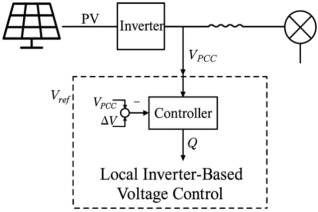
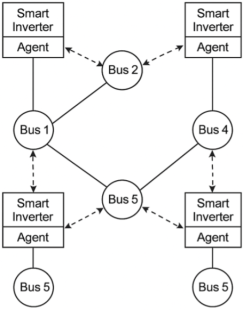
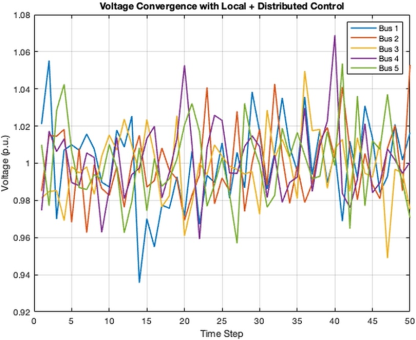
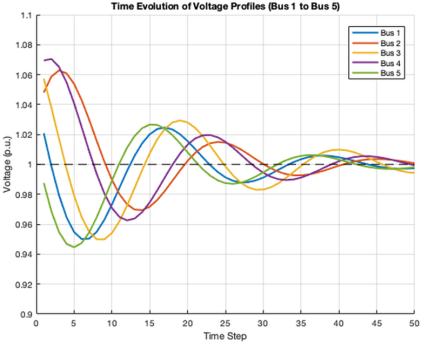
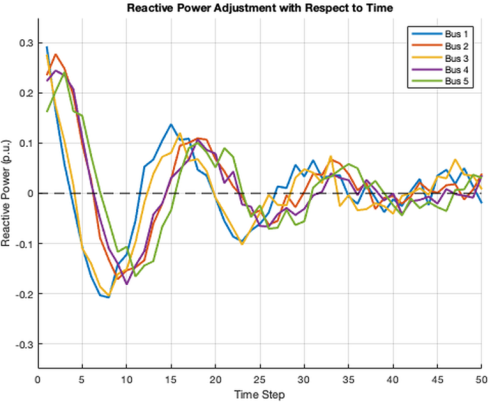
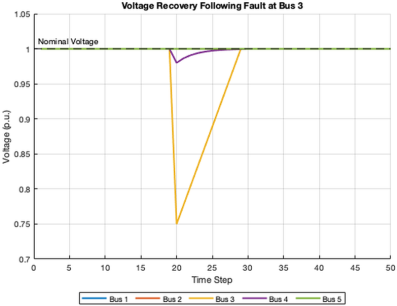
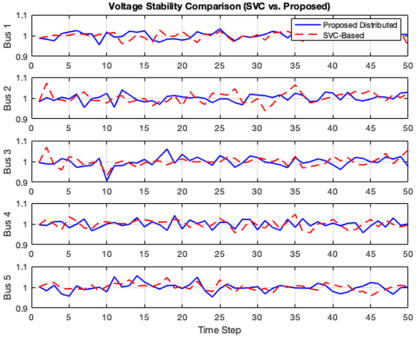
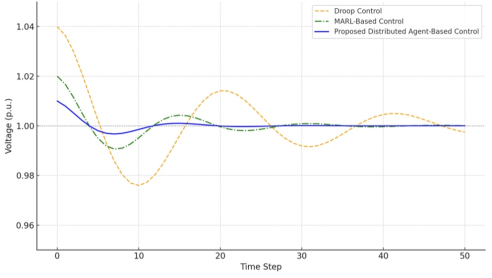
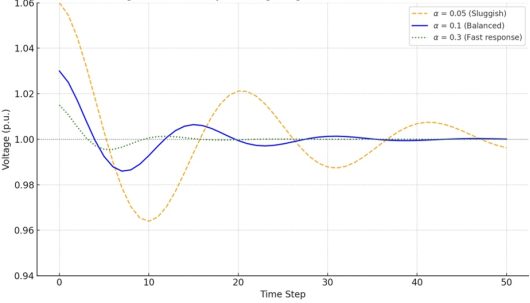
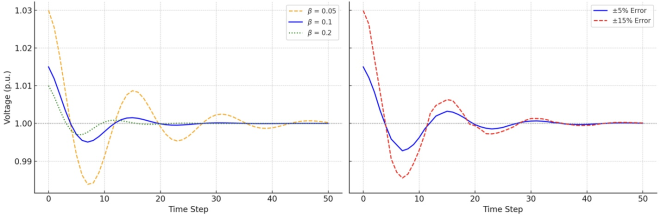




 Share This Article
 Twitter
 Linked In
 Facebook