
The growing demand for clean, reliable energy in off-grid and rural areas has made Solar Photovoltaic (PV) systems a viable alternative to conventional power sources; however, maximising their efficiency while balancing cost and reliability remains a significant challenge, especially in developing regions. This study presents a novel, locally engineered Pulse Width Modulation (PWM) Solar charge controller (SCC) designed to enhance energy conversion efficiency in stand-alone PV systems while maintaining affordability and ease of maintenance. Unlike existing studies that rely on imported or commercially available controllers, this research integrates indigenous design optimisation, locally sourced components, and context-specific testing under Nigerian climatic conditions. The locally constructed PWM charge controller was experimentally compared with a foreign PWM and a Maximum Power Point Tracking (MPPT) controller. Results showed that the MPPT controller achieved the highest efficiency (45-77.6%), while the PWM SCC recorded 43-66%. The inverter efficiency reached 89.7%, and the overall system efficiency was 24.4% for MPPT and 17.4% for the local PWM design. Despite its lower efficiency, the locally built PWM controller demonstrated significant potential as a cost-effective and reliable solution for rural electrification, particularly where access to advanced components is limited. The novelty of this study lies in the development and validation of a locally fabricated PWM SCC tailored to regional energy demands and environmental conditions, bridging the gap between performance optimisation and economic feasibility. It also offers a platform for standardising the overall efficiency of stand-alone Solar PV systems while providing practical insights for advancing contextualised renewable energy technologies that promote sustainable, community-driven electrification in Nigeria and similar developing regions.
| Published in | International Journal of Energy and Power Engineering (Volume 14, Issue 4) |
| DOI | 10.11648/j.ijepe.20251404.12 |
| Page(s) | 107-114 |
| Creative Commons |
This is an Open Access article, distributed under the terms of the Creative Commons Attribution 4.0 International License (http://creativecommons.org/licenses/by/4.0/), which permits unrestricted use, distribution and reproduction in any medium or format, provided the original work is properly cited. |
| Copyright |
Copyright © The Author(s), 2025. Published by Science Publishing Group |
Solar Photovoltaic Systems, PWM, MPPT, Efficiency
Research | Context | Key findings |
|---|---|---|
[10] | The growing demand for affordable and reliable clean energy in off-grid areas has made Solar PV systems vital for rural electrification. This study presents a novel, locally developed PWM SCC designed for improved efficiency and cost-effectiveness using locally sourced components optimized for Nigerian conditions. | Solar charge controllers are mainly classified as Pulse Width Modulation (PWM) and Maximum Power Point Tracking (MPPT) types. The PWM controller operates as a simple switch between the solar panel and the battery, achieving 75-80% efficiency, while the MPPT controller dynamically adjusts the operating point to extract maximum power, converting excess voltage into current for higher utilization. Using the Perturb and Observe (P&O) algorithm, the MPPT controller attains 94-99% efficiency, making it a more effective solution for optimizing solar energy harvesting under varying conditions |
[11] | This study presents a maximum power point tracking (MPPT)-based SCC designed for efficient battery charging in stand-alone photovoltaic systems. The proposed system enhances conventional PWM-based controllers by integrating MPPT technology with IoT-enabled monitoring for improved charging control and user interaction. | Simulation results show that the MPPT-based controller achieved 94% efficiency, significantly outperforming the PWM-based controller at 65%. The prototype also includes a Wi-Fi module for real-time monitoring of voltage, current, and battery status, with automatic disconnection and user notifications to prevent overcharging, ensuring both efficiency and safety |
[12] | This study presents the design and implementation of Arduino-based PWM and MPPT SCCs using a buck converter topology for stand-alone photovoltaic systems where the PV voltage exceeds the battery voltage. The design process includes simulation in Proteus, hardware construction, and a modified Perturb-and-Observe (P&O) MPPT algorithm with variable-duty-cycle control for improved performance. | Experimental and real-time measurements show that both controllers can safely charge a 12 V battery, but the MPPT design achieved 9% higher efficiency than the PWM controller. The system, monitored using an Arduino data logger, demonstrates that the MPPT-based controller offers superior energy conversion efficiency and practical applicability for small-scale 12 V, 100 Wp PV systems |
[13] | People in remote areas often face difficulties accessing electricity despite their regions’ high solar potential, as observed in parts of Indonesia. This study investigates how variations in weather and solar irradiance affect battery output performance in Solar PV systems | Using a SEPIC converter with PI control and a P&O-based MPPT algorithm, the system achieved efficiencies ranging from 73% to 97%. Even under low solar radiation, the converter maintained an efficiency above 90%, proving its suitability for reliable solar power generation in remote locations. |
Time | Voltage (V) | Current (A) | Power Output (W) |
|---|---|---|---|
10:45 am | 14.50 | 2.08 | 30.16 |
11.45 am | 15.00 | 2.26 | 33.90 |
12:45 pm | 15.80 | 2.95 | 46.61 |
1:45 pm | 16.30 | 3.59 | 58.52 |
2:45 pm | 16.10 | 3.02 | 48.62 |
3:45 pm | 15.60 | 2.92 | 45.56 |
4:45 pm | 14.90 | 2.35 | 35.02 |
Time | Power input (W) | Power output (W) | Efficiency (%) |
|---|---|---|---|
10:45am | 30.16 | 13.79 | 45.7 |
11.45am | 33.90 | 20.28 | 61.3 |
12:45pm | 46.61 | 33.25 | 71.3 |
1:45pm | 58.57 | 45.44 | 77.6 |
2:45pm | 48.62 | 38.08 | 65.0 |
3:45pm | 45.52 | 29.04 | 49.6 |
4:45pm | 35.05 | 20.80 | 35.6 |
Time | Power input (W) | Power output (W) | Efficiency (%) |
|---|---|---|---|
10:45am | 30.16 | 12.72 | 42.10 |
11.45am | 33.9 | 16.63 | 49.06 |
12:45pm | 46.61 | 24.70 | 52.90 |
1:45pm | 58.52 | 23.76 | 40.60 |
2:45pm | 48.62 | 20.25 | 41.64 |
3:45pm | 45.56 | 21.93 | 37.40 |
4:45pm | 35.02 | 14.88 | 25.30 |
AC | Alternating Current |
DC | Direct Current |
IEC | International Electrotechnical Commission |
MPPT | Maximum Power Point Tracking |
P&O | Perturb and Observe |
PI | Proportional-Integral |
PWM | Pulse Width Modulation |
PV | Photovoltaic |
SCC | Solar Charge Controller |
SEPIC | Single-Ended Primary Inductor Converter |
| [1] | S. N. Vodapally and M. H. Ali, “A Comprehensive Review of Solar Photovoltaic (PV) Technologies, Architecture, and Its Applications to Improved Efficiency,” Energies, vol. 16, no. 1, p. 319, Jan. 2023, |
| [2] | D. M. C. D. L. Veut, W. Shuting, and Z. Bolin, “Comparative Study of MPPT and PWM Charge Controllers: Designing an Efficient Solution for Small-Scale Solar Installations with Budget Constraints,” Saudi J. Eng. Technol., vol. 9, no. 08, pp. 367-376, Aug. 2024, |
| [3] | A. O. M. Maka and J. M. Alabid, “Solar energy technology and its roles in sustainable development,” Clean En, vol. 6, no. 3, pp. 476-483, June 2022, |
| [4] | A. Z. Arsad, A. W. M. Zuhdi, A. D. Azhar, C. F. Chau, and A. Ghazali, “Advancements in maximum power point tracking for solar charge controllers,” Renewable and Sustainable Energy Reviews, vol. 210, p. 115208, Mar. 2025, |
| [5] | M. S. Endiz, “Design and implementation of microcontroller-based solar charge controller using modified incremental conductance MPPT algorithm,” Journal of Radiation Research and Applied Sciences, vol. 17, no. 2, p. 100938, June 2024, |
| [6] | Z. A. H. Al-Jawary, “Study and evaluation of distributed power electronic converters in photovoltaic generation applications,” 2022, |
| [7] | O. Ray, K. Biswas, and R. Chakraborty, “Battery-Assisted Solar Energy Harvester Using Integrated Three-Port Converter With Adaptive Peak Power Tracking,” IEEE Transactions on Consumer Electronics, vol. 71, no. 1, pp. 1854-1864, Feb. 2025, |
| [8] | H.-Y. Lu, C.-E. Ye, H.-Y. Tsai, and Y.-P. Huang, “Enhanced harmony search for MPPT control in solar systems,” Results in Engineering, vol. 25, p. 104274, Mar. 2025, |
| [9] | A. Ullah, S. Ullah, U. Hussan, B. Alghamdi, and J. Pan, “Optimized Neuro-Adaptive Third-Order Sliding Mode Control with High-Gain Differentiator for Enhanced Photovoltaic System Performance: Simulation and Experimental Validation,” IEEE Journal of Emerging and Selected Topics in Power Electronics, pp. 1-1, 2025, |
| [10] | M. Deepika et al., “MPPT-Based Charge Controller for Battery Fast Charging,” in 2023 9th International Conference on Advanced Computing and Communication Systems (ICACCS), Mar. 2023, pp. 449-453. |
| [11] | S. Samal, P. K. Barik, R. K. Soni, and S. Nayak, “Simulation and Experimental Investigation of a Smart MPPT based Solar Charge Controller,” Energy Sources, Part A: Recovery, Utilization, and Environmental Effects, vol. 44, no. 3, pp. 7748-7763, Sept. 2022, |
| [12] | C. M. Aung, E. Mon, T. T. Htike, and H. M. Tun, “Comparative Analysis of Arduino-microcontroller based on PWM and MPPT Solar Charge Controller for Stand-alone Solar PV System in Charging Stations of Electric Vehicles,” Engineering Science Letter, vol. 4, no. 02, pp. 32-38, May 2025, |
| [13] | I. N. Syamsiana, R. N. A. Wijaya, A. D. W. Sumari, R. N. Amalia, and H. Sungkowo, “Maximization of battery charging efficiency in photovoltaic systems through PI Controlled SEPIC Converter with P&O MPPT,” Results in Engineering, vol. 26, p. 105469, June 2025, |
| [14] | A. Cabrera-Tobar and G. Spagnuolo, “Digital Twin Framework for Monitoring, Controlling and Diagnosis of Photovoltaic DC Microgrids,” in IoT Enabled-DC Microgrids, CRC Press, 2024. |
| [15] | M. Obi and R. Bass, “Trends and challenges of grid-connected photovoltaic systems - A review,” Renewable and Sustainable Energy Reviews, vol. 58, pp. 1082-1094, May 2016, |
APA Style
Lawal, O. A., Oba, M. Z., Kabiru, L., Jimoh, A. A. (2025). Benchmarking the Efficiency of Stand-Alone Solar Photovoltaic Systems in Nigeria. International Journal of Energy and Power Engineering, 14(4), 107-114. https://doi.org/10.11648/j.ijepe.20251404.12
ACS Style
Lawal, O. A.; Oba, M. Z.; Kabiru, L.; Jimoh, A. A. Benchmarking the Efficiency of Stand-Alone Solar Photovoltaic Systems in Nigeria. Int. J. Energy Power Eng. 2025, 14(4), 107-114. doi: 10.11648/j.ijepe.20251404.12
AMA Style
Lawal OA, Oba MZ, Kabiru L, Jimoh AA. Benchmarking the Efficiency of Stand-Alone Solar Photovoltaic Systems in Nigeria. Int J Energy Power Eng. 2025;14(4):107-114. doi: 10.11648/j.ijepe.20251404.12
@article{10.11648/j.ijepe.20251404.12,
  author = {Olatunji Ahmed Lawal and Mustapha Zubair Oba and Lateef Kabiru and Adeyemi Abdulhameed Jimoh},
  title = {Benchmarking the Efficiency of Stand-Alone Solar Photovoltaic Systems in Nigeria
},
  journal = {International Journal of Energy and Power Engineering},
  volume = {14},
  number = {4},
  pages = {107-114},
  doi = {10.11648/j.ijepe.20251404.12},
  url = {https://doi.org/10.11648/j.ijepe.20251404.12},
  eprint = {https://article.sciencepublishinggroup.com/pdf/10.11648.j.ijepe.20251404.12},
  abstract = {The growing demand for clean, reliable energy in off-grid and rural areas has made Solar Photovoltaic (PV) systems a viable alternative to conventional power sources; however, maximising their efficiency while balancing cost and reliability remains a significant challenge, especially in developing regions. This study presents a novel, locally engineered Pulse Width Modulation (PWM) Solar charge controller (SCC) designed to enhance energy conversion efficiency in stand-alone PV systems while maintaining affordability and ease of maintenance. Unlike existing studies that rely on imported or commercially available controllers, this research integrates indigenous design optimisation, locally sourced components, and context-specific testing under Nigerian climatic conditions. The locally constructed PWM charge controller was experimentally compared with a foreign PWM and a Maximum Power Point Tracking (MPPT) controller. Results showed that the MPPT controller achieved the highest efficiency (45-77.6%), while the PWM SCC recorded 43-66%. The inverter efficiency reached 89.7%, and the overall system efficiency was 24.4% for MPPT and 17.4% for the local PWM design. Despite its lower efficiency, the locally built PWM controller demonstrated significant potential as a cost-effective and reliable solution for rural electrification, particularly where access to advanced components is limited. The novelty of this study lies in the development and validation of a locally fabricated PWM SCC tailored to regional energy demands and environmental conditions, bridging the gap between performance optimisation and economic feasibility. It also offers a platform for standardising the overall efficiency of stand-alone Solar PV systems while providing practical insights for advancing contextualised renewable energy technologies that promote sustainable, community-driven electrification in Nigeria and similar developing regions.},
 year = {2025}
}
TY  - JOUR
T1  - Benchmarking the Efficiency of Stand-Alone Solar Photovoltaic Systems in Nigeria

AU  - Olatunji Ahmed Lawal
AU  - Mustapha Zubair Oba
AU  - Lateef Kabiru
AU  - Adeyemi Abdulhameed Jimoh
Y1  - 2025/11/07
PY  - 2025
N1  - https://doi.org/10.11648/j.ijepe.20251404.12
DO  - 10.11648/j.ijepe.20251404.12
T2  - International Journal of Energy and Power Engineering
JF  - International Journal of Energy and Power Engineering
JO  - International Journal of Energy and Power Engineering
SP  - 107
EP  - 114
PB  - Science Publishing Group
SN  - 2326-960X
UR  - https://doi.org/10.11648/j.ijepe.20251404.12
AB  - The growing demand for clean, reliable energy in off-grid and rural areas has made Solar Photovoltaic (PV) systems a viable alternative to conventional power sources; however, maximising their efficiency while balancing cost and reliability remains a significant challenge, especially in developing regions. This study presents a novel, locally engineered Pulse Width Modulation (PWM) Solar charge controller (SCC) designed to enhance energy conversion efficiency in stand-alone PV systems while maintaining affordability and ease of maintenance. Unlike existing studies that rely on imported or commercially available controllers, this research integrates indigenous design optimisation, locally sourced components, and context-specific testing under Nigerian climatic conditions. The locally constructed PWM charge controller was experimentally compared with a foreign PWM and a Maximum Power Point Tracking (MPPT) controller. Results showed that the MPPT controller achieved the highest efficiency (45-77.6%), while the PWM SCC recorded 43-66%. The inverter efficiency reached 89.7%, and the overall system efficiency was 24.4% for MPPT and 17.4% for the local PWM design. Despite its lower efficiency, the locally built PWM controller demonstrated significant potential as a cost-effective and reliable solution for rural electrification, particularly where access to advanced components is limited. The novelty of this study lies in the development and validation of a locally fabricated PWM SCC tailored to regional energy demands and environmental conditions, bridging the gap between performance optimisation and economic feasibility. It also offers a platform for standardising the overall efficiency of stand-alone Solar PV systems while providing practical insights for advancing contextualised renewable energy technologies that promote sustainable, community-driven electrification in Nigeria and similar developing regions.
VL  - 14
IS  - 4
ER  -
Department of Electrical and Electronics Engineering, Kwara State Polytechnic, Ilorin, Nigeria
Department of Electrical and Electronics Engineering, Kwara State Polytechnic, Ilorin, Nigeria
Department of Electrical and Electronics Engineering, Kwara State Polytechnic, Ilorin, Nigeria
Department of Electrical and Electronics Engineering, Kwara State Polytechnic, Ilorin, Nigeria
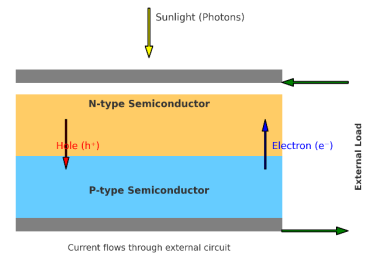
Figure 1. The basic operation of a PV cell [3].
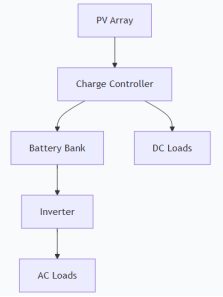
Figure 2. Main component of a Solar PV system.
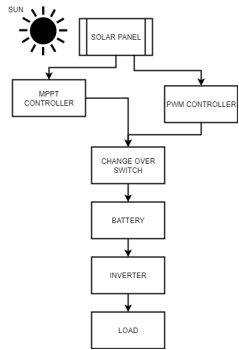
Figure 3. Block diagram of the experimental connections.
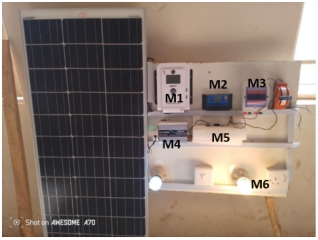
Figure 4. System Configuration.
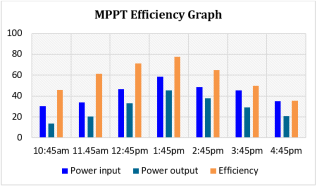
Figure 5. The graph shows the MPPT SCC power input, power output, and efficiency over time.
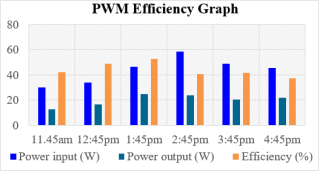
Figure 6. The graph shows the power input, power output, and efficiency of the foreign PWM SCC over time.

Information



 Share This Article
 Twitter
 Linked In
 Facebook
 Copy
Copy Download