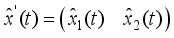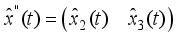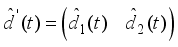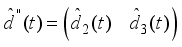
Research Article | | Peer-Reviewed

Adaptive Generalized Extended State Observer for a Single Phase PV Grid-connected System Operating Under the Sudanese-Sahelian Climate of Cameroon

Received: 24 September 2024     Accepted: 16 October 2024     Published: 11 November 2024
Views:       Downloads:
Abstract

Knowing the health of a system allows to guarante its efficiency and sustainability. The state observer is one of several techniques used by authors to estimate system state. This paper focuses on the problem of simultaneous states estimation of DC (Direct Current) and AC (Alternating Current) sides of a single-phase Photovoltaic (PV) grid-connected operating under the Sudanese-Sahelian climate of Cameroon. A generalized extended state observer (GESO) has been designed to simultaneously estimate the three states and the three disturbances of the system. A good estimation of the state and disturbances is achieved by the appropriate choice of the observer gain and the disturbance compensation gain resulting from the correct pole placement. The GESO robustness has been tested by varying the PV voltage and grid voltage. When there are no input fluctuations, the estimation errors of nominal states and disturbances converge to zero. The fluctuation in PV voltage resulting from partial shading has a significant impact on the boost converter current. The boost converter current varies proportionally with the drop in voltage due to partial shading from 55% to 59%. Under the grid voltage fluctuation, the boost converter current remains stable while the DC bus voltage and inverter current are significantly affected. The proposed GESO prove its robustness to perturbations from the PV array and grid side into the Single-Phase PV Grid-connected System. This paper contributes to the study of observers applied to the PV system and points the way to future work on diagnosing faults in PV systems operating in Cameroon's Sudanese-Sahelian climate.

Published in International Journal of Energy and Power Engineering (Volume 13, Issue 5)
DOI 10.11648/j.ijepe.20241305.11
Page(s) 73-96
Creative Commons

This is an Open Access article, distributed under the terms of the Creative Commons Attribution 4.0 International License (http://creativecommons.org/licenses/by/4.0/), which permits unrestricted use, distribution and reproduction in any medium or format, provided the original work is properly cited.

Copyright

Copyright © The Author(s), 2024. Published by Science Publishing Group

Keywords

Generalized Extended State Observer, Active Disturbance Rejection Control, PV Grid-Connected System, Sudanese-Sahelian Climate, Cameroon
1. Introduction
1.1. Background
The availability, quality and sustainable management of electrical energy is one of the world's major energy challenges, as the population grows rapidly and fossil fuels become increasingly scarce . In Cameroon, more than 50% of the country's electricity comes from hydroelectric power . Because of climate change in recent years, hydropower is affected by hydrological variability and decreases during periods of low rainfall. To address these issues, the Cameroonian government launched a rural electrification project using solar photovoltaic energy. As renewable energy is an attractive option for electrifying remote areas, this policy is a first step towards solving the problem of energy availability. However, due to the remoteness of the installation sites, the maintenance of solar power plants is an issue which requires special attention, since parameters such as variations in irradiance, temperature, angle of incidence, shading, dust deposits, etc., influence significally the PV system efficiency . To prevent energy loss and equipment damage, a proper and early fault detection is very important .
1.2. Related Work
Many significant monitoring and PV diagnosis techniques are developed. Visual inspection and imaging-based methods such as infrared (IR) thermography, ultraviolet (UV) fluorescence, photoluminescence (PL) and electroluminescence (EL) are widely used. However, these techniques consume time and require additional expensive equipment . Apart from fact that additional equipment, such as sensor redundancy, is expensive; the reliability of the sensors has to be constantly monitored to avoid false readings. To deal with these problems, state observer method is used to reconstruct the system's state based on the knowledge of its inputs and outputs .
Observers are designed to estimate state or disturbance of a system. There are several types of observers described in the literature, such as adaptive observer, extended state observers, sliding mode observer (SMO), unknown input observer (UIO), learning observer (LO), disturbance observer, perturbation observer, equivalent input disturbance (EID) based estimation, Extended State Observer (ESO) . Disturbances Observers-based control are classified into two categories by : linear disturbance and uncertainty estimation (LDUE) techniques, and nonlinear disturbance and uncertainty estimation (NDUE). The Extended State Observer is a fundamental part of Active Disturbance Rejection Control (ADRC), which goal is to eliminate unknown uncertainties and external disturbances. Proposed the first time by Han in 1990, ADRC is a practical alternative to classical proportional-integral-derivative (PID) control . The GESO differs from other observers by minimizing the influence of uncertainties on the output of the studied system, whether the unknown disturbances are accurately estimated or not. On the other hand, the main question is whether UIO and sliding mode observer approaches can accurately reconstruct an unknown disturbance. Perturbation-based feedforward control for systems with mismatched uncertainties has been an unsolved problem for a long time. Therefore, it is important to consider a more restrictive condition for the design of the observer . This should take into account the operating conditions and the specificity of each system studied.
Shah and Singh (2020) proposed a multifunctional adaptive observer for a solar energy conversion . Alshiekh et al. (2020) proposed a control scheme to maintain the system stable and eliminate the effect of the computation delay. Based on measuring the injected current, they performed an estimation of filter capacitor current using the discrete -time observer .
Because of voltage and current sensor disadvantages and to minimize the number of sensors required, Mokhlis et al. (2020) designed the high gain observer to rapidly and accurately determine the desired global maximum power point .
Wang et al. (2015) studied the mismatched disturbance rejection control problem. By using the disturbance estimation technique based on ESO, the proposed controller not only makes the states of a closed-loop system obtain better tracking performance but also provides better disturbance rejection ability against resistance load variation .
When an LCL filter is applied to remove power electronic chopping harmonics, the power quality faces two issues: resonance damping and grid voltage-induced current distortion. Two separate control algorithms requiring an additional current sensor, increasing control complexity and limiting performance, conventionally solve this problem. To deal with that, a current control strategy based on linear ADRC for a grid-connected inverter with an LCL filter to enhance power quality is proposed by Wang et al. (2018) . The proposed strategy can realize active damping and suppression of grid voltage-induced current distortion at the same time in the same control structure with fewer sensors. Moreover, it can give better performance in both dynamic and steady states.
Uncertainties due to variations in component parameters and changes in climatic conditions have a serious impact on the control performance of the inverter. To overcome this problem, Zhu and Fei (2018) proposed to estimate disturbances in real-time by using a sliding mode to control the output voltage of the DC-AC inverter, and a fuzzy logic to approximate the upper bound of the observation error between the actual disturbance and its observed value .
Fast-varying sinusoidal disturbances are disturbances in the phase, frequency or magnitude of sinusoidal signals. The conventional extended state observer (ESO) cannot handle these fast perturbations. In response to these issues, Guo et al. (2021) developed the Generalized Integrator-Extended State Observer and applied it to grid-connected converters in the presence of disturbances. In particular, the case of a three-phase phase-locked loop with noisy regimes is studied. The proposed observer solves the trade-off between the bandwidth of the observer and the noise filtering .
Jain et al. (2017) presented a robust fault detecting and identifying scheme based on a linearly switched Luenberger observer for DC-DC power electronic converters. The proposed scheme includes a fault diagnosis filter detecting a fault event and a bank of fault identification filters identifying a faulty converter component. With a suitable gain matrix design, the residual function converges to zero in the absence of faults and is robust in the presence of noise and other non-idealities .
Qin (2020) discuss the double current loop control strategy of a single-phase LCL grid- connected inverter based on the Luenberger state observer. This strategy solves the problems of sensor installation and measurement noise .
To improve the control of grid-connected inverters under unbalanced grid voltage conditions, Benyamina et al. (2021) proposed an extended state observer - based sensorless control. Positive and negative sequence components are estimated .
Generalized Active Disturbance Rejection Control (GADRC) applied to the boost converter was tested by Ayang (2020). The results of this work show that the extended generalized state observer is robust to disturbances, but the control that is used does not follow the fixed references during the disturbed periods .
1.3. Key Research Gap
Like other industrial processes, photovoltaic systems are subject to several uncertainties, such as parameter perturbation, external disturbances and non-linear loads . The integration of PV generation into the grid brings different challenges affecting the stability of the grid . Thus, because the reliability and durability of PV installation have an significant impact on the cost investment, it is necessary and imperative to know the status of the system in real-time . Several important approaches have been developed in the literature to meet these requirements, and we have listed a few of them above. However, these approaches are either state estimators or disturbances estimators . Few approaches are both state and disturbances estimators. On the other hand, in most of the works using the observer method in photovoltaic systems, the authors are interested in either the DC side or the AC side . In addition, the ADRC approach, which emphasizes the use of the Extended State Observer (ESO) to timely estimate and eliminate the effect of the total disturbance, including both internal unmodeled dynamics and external disturbances in the system shows more significant results among many significant approaches based on state and disturbance estimation developed in the literature . A major asset of this paper is the application of this approach to photovoltaic systems, considering both the DC and AC sides.
1.4. Motivations and Paper's Main Contributions
In this work, the aim is to propose an Adaptive Observer capable of estimating both the states and the disturbances of a photovoltaic system and eliminating the effect of mismatched uncertainties. The robustness test is based on the work of Yaouba et al. (2022) who demonstrated that in the Sudanese-Sahelian zone of Cameroon, when shading varies from 60% to 95%, PV voltage decreases from 55% to 59% . The main contributions of this paper are illustrated as follows:
1) The application of the Adaptive GESO to photovoltaic systems, considering both the DC and AC sides,
2) Design of the nominal and extended state observer with two controls (one control on DC side and one control on AC side),
3) Simultaneous estimation of system states and unmodeled dynamics,
4) Evaluating of the GESO robustness applied to the single-phase grid-connected PV system operating under the Sudanese-Sahelian climate of Cameroon,
5) Assessing the effects of the external disturbances from the DC and AC sides of the studied system.
This paper is organized as follows: The model of the system is illustrated in Section 2 by the general GESO approach and the studied system topology. In section 3, the proposed observer is constructed. Section 4 presents the simulation results. The conclusion and outlook are given in section 5.
2. Model of Studied System
2.1. The GESO Approach
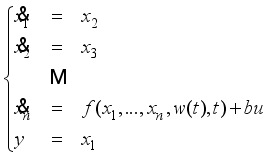
Let us consider an uncertain system with the order of n described in :
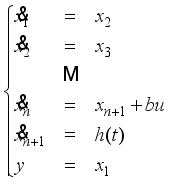
(1)
The states are x1,..., xn, the control input is u, the output is y, the external disturbance is ω(t), b is a system parameter, and f(x1,..., xn, ω(t), t) represents the uncertain function or lumped disturbance.
The system (1) can be linearized by introducing an additional variable:
(2)
The extended state equation resulting from combining (1) with (2) is given by:
(3)
With
A general MIMO (Multiple Input, Multiple Output) system includes multiple disturbances is defined as follows :
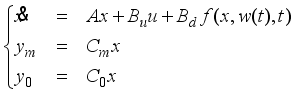
(4)
Where x
f(x, ω(t), t) is the uncertain function in terms of x
As in system (1), the system (4) can be linearized by adding an extended variable:
(5)
Thus, the extended system equation is obtained as:
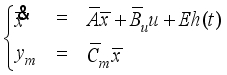
(6)
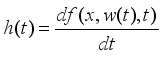
With variables ; ; and matrices
; ; ;
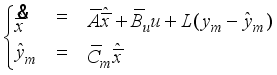
From system equation (6), the GESO is derived as follows:
(7)
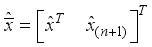
Where , with , and the state variable estimates of , and , respectively. Matrix L
2.2. Studied system Topology
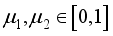
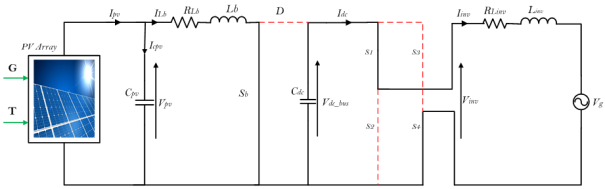
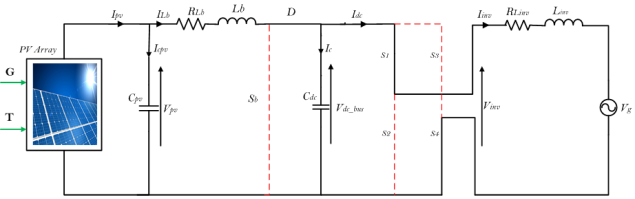
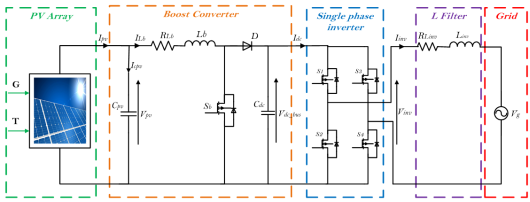
This section presents the model of a single-phase PV system connected to the grid, and the equivalent circuit diagram and the equations of the dynamic system. The equivalent circuit of the system studied is shown in Figure 1. It consists of a PV module, a DC-DC converter, a single-phase inverter, a filter L and the grid part represented by the voltage Vg. In the PV part, G and T are the irradiance and temperature respectively. The type of converter used in this work is a boost converter. Ipv is the PV module current; Lb, ILb and RLb are respectively the smoothing inductance, the inductance current and the resistance of the boost converter. Lb and RLb are used to limit the current ripple in the converter. The power switch Sb (MOSFET, IGBT) coupled to the diode D ensures the transfer of energy to the load. The ripple caused by switching at the output of the converter is reduced by the filter capacitor Cdc. The DC-DC converter and the single-phase inverter are controlled by PWM (Pulse Width Modulation) modulators that generate pulses with a frequency of f=1/T and a width of µT, where μ∈ [0,1] is the duty cycle of the control pulses. Iinv, RLinv, and Linv are respectively the current, the resistance and the inductance of the inverter controlled by the switches S1, S2, S3 and S4.
Figure 1. System equivalent circuit.
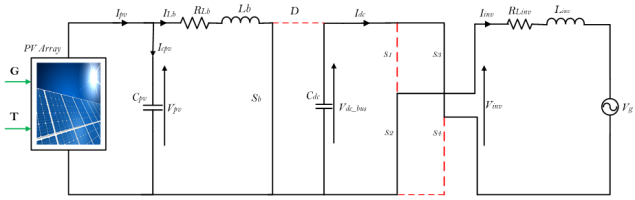
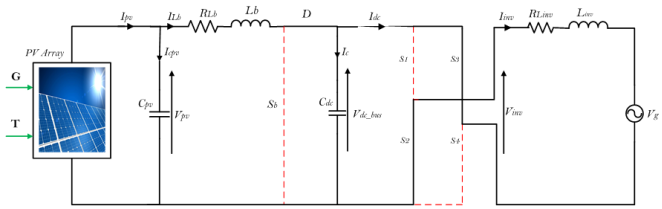
The equivalent circuits shown in Figures 2-5 illustrate respectively the energy accumulation and the energy transfer phases described by four conduction sequences.
2.2.1. Energy Accumulation Phase in the Smoothing Inductor Lb
Conduction sequence 1: Sb closed and D blocked (converter side, µ1=1); S1, S4 closed and S2, S3 opened (inverter side, µ2=1)
Figure 2. Energy accumulation phase 1.
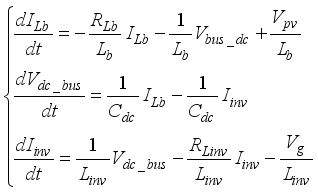
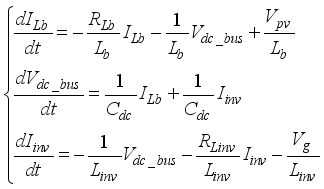
The dynamic model of the system is described by the equations (8)-(11) from this equivalent circuit.
(8)
Conduction sequence 2: Sb closed and D blocked (converter side µ1=1); S1, S4 opened and S2, S3 closed (inverter side µ2=0)
Figure 3. Energy accumulation phase 2.
(9)
2.2.2. Energy Transfer Phase
Conduction sequence 3: Sb open and D open (converter side µ1=0); S1, S4 closed and S2, S3 opened (inverter side µ2=1)
Figure 4. Energy transfer phase 1.
(10)
Conduction sequence 4: Sb opened and D on (converter side µ1=0); S1, S4 open and S2, S3 closed (inverter side µ2=0)
Figure 5. Energy transfer phase 2.
(11)
Average dynamic model
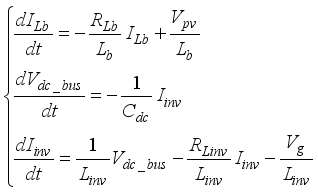
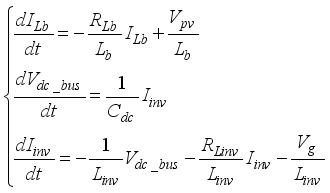
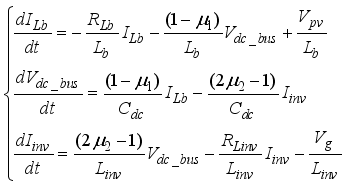
By combining systems (8), (9), (10), and (11), the average dynamic model of the system can be derived as follows:
(12)
With
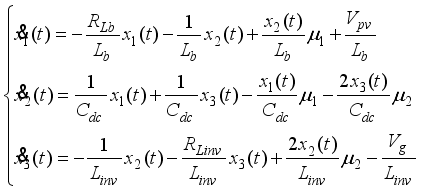
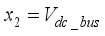
ILb, RLb and Lb are the current, internal resistance, and boost converter inductance respectively. Vpv is the voltage supplied by the PV module; Vdcbus is the DC bus voltage. Iinv, Rinv, and Linv are the current, resistance, and inductance of the inverter respectively. Vg is the grid voltage; μ1 and μ2 are the duty cycles of the boost converter and the inverter respectively.
By setting ; and , the equation (12) is transformed as follows:
(13)
Equation (13) takes the form of equation (14) as:
(14)
With:
Equation (14) represents the nonlinear dynamic model of the system.
3. Construction of the Studied Observer
3.1. Model of Dynamic Nominal state
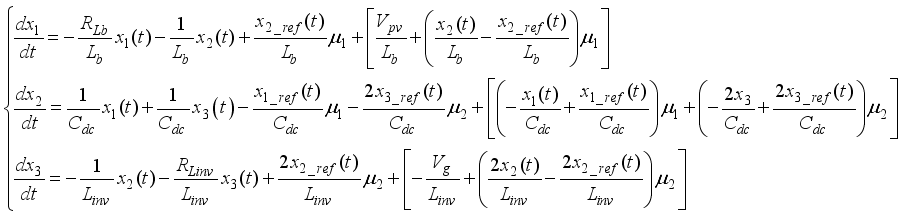
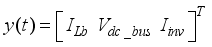
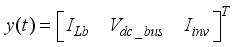
By setting the state, reference, and output variables as follows:
; and ; equation (13) can be written as:
(15)
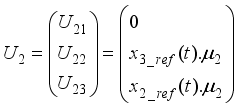
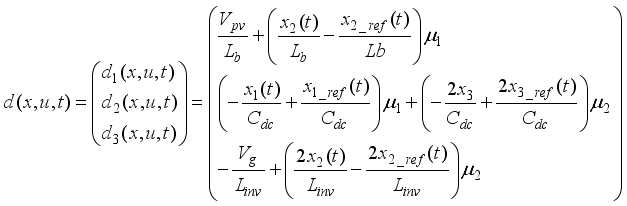
Considering and as the system controls (boost converter and inverter controls respectively), and , a nonlinear function representing the nonlinearity of the system and the parts likely to be disturbed, the equation (15) becomes:
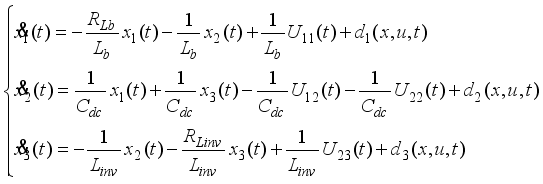
(16)
1) The disturbances d1 are influenced by the parameters Vpv, Lb, the state x2 and the duty cycle μ1
2) The disturbances d2 are influenced by the parameters Cdc, the state x1, x3 and the duty cycle μ1, μ2
3) The disturbances d3 are influenced by the parameters Vg, Linv, the state x2 and the duty cycle μ2
The state space representation of equation (14) can be written as:
(17)
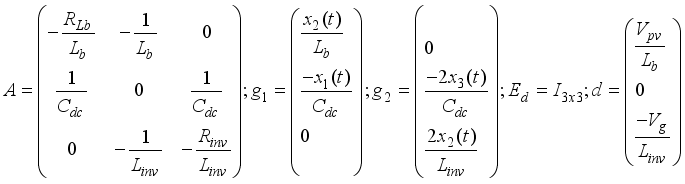
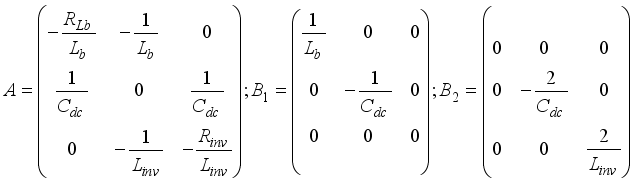
By identification with equation (15), the following matrices are obtained:
; ; ; ;
Where , , , are the state vector, input, external disturbance, measurable outputs respectively. A is the state matrix of the nominal system with dimension , the control matrix of the nominal system with dimension , C the output matrix of the nominal system with dimension , and D, are dimension.
Controllability and Observability of the nominal system
Let be the order of the matrix A,
The controllability and observability matrixes are obtained as follows:
(18)
(19)
For ; and , the controllability matrix and the observability matrix are full rank. This means that the nominal system is controllable and observable, and therefore stable.

3.2. Model of Extended State System
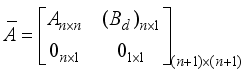
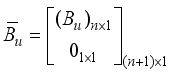
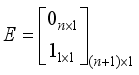
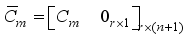
By adding the extended variable to linearize the system (17), the extended state system is written as:

(20)
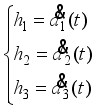
Let us make a change of the variables as follows:
; ; ; ;
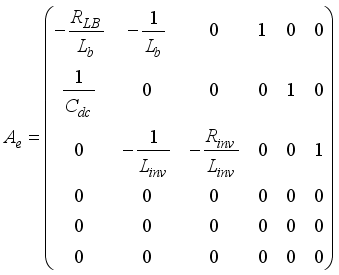
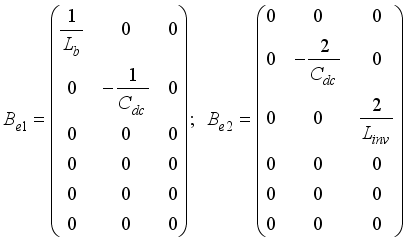
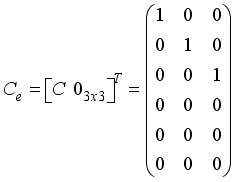
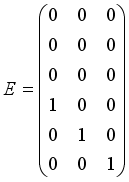
The matrices derived from the equation (20) are:
;
;
Controllability and Observability of the extended system
Let be the order of the matrix ,
(21)
(22)
The is the observability matrix rank and is the controllability matrix rank of the extended system. It’s verified that and

This allows us to conclude that the extended system is observable and partially controllable for the nominal states. However, it is not controllable for the extended states. This could be because perturbations are difficult, if not impossible to control.
3.3. Generalized Extended State Observer Design
From the preceding extended state model, the generalized extended state observer is designed as follows:
(23)
Where
are the estimated state variables.
is the extended state observer gain to be dimensioned.

3.3.1. Control Low
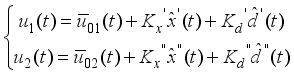
Assuming that the three nominal states of the system are observable, to mitigate the disturbances of the system in steady state, the usual control is proposed as :
(24)
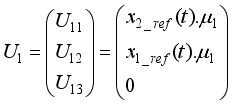
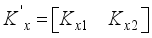
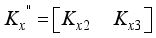
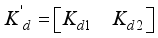
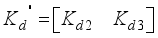
Where , is the internal model of reference input r(t), is the Laplace transform of tracking error e(t) = r(t) - y(t); the inverse Laplace transform; Kx is the state-feedback control gain; and Kd is the disturbance compensation gain.

(25)
In this study, the two commands of our system are written as follows:
(26)
Let us set:
; ; ; ;
; ; ;
Equation (26) becomes:
(27)
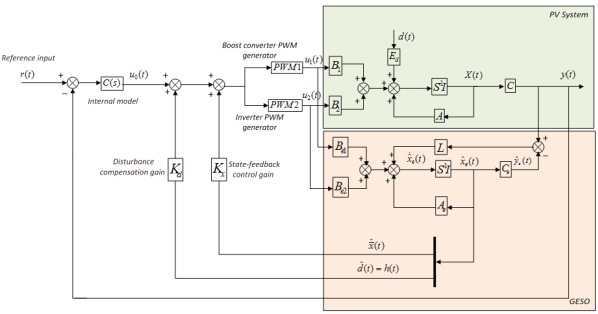
Figure 6 shows the configuration of the proposed GESO system.
Figure 6. Configuration of the proposed GESO-based control system.
3.3.2. System Stability Analysis
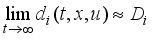
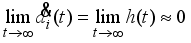
Assumption: Disturbances and their derivatives are bounded, and have constant values in steady state. et ; is a constant and .
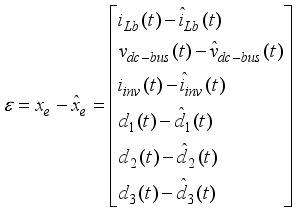
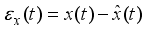
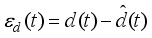
The estimation errors of the state variables and disturbances are defined as follows:
(28)
From the extended state system (20) and the generalized extended state observer (23), the dynamic state equation of the error is given by:
(29)
Lemma: Assuming that the Extended State Observer gain vector is chosen so that is Hurwitz matrix, and then the observer error is bounded for any bounded disturbance .
From Lemma 1, it can be concluded that the closed-loop system (23) is bounded-input–bounded-output stable for any bounded d(t) and h(t) if Kx and L are well-defined.
Theorem 1: Suppose that the Assumption is satisfied. The stability of system (23) is guaranteed if the ESO gain L and the state feedback control gain Kx are chosen such that matrices and are Hurwitz .
Theorem 2: The disturbance compensation gain Kd is no longer available since is possible noninvertible or even not a square matrix .
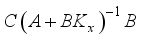
Considering theorem 2, assuming that is invertible, then the disturbance compensation gain Kd takes the form:

(30)
Theorem 3: Suppose that Assumption 1 is satisfied. If the following conditions are satisfied :
1) Matrix is Hurwitz;
2) Matrix is Hurwitz;
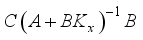
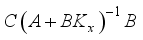
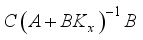
3) Matrix is invertible
According to the control law (24), the disturbance d(x, t) can then be attenuated from the output channel in a the steady state.
Remark: The influence of disturbances on the system state may not be completely eliminated . In the case studied, one of the main objectives is to eliminate the effects of any disturbance from the output channel. Theorem 3 gives the necessary conditions for the closed-loop GESO to ensure stability and attenuation of disturbances from the output channel in the steady state.
3.3.3. Active Disturbance Rejection Analysis
Substituting ; and into equation (17), the following equation is obtained:
(31)
Substituting equations (30) and (31) into equation (17), the output can be represented as:
(32)
It is clear that the output of the system does not contain the distorted expression. We can therefore conclude that there is active noise suppression at the output of the system.
3.3.4. Algorithm for Designing the GESO-based PV System
Step 1: Design the observer gains L through the pole placement method, ensuring that is Hurwitz.
Step 2: Design feedback control gain Kx by the pole placement method so that is Hurwitz.
Step 3: Check if is inversible. If not, go to Step 2, and redesign Kx
Step 4: Calculate Kd from (30).
4. Simulation Results
4.1. Studied System Parameters
In this section, the proposed GESO-based method is applied to the system with the parameters shown in Table 1.
Table 1. System parameters .

Parameter

Symbol

Value

Photovoltaic generator voltage

Vpv

120 V

Boost converter inductance

Lb

5 mH

Internal resistance of converter

RLb

1 Ω

Boost converter current

ILb

12 A

DC bus capacitance

Cdc

2.85 mF

DC bus voltage

Vdc_bus

240 V

Inverter inductance

Linv

5.16 mH

Internal resistance of inverter

Rinv

1 Ω

Inverter current

Iinv

6 A

Grid voltage

Vg

220 V

Switching frequency

fc

20 kHz

Sample time

t

10-5 S

There are three main parameters to design the GESO; the observer gain matrix L, the disturbance compensation gain Kd and the feedback control gain matrix Kx. The algorithm described in section 3.3.4 is used to determine these parameters. The most important design parameters are Kx and L . They ensure the stability of the closed-loop system. They should be chosen to stabilize the error dynamics and to allow ε(t) to move rapidly to zero independently of ε(0) . The pole placement approach allows one to parameterize the gains and analytically define the desired behaviour of the observer outputs by setting the characteristic polynomial :
(33)
Where are the eigenvalues of matrix .
The nominal system (A, B) is controllable and the extended system (Ae, Ce) is observable. Matrices and are Hurwitz, the poles of both the closed-loop system and the ESO can be placed arbitrarily .

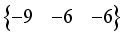
By choosing the pole placement as , the feedback control gain matrix is
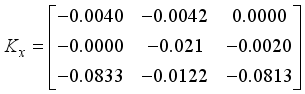
(34)
The Eigen values of matrix are:
The real parts of the eigenvalues are negative, so the matrix is Hurwitz. The nominal system is therefore stable. The disturbance compensation gain Kd is obtained as follows:
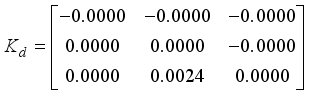
(35)
By choosing ; observer gain matrix L is obtained as:
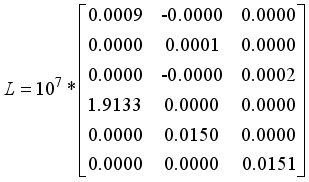
(36)
The eigenvalues of are: .
These values are completely negative, so matrix is Hurwitz ensuring the stability of GESO.
4.2. States and Disturbances Estimation Results
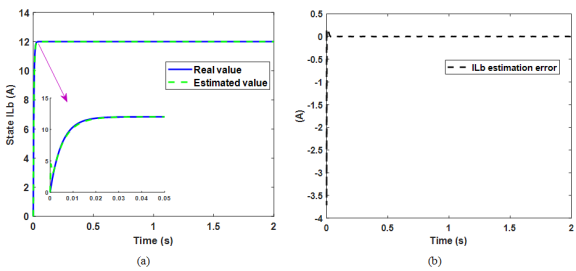
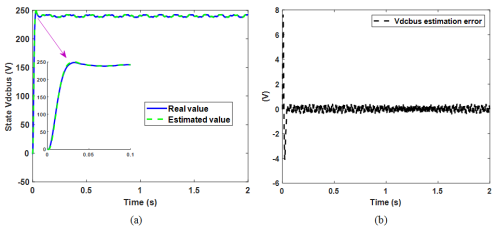
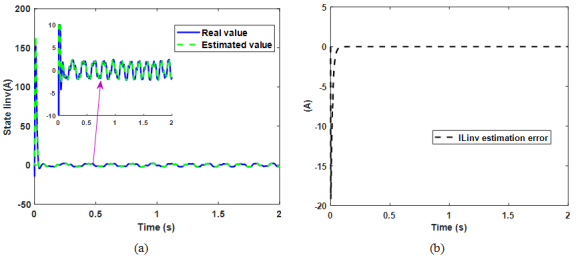
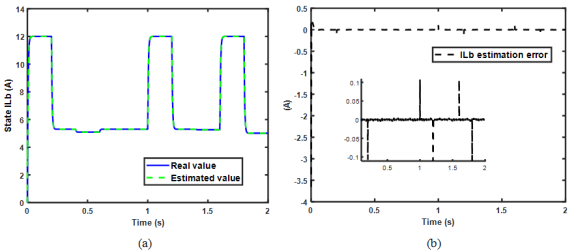
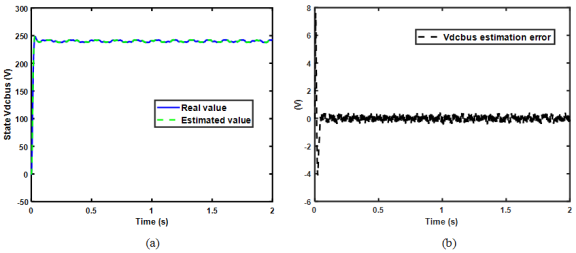
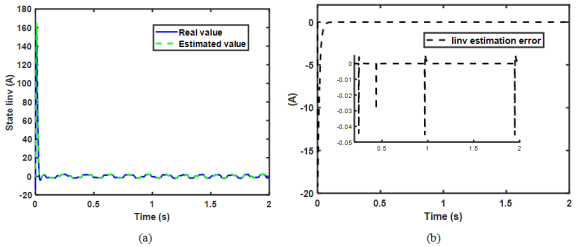
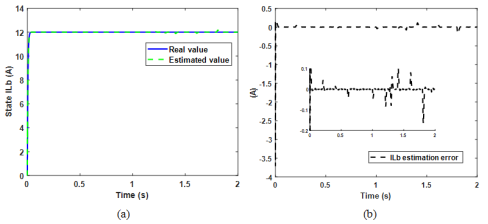
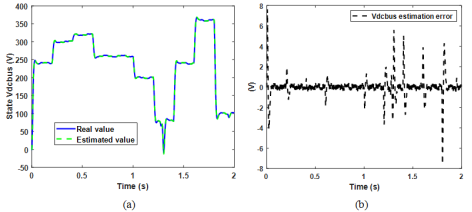
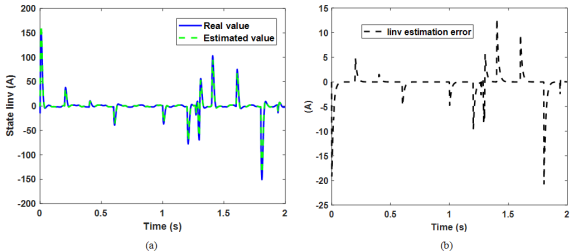
The response curves of the real and estimated states ILb, Vdc_bus, and Iinv, and their estimation errors are shown in Figures 7-9. The estimated curves converge correctly to the real curves as can be seen from these figures and the estimation errors of GESO converge to zero.
In Figure 8, the small oscillations observed in the Vdc_bus response curve would be caused by the current term Iinv in the expression of the DC bus voltage equation.
Figure 7. Response curves of the real and estimated boost converter inductance current ILb (a) and estimation error (b).
Figure 8. Response curves of the real and estimated DC bus voltage Vdc_bus (a) and the estimation error (b).
Figure 9. Response curves of the real and estimated inverter current Iinv (a) and estimation error (b).
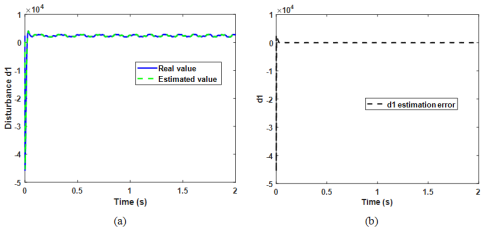
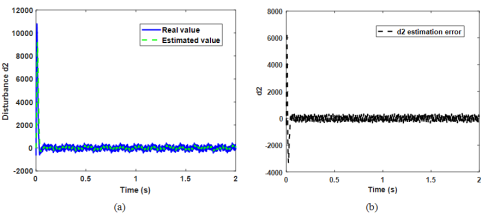
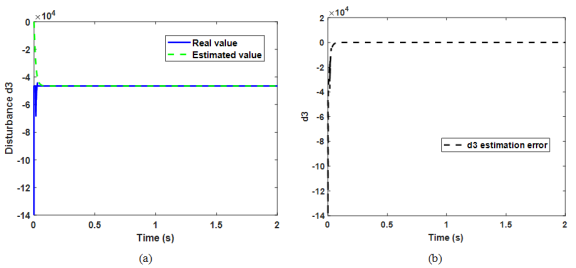
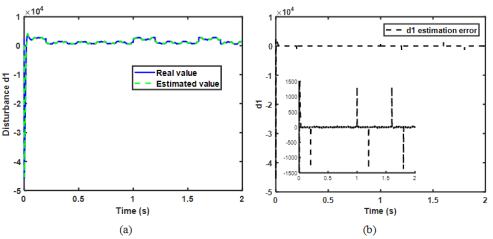
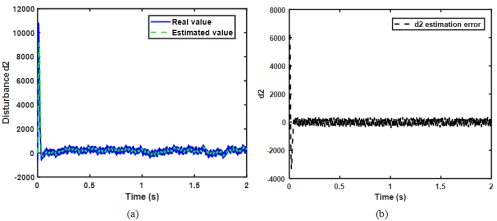
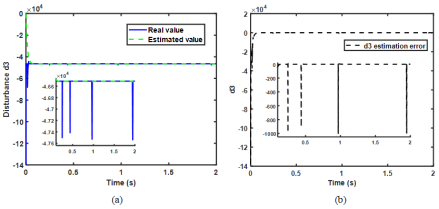
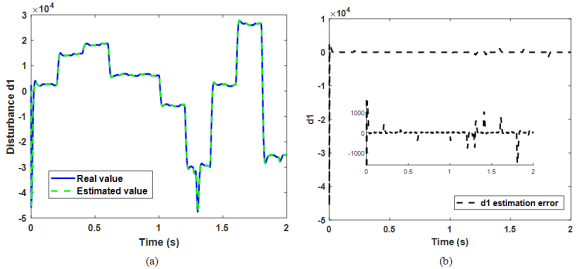
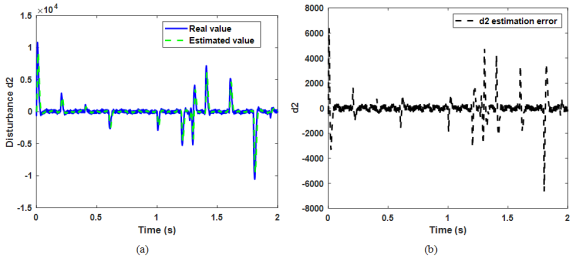
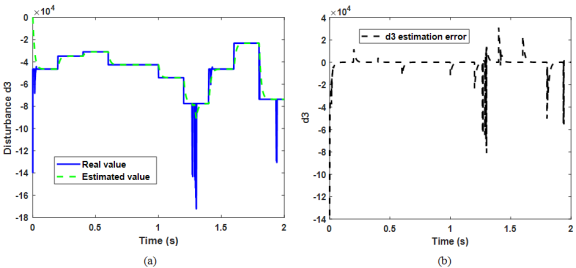
Figures 10-12 show the response curves of the real and estimated disturbances d1, d2, and d3 and their estimation errors. It can be seen that the estimated curves correctly converge to the real curves and the estimation errors of GESO converge to zero for all disturbances.
Figure 10. Real and estimated disturbance d1 curves (a) and estimation error (b).
Figure 11. Real and estimated disturbance d2 curves (a) and estimation error (b).
Figure 12. Real and estimated disturbance d3 curves (a) and estimation error (b).
As shown in Figures 7-12, the GESO can estimate the states and disturbances timely and accurately.
4.3. Test of GESO Robustness
The GESO is subjected to PV and grid voltage variations in this section. The aim is to test the robustness of the estimator to see if these external disturbances have impacts on the estimation of the system states.
4.3.1. GESO Subjected to Photovoltaic Voltage (Vpv) Variation
In this work, we assume that the voltage variation is due to partial shading. To this end, we have based our analysis on the work conducted by the author . This work deals with the effect of partial shading on the performance of PV modules operating in the Sudanese-Sahelian climate of Cameroon. The voltage variation according to shading is shown in the table below.
Table 2. The effect of shading on Vpv voltage.

Nominal Vpv Voltage: 120 V

Shading

Voltage drop

Operating voltage

60 %

55.78 % (66.93 V)

53.01 V

65 %

56.17 % (67.40 V)

52.60 V

70 %

56.39 % (67.66 V)

52.34 V

80 %

57.61 % (69.13 V)

50.87 V

85 %

57.83 % (69.39 V)

50.61 V

90 %

57.72 % (69.26 V)

50.74 V

95 %

58.22 % (69.86 V)

50.14 V

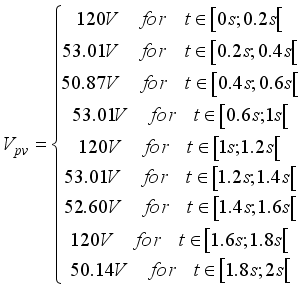
Assume that the PV generator voltage Vpv changes as follows according to the shading:
(37)
According to Figures 13-15, the variation of the voltage Vpv due to the shading has an important effect on the current ILb while the states Vdc_bus, and Iinv remain relatively stable. Furthermore, the estimated curves correctly follow the actual curves as shown by the response curves for the three states. This means that the disturbances from the PV source do not affect the estimation of the system states. In addition, the estimation error curve in Figure 13 shows peaks of the order of 0.1 V at times of Vpv variation, indicating the presence of external disturbances to the system. Similarly, the presence of peaks in the estimation error curve in Figure 15 indicates the voltage drop on the PV side.
Figure 13. Response curves of the real and estimated boost converter inductance current ILb under Vpv variation (a) and estimation error (b).
Figure 14. Response curves of the real and estimated DC bus voltage Vdc_bus under Vpv variation (a) and estimation error (b).
Figure 15. Response curves of the real and estimated inverter current Iinv under Vpv variation (a) and estimation error (b).
The influence of faults from the PV source on the three modelled internal disturbances d1, d2 and d3 is shown in Figures 16 and 18 by the presence of the peaks observed in the estimation error curves. As the voltage Vpv increases, the peaks increase, and as the voltage decreases, the peaks decrease. However, as the response curves for the three disturbances show, the estimated curves correctly follow the actual curves. This demonstrates GESO's robustness in estimating disturbances.
Figure 16. Real and estimated disturbance d1 curves under Vpv variation (a) and estimation error (b).
Figure 17. Real and estimated disturbance d2 curves under Vpv variation (a) and estimation error (b).
Figure 18. Real and estimated disturbance d3 curves under Vpv variation (a) and estimation error (b).
4.3.2. GESO Subjected to Grid Voltage (Vg) Variation
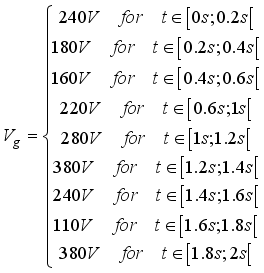
For a distribution network, the joule effect, overloading, line length, etc. can cause technical losses related to the operation of network equipment. In Cameroon, low-voltage distribution networks vary from 110V to 380V. In our study, assume that network disturbances cause the network voltage Vg to vary as follows:
(38)
As shown in Figures 19-21, GESO shows good robustness in estimating the three states ILb, Vdc_bus and Iinv when the system is subjected to grid variations. According to these figures, the presence of rising and falling peaks in the estimation error curves indicates a failure due to voltage variation on the grid side. Figure 20 also shows that the DC bus voltage varies with the grid voltage.
Furthermore, the rising and falling peaks in Figure 21 show that the current Iinv decreases as the grid voltage increases and it increases as the voltage decreases. This justifies the expression of the Iinv current in equation (12).
Figure 19. Response curves of the real and estimated boost converter inductance current ILb under Vg variation (a) and estimation error (b).
Figure 20. Response curves of the real and estimated DC voltage Vdc_bus under Vg variation (a) and estimation error (b).
Figure 21. Response curves of the real and estimated inverter current Iinv under Vg variation (a) and estimation error (b).
Figures 22-24 show that the estimated curves correctly follow the real ones, despite the disturbances coming from the grid side. The GESO shows good robustness in the estimation of the internal disturbances d1, d2 and d3. In Figure 22, varying the Vg voltage varies the d1 disturbance in the same way as it varies the DC bus voltage. This is because the disturbance d1 model is strongly influenced by the DC bus voltage. Therefore, the peaks observed in the estimation error curve indicate the presence of an external disturbance. Figure 23 shows that the changes in disturbances d2 due to the variation of the grid voltage are similar to those observed for the current Iinv, as shown by the presence of peaks in the estimation error curve. According to equation (15), the disturbance d2 is strongly influenced by the state Iinv. Therefore, the forms of their modifications under the influence of the voltage Vg are practically the same. In Figure 24 the value of the disturbance d3 increases as the voltage Vg decreases and decreases as the voltage Vg increases.
Figure 22. Real and estimated disturbance d1 curves under Vg variation (a) and estimation error (b).
Figure 23. Real and estimated disturbance d2 curves under Vg variation (a) and estimation error (b).
Figure 24. Real and estimated disturbance d3 curves under Vg variation (a) and estimation error (b).
4.4. Discussion
4.4.1. State and Disturbance Estimation Analysis
Four aspects, namely accuracy, speed, stability and robustness, underpin the proposed GESO performance. Figures 7-9 show a good estimation of the states of the ILb current, the Vdc_bus voltage, and the Iinv current by the GESO. The estimated states follow the real states in transient and steady states. The transient mode takes less than 0.02 s to estimate ILb and less than 0.05 s to estimate Vdc_bus and ILinv.
Figures 10-12 show the estimation of the disturbances d1, d2, d3. The estimated values follow the real values.
For any bounded h(t) and d(t), the stability of the system under the proposed GESO is guaranteed by the proper of the observer gain L and the feedback control gain Kx using the pole placement method such that Ae and are Hurwitz matrices.
4.4.2. Analysis of Estimation Error
Figures 7-12 show the state and disturbance estimation errors. The different error curves show a convergence to zero when the system is not subject to Vpv and Vg fluctuations. The estimation error curves demonstrate the robustness of the control and estimator in the face of PV generator voltage and grid voltage variations. However, peaks can be observed at the variation times. This shows a slight influence of external perturbations on the GESO and indicates the presence of a fault (an external disturbance) in the system.
4.4.3. The Robustness of the Proposed GESO Under the Photovoltaic Voltage Variation
Due to the changes in atmospheric conditions (partial shading in the context of this study), the output voltage, of the PV system changes significantly . As shown in Figures 13-18, the variation in Vpv voltage due to partial shading has a significant effect on the ILb current and a slight impact on the Iinv current and on disturbances d1 and d3. The ILb current varies proportionally to the voltage drop due to partial shading, from 55% to 59%.
In Figure 13, depending on whether the voltage is falling or rising, the current estimation error curve ILb shows peaks of the order of -0.1 A and 0.1 A at the instant of variation.
Peaks around -0.04 A are observed on the Iinv current estimation error curve in Figure 14. In Figure 15, the disturbance d1 estimation error curve shows peaks of the order of 1400 and -1400 depending on the direction of the Vpv voltage variation. The disturbance d3 estimation error curve shows a peak of the order of -1000 regardless of the direction of the Vpv voltage variation. The presence of these peaks indicates a fault outside the system. The different values indicate how much the faults affect the internal conditions of the system. However, the estimator estimates the currents and disturbances well, since the curves of the estimated values follow the curves of the real values, despite the Vpv variation. The proposed GESO correctly estimates the states and disturbances in the face of the PV generator faults. The states and disturbances values also return to normal when the voltage Vpv returns to normal. We conclude that the proposed GESO is robust to PV generator changes.
4.4.4. The Robustness of the Proposed GESO Under Grid Voltage Fluctuation
Figures 19-24 show the response of the GESO to the variation of grid voltage. The variation of the grid voltage affects the three states and the three disturbances at different levels. The ILb current remains almost stable during grid voltage fluctuation. The peaks observed in the estimation error curve indicate a fault in the system, which is reflected in the expression of the bus voltage in the state equation of ILb. The Vdc_bus and Iinv states, and the three internal disturbances modelled d1, d2 and d3 are significantly affected by the grid voltage variation.
The response curves deviate from the reference at the time of the variation of the grid voltage and return to the normal ones when the network stabilizes. However, the presence of external faults does not disrupt the estimation of the states and modelled disturbances, and we observe that the estimated curves follow well the real ones. This demonstrates the robustness of the GESO in the presence of grid voltage disturbances.
5. Conclusion
As mentioned in many works in the literature, knowing the health of a system helps to guarantee its efficiency and sustainability. The state observer is one of the techniques used by several authors to estimate the state of a system. For observers applied to the PV system, many authors do not take into account the estimation of some parameters. Unlike other authors who have only taken account either the states on the DC side or the states on the AC side, the proposed method not only allows to estimate the whole states of the system but also estimate the associated disturbances. In this paper, the Generalized Extended State Observer has been used to estimate simultaneously the states and disturbances of a single-phase grid-connected photovoltaic system operating under the Sudanese-Sahelian climate of Cameroon. Over the existing observers applied to PV system, the proposed one presents the following advantages:
1) Adequate design of the nominal and extended state observer with two controls (one control on DC side and one control on AC side);
2) Simultaneously estimating of states and disturbances, considering both the DC and AC sides of the photovoltaic system;
3) A correct selection of a disturbance compensation gain, resulting from the correct pole placement, allows a good estimation of the state and disturbances, as well as the stability of the studied photovoltaic system under mismatched uncertainties;
4) Active disturbance rejection well demonstrated by the noise suppression at the system output.
The proposed adaptive GESO is robust and globally asymptotically stable, as shown by the state and disturbance estimation curves. The present work contributes to the study of observers applied to the PV system. However, the control may not work satisfactorily when the system operates under photovoltaic and grid voltage variations. It would be useful to consider the optimal control of the boost converter and the inverter, on which depend the inductance current ILb, the DC bus voltage Vdc_bus and the inverter current Iinv. Therefore, to improve the present GESO, it is necessary to strengthen the control part with a robust tool such as sliding mode control. Finally, the simulation results show that the proposed approach is quite efficient for diagnosing PV systems despite the effect of concurrent faults and unknown disturbances. The simulated results presented in this paper suggest future experimental work.
Abbreviations

Vpv

Photovoltaic Generator Voltage

Lb

Boost Converter Inductance

RLb

Internal Resistance of Converter

ILb

Boost Converter Current

Cdc

DC Bus Capacitance

Vdc_bus

DC Bus Voltage

Linv

Inverter Inductance

Rinv

Internal Resistance of Inverter

Iinv

Inverter Current

Vg

Grid Voltage

d1, d2, d3

Disturbances

Kd

Compensation Gain

L

Observer Gain

Kx

State Feedback Control Gain

A

State Matrix of the Nominal System

Bi

Control Matrix of the Nominal System

C

Output Matrix of the Nominal System

Ae

State Matrix of the Extended System

Bei

Control Matrix of the Extended System

Ce

Output Matrix of the Extended System

A0

Controllability Matrix of the Nominal System

C0

Observability Matrix of the Nominal System

GESO

Generalized Extended State Observer

ADRC

Active Disturbance Rejection Control

PV

Photovoltaic

GADRC

Generalized Active Disturbance Rejection Control

UV

Ultraviolet

IR

Infrared

PL

Photoluminescence

EL

Electroluminescence

SMO

Sliding Mode Observer

UIO

Unknown Input Observer

LO

Learning Observers

EID

Equivalent Input Disturbance

ESO

Extended State Observer

LDUE

Linear Disturbance and Uncertainty Estimation

NDUE

Nonlinear Disturbance and Uncertainty Estimation

PID

Proportional-Integral-Derivative

LCL

Inductor (L) - Capacitor (C) - Inductor (L)

AD

Active Damping

PWM

Pulse Width Modulation

MOSFET

Metal-Oxide-Semiconductor Field-Effect Transistor

IGBT

Insulated-Gate Bipolar Transistor

Acknowledgments
The authors would like to acknowledge Department of Renewable Energy, National Advance School of Engineering of Maroua, University of Maroua.
Author Contributions
Yaouba: Conceptualization, Formal Analysis, Methodology, Resources, Software, Writing – original draft, Writing – review & editing
Albert Ayang: Conceptualization, Formal Analysis, Methodology, Resources, Software, Writing – original draft, Writing – review & editing
Ahmat Tom: Supervision, Validation
Noël Djongyang: Project administration, Supervision, Validation
Conflicts of Interest
The authors declare no conflicts of interest.
References
[1] T. Kousksou, P. Bruel, A. Jamil, T. El Rha, and Y. Zeraouli, “Solar Energy Materials & Solar Cells Energy storage : Applications and challenges,” Sol. energy Mater. Sol. cells, vol. 120, pp. 59–80, 2014,
[2] M. P. Clark et al., “Characterizing Uncertainty of the Hydrologic Impacts of Climate Change,” Curr. Clim. Chang. Reports, vol. 2, no. 2, pp. 55–64, 2016,
[3] A. D. Dhass, N. Beemkumar, S. Harikrishnan, and H. M. Ali, “A Review on Factors Influencing the Mismatch Losses in Solar Photovoltaic System,” Int. J. Photoenergy, vol. 2022, 2022,
[4] T. F. Wu, C. H. Chang, L. C. Lin, and C. L. Kuo, “Power loss comparison of single- and two-stage grid-connected photovoltaic systems,” IEEE Trans. Energy Convers., vol. 26, no. 2, pp. 707–715, 2011,
[5] S. Daliento et al., “Monitoring, diagnosis, and power forecasting for photovoltaic fields: A review,” Int. J. Photoenergy, vol. 2017, 2017,
[6] A. Livera, M. Theristis, G. Makrides, and G. E. Georghiou, “Recent advances in failure diagnosis techniques based on performance data analysis for grid-connected photovoltaic systems,” Renew. Energy, vol. 133, pp. 126–143, 2019,
[7] H. Kazemi and A. Yazdizadeh, “Optimal state estimation and fault diagnosis for a class of nonlinear systems,” IEEE/CAA J. Autom. Sin., vol. 7, no. 2, pp. 517–526, 2020,
[8] J. Han, “From PID to active disturbance rejection control,” IEEE Trans. Ind. Electron., vol. 56, no. 3, pp. 900–906, 2009,
[9] D. Kharrat, H. Gassara, A. El Hajjaji, and M. Chaabane, “Adaptive Observer and Fault Tolerant Control for Takagi-Sugeno Descriptor Nonlinear Systems with Sensor and Actuator Faults,” Int. J. Control. Autom. Syst., vol. 16, no. 3, pp. 972–982, 2018,
[10] X. J. Li, J. J. Yan, and G. H. Yang, “Adaptive Fault Estimation for T-S Fuzzy Interconnected Systems Based on Persistent Excitation Condition via Reference Signals,” IEEE Trans. Cybern., vol. 49, no. 8, pp. 2822–2834, 2019,
[11] Z. Gao, X. Shi, and S. X. Ding, “Fuzzy state/disturbance observer design for T-S fuzzy systems with application to sensor fault estimation,” IEEE Trans. Syst. Man, Cybern. Part B Cybern., vol. 38, no. 3, pp. 875–880, 2008,
[12] X. Liu, Z. Gao, and M. Z. Q. Chen, “Takagi-Sugeno Fuzzy Model Based Fault Estimation and Signal Compensation with Application to Wind Turbines,” IEEE Trans. Ind. Electron., vol. 64, no. 7, pp. 5678–5689, 2017,
[13] F. Benyamina, A. Benrabah, F. Khoucha, M. F. Zia, Y. Achour, and M. Benbouzid, “An augmented state observer-based sensorless control of grid-connected inverters under grid faults,” Int. J. Electr. Power Energy Syst., vol. 133, no. December 2020, p. 107222, 2021,
[14] M. Liu, X. Cao, and P. Shi, “Fuzzy-model-based fault-tolerant design for nonlinear stochastic systems against simultaneous sensor and actuator faults,” IEEE Trans. Fuzzy Syst., vol. 21, no. 5, pp. 789–799, 2013,
[15] M. Li, M. Liu, Y. Zhang, and Y. Geng, “Fault tolerant sliding mode control for T-S fuzzy stochastic time-delay system via a novel sliding mode observer approach,” Int. J. Syst. Sci., vol. 49, no. 7, pp. 1353–1367, 2018,
[16] H. Zhang, J. Han, Y. Wang, and X. Liu, “Sensor Fault Estimation of Switched Fuzzy Systems With Unknown Input,” IEEE Trans. Fuzzy Syst., vol. 26, no. 3, pp. 1114–1124, 2018,
[17] J. Lan and R. J. Patton, “Integrated Design of Fault-Tolerant Control for Nonlinear Systems Based on Fault Estimation and T-S Fuzzy Modeling,” IEEE Trans. Fuzzy Syst., vol. 25, no. 5, pp. 1141–1154, 2017,
[18] Q. Jia, W. Chen, Y. Zhang, and H. Li, “Fault reconstruction and fault-tolerant control via learning observers in Takagi-Sugeno fuzzy descriptor systems with time delays,” IEEE Trans. Ind. Electron., vol. 62, no. 6, pp. 3885–3895, 2015,
[19] Q. Jia, W. Chen, Y. Zhang, and H. Li, “Fault reconstruction for Takagi-Sugeno fuzzy systems via learning observers,” Int. J. Control, vol. 89, no. 3, pp. 564–578, 2016,
[20] W. H. Chen, D. J. Ballance, P. J. Gawthrop, and J. O’Reilly, “A nonlinear disturbance observer for robotic manipulators,” IEEE Trans. Ind. Electron., vol. 47, no. 4, pp. 932–938, 2000,
[21] S. J. Kwon and W. K. Chung, “A discrete-time design and analysis of perturbation observer for motion control applications,” IEEE Trans. Control Syst. Technol., vol. 11, no. 3, pp. 399–407, 2003,
[22] J. H. She, M. Fang, Y. Ohyama, H. Hashimoto, and M. Wu, “Improving disturbance-rejection performance based on an equivalent-input-disturbance approach,” IEEE Trans. Ind. Electron., vol. 55, no. 1, pp. 380–389, 2008,
[23] Z. Gao, Y. Huang, and J. Han, “An alternative paradigm for control system design,” Proc. IEEE Conf. Decis. Control, vol. 5, pp. 4578–4585, 2001,
[24] W. H. Chen, J. Yang, L. Guo, and S. Li, “Disturbance-Observer-Based Control and Related Methods - An Overview,” IEEE Trans. Ind. Electron., vol. 63, no. 2, pp. 1083–1095, 2016,
[25] S. Li, J. Yang, W. H. Chen, and X. Chen, “Generalized extended state observer based control for systems with mismatched uncertainties,” IEEE Trans. Ind. Electron., vol. 59, no. 12, pp. 4792–4802, 2012,
[26] P. Shah and B. Singh, “Adaptive Observer Based Control for Roof-Top Solar PV System,” IEEE Trans. Power Electron., vol. 35, no. 9, pp. 9402–9417, 2020,
[27] M. Alshiekh, A. Marouf, and M. Kubeitari, “Current Control and Active Damping for Single Phase LCL-Filtered Grid Connected Inverter,” J. Control Sci. Eng., vol. 2020, 2020,
[28] M. Mokhlis, M. Ferfra, and R. El Idrissi, “High gain observer-based control for grid-connected pv system under partial shading effect,” Int. J. Intell. Eng. Syst., vol. 13, no. 2, pp. 161–181, 2020,
[29] J. Wang, S. Li, J. Yang, B. Wu, and Q. Li, “Extended state observer-based sliding mode control for PWM-based DC-DC buck power converter systems with mismatched disturbances,” IET Control Theory Appl., vol. 9, no. 4, pp. 579–586, 2015,
[30] B. Wang, Z. Shen, H. Liu, and J. Hu, “Linear ADRC direct current control of gridconnected inverter with LCL filter for both active damping and grid voltage induced current distortion suppression,” IET Power Electron., vol. 11, no. 11, pp. 1748–1755, 2018,
[31] Y. Zhu and J. Fei, “Disturbance Observer Based Fuzzy Sliding Mode Control of PV Grid Connected Inverter,” IEEE Access, vol. 6, pp. 21202–21211, 2018,
[32] B. Guo, S. Bacha, M. Alamir, A. Hably, and C. Boudinet, “Generalized Integrator-Extended State Observer with Applications to Grid-Connected Converters in the Presence of Disturbances,” IEEE Trans. Control Syst. Technol., vol. 29, no. 2, pp. 744–755, 2021,
[33] P. Jain et al., “A luenberger observer-based fault detection and identification scheme for photovoltaic DC-DC converters,” Proc. IECON 2017 - 43rd Annu. Conf. IEEE Ind. Electron. Soc., vol. 2017-Janua, pp. 5015–5020, 2017,
[34] L. Qin, “Control of Single Phase LCL Photovoltaic Grid-Gonnected Inverter Based on State Observer,” Proc. 2020 IEEE Int. Conf. Power, Intell. Comput. Syst. ICPICS 2020, pp. 762–765, 2020,
[35] A. Ayang, “Diagnostic d’un système photovoltaïque à stockage par estimation paramétrique et commandes ADRC, intégré à une centrale autonome de cogénération d’énergie,” 2020. [Online]. Available:
[36] L. Zhou, L. Cheng, C. Pan, and Z. Jiang, “Generalized Extended State Observer Based Speed Control for DC Motor Servo System,” Chinese Control Conf. CCC, vol. 2018-July, pp. 221–226, 2018,
[37] M. A. Khan, S. Member, A. Haque, S. Member, and V. S. Bharath, “Dynamic Voltage Support for Low Voltage Ride Through Operation in Single-Phase Grid-Connected Photovoltaic Systems,” IEEE Trans. Power Electron., vol. 8993, no. c, 2021,
[38] S. Sarikh, M. Raoufi, A. Bennouna, and B. Ikken, “Characteristic curve diagnosis based on fuzzy classification for a reliable photovoltaic fault monitoring,” Sustain. Energy Technol. Assessments, vol. 43, no. December 2020, p. 100958, 2021,
[39] H. Renaudineau, J. Martin, S. Member, and S. Pierfederici, “DC-DC Converters Dynamic Modeling with State Observer-Based Parameter Estimation,” EEE Trans. POWER Electron., vol. 8993, no. c, pp. 1–9, 2014,
[40] R. Errouissi and A. Al-durra, “Extended high-gain observer-based DC-link voltage regulation in dual-stage grid-tied PV system under balanced and unbalanced voltages,” IET Renew. Power Gener., vol. 14, no. 12, pp. 2037–2046, 2020,
[41] L. Xu, R. Ma, S. Zhuo, R. Xie, X. Wang, and Y. Huangfu, “Observer Based Switch Open-Circuit Diagnosis for Interleaved Boost Converter,” IECON Proc. (Industrial Electron. Conf., vol. 2020-Octob, pp. 5012–5017, 2020,
[42] B. Wang, Y. Xu, Z. Shen, J. Zou, C. Li, and H. Liu, “Current Control of Grid-Connected Inverter with LCL Filter Based on Extended-State Observer Estimations Using Single Sensor and Achieving Improved Robust Observation Dynamics,” IEEE Trans. Ind. Electron., vol. 64, no. 7, pp. 5428–5439, 2017,
[43] W. Xue, W. Bai, S. Yang, and K. Song, “ADRC With Adaptive Extended State Observer and its Application to Air – Fuel Ratio Control in Gasoline Engines,” IEEE Trans. Ind. Electron., vol. 62, no. August, pp. 5847–5857, 2015,
[44] Yaouba et al., “An Experimental and Case Study on the Evaluation of the Partial Shading Impact on PV Module Performance Operating Under the Sudano-Sahelian Climate of Cameroon,” Front. Energy Res., vol. 10, no. August, pp. 1–13, 2022,
[45] L. Zhou, L. Cheng, J. She, and Z. Zhang, “Generalized extended state observer–based repetitive control for systems with mismatched disturbances,” Int. J. Robust Nonlinear Control, vol. 29, no. 11, pp. 3777–3792, 2019,
[46] R. Madoński and P. Herman, “Survey on methods of increasing the efficiency of extended state disturbance observers,” ISA Trans., vol. 56, pp. 18–27, 2015,
[47] M. A. Mahmud, H. R. Pota, M. J. Hossain, and S. Member, “Nonlinear Current Control Scheme for a Single-Phase Grid-Connected Photovoltaic System,” IEEE Trans. Sustain. ENERGY, vol. 5, no. 1, pp. 218–227, 2014,
Cite This Article
  • APA Style

    Yaouba, Ayang, A., Tom, A., Djongyang, N. (2024). Adaptive Generalized Extended State Observer for a Single Phase PV Grid-connected System Operating Under the Sudanese-Sahelian Climate of Cameroon. International Journal of Energy and Power Engineering, 13(5), 73-96. https://doi.org/10.11648/j.ijepe.20241305.11

    Copy | Download

    ACS Style

    Yaouba; Ayang, A.; Tom, A.; Djongyang, N. Adaptive Generalized Extended State Observer for a Single Phase PV Grid-connected System Operating Under the Sudanese-Sahelian Climate of Cameroon. Int. J. Energy Power Eng. 2024, 13(5), 73-96. doi: 10.11648/j.ijepe.20241305.11

    Copy | Download

    AMA Style

    Yaouba, Ayang A, Tom A, Djongyang N. Adaptive Generalized Extended State Observer for a Single Phase PV Grid-connected System Operating Under the Sudanese-Sahelian Climate of Cameroon. Int J Energy Power Eng. 2024;13(5):73-96. doi: 10.11648/j.ijepe.20241305.11

    Copy | Download

  • @article{10.11648/j.ijepe.20241305.11,
      author = {Yaouba and Albert Ayang and Ahmat Tom and Noël Djongyang},
      title = {Adaptive Generalized Extended State Observer for a Single Phase PV Grid-connected System Operating Under the Sudanese-Sahelian Climate of Cameroon
    },
      journal = {International Journal of Energy and Power Engineering},
      volume = {13},
      number = {5},
      pages = {73-96},
      doi = {10.11648/j.ijepe.20241305.11},
      url = {https://doi.org/10.11648/j.ijepe.20241305.11},
      eprint = {https://article.sciencepublishinggroup.com/pdf/10.11648.j.ijepe.20241305.11},
      abstract = {Knowing the health of a system allows to guarante its efficiency and sustainability. The state observer is one of several techniques used by authors to estimate system state. This paper focuses on the problem of simultaneous states estimation of DC (Direct Current) and AC (Alternating Current) sides of a single-phase Photovoltaic (PV) grid-connected operating under the Sudanese-Sahelian climate of Cameroon. A generalized extended state observer (GESO) has been designed to simultaneously estimate the three states and the three disturbances of the system. A good estimation of the state and disturbances is achieved by the appropriate choice of the observer gain and the disturbance compensation gain resulting from the correct pole placement. The GESO robustness has been tested by varying the PV voltage and grid voltage. When there are no input fluctuations, the estimation errors of nominal states and disturbances converge to zero. The fluctuation in PV voltage resulting from partial shading has a significant impact on the boost converter current. The boost converter current varies proportionally with the drop in voltage due to partial shading from 55% to 59%. Under the grid voltage fluctuation, the boost converter current remains stable while the DC bus voltage and inverter current are significantly affected. The proposed GESO prove its robustness to perturbations from the PV array and grid side into the Single-Phase PV Grid-connected System. This paper contributes to the study of observers applied to the PV system and points the way to future work on diagnosing faults in PV systems operating in Cameroon's Sudanese-Sahelian climate.
    },
     year = {2024}
    }
    

    Copy | Download

  • TY  - JOUR
    T1  - Adaptive Generalized Extended State Observer for a Single Phase PV Grid-connected System Operating Under the Sudanese-Sahelian Climate of Cameroon
    
    AU  - Yaouba
    AU  - Albert Ayang
    AU  - Ahmat Tom
    AU  - Noël Djongyang
    Y1  - 2024/11/11
    PY  - 2024
    N1  - https://doi.org/10.11648/j.ijepe.20241305.11
    DO  - 10.11648/j.ijepe.20241305.11
    T2  - International Journal of Energy and Power Engineering
    JF  - International Journal of Energy and Power Engineering
    JO  - International Journal of Energy and Power Engineering
    SP  - 73
    EP  - 96
    PB  - Science Publishing Group
    SN  - 2326-960X
    UR  - https://doi.org/10.11648/j.ijepe.20241305.11
    AB  - Knowing the health of a system allows to guarante its efficiency and sustainability. The state observer is one of several techniques used by authors to estimate system state. This paper focuses on the problem of simultaneous states estimation of DC (Direct Current) and AC (Alternating Current) sides of a single-phase Photovoltaic (PV) grid-connected operating under the Sudanese-Sahelian climate of Cameroon. A generalized extended state observer (GESO) has been designed to simultaneously estimate the three states and the three disturbances of the system. A good estimation of the state and disturbances is achieved by the appropriate choice of the observer gain and the disturbance compensation gain resulting from the correct pole placement. The GESO robustness has been tested by varying the PV voltage and grid voltage. When there are no input fluctuations, the estimation errors of nominal states and disturbances converge to zero. The fluctuation in PV voltage resulting from partial shading has a significant impact on the boost converter current. The boost converter current varies proportionally with the drop in voltage due to partial shading from 55% to 59%. Under the grid voltage fluctuation, the boost converter current remains stable while the DC bus voltage and inverter current are significantly affected. The proposed GESO prove its robustness to perturbations from the PV array and grid side into the Single-Phase PV Grid-connected System. This paper contributes to the study of observers applied to the PV system and points the way to future work on diagnosing faults in PV systems operating in Cameroon's Sudanese-Sahelian climate.
    
    VL  - 13
    IS  - 5
    ER  - 

    Copy | Download

Author Information
  • Department of Renewable Energy, National Advance School of Engineering of Maroua, University of Maroua, Maroua, Cameroon; Research Centre for Renewable Energy, Institute of Geological and Mining Research, Yaoundé, Cameroon

  • Department of Renewable Energy, National Advance School of Engineering of Maroua, University of Maroua, Maroua, Cameroon
  • Department of Energy Engineering, University Institute of Technology, University of Ngaoundéré, Ngaoundéré, Cameroon

  • Department of Renewable Energy, National Advance School of Engineering of Maroua, University of Maroua, Maroua, Cameroon

  • Abstract
  • Keywords
  • Document Sections

    1. 1. Introduction
    2. 2. Model of Studied System
    3. 3. Construction of the Studied Observer
    4. 4. Simulation Results
    5. 5. Conclusion
    Show Full Outline
  • Abbreviations
  • Acknowledgments
  • Author Contributions
  • Conflicts of Interest
  • References
  • Cite This Article
  • Author Information